




Slayd 1
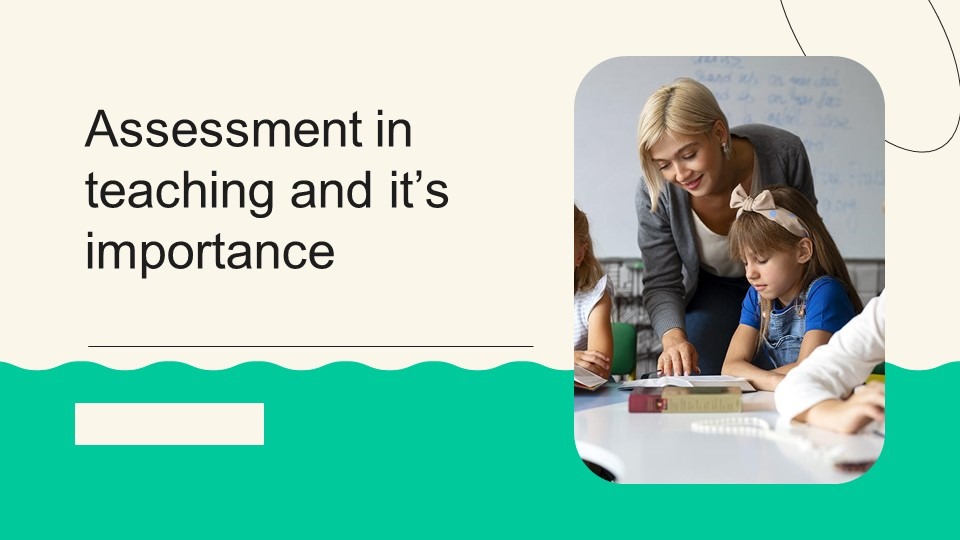
Assessment in teaching and it’s importance
Slayd 2
Assessments help the students understand their errors, understand the feedback received on their errors, and help them improve. Assessments may also provide another opportunity to assimilate the new information and re-do the exam to improve performance.
Slayd 3
Importance of Assessment
Assessment plays a crucial role in education and has importance in teaching and learning. It provides valuable information about students’ progress, identifies areas of improvement, and helps enhance the teaching and learning process. It serves as a tool for measuring students’ knowledge and skills, allowing educators to gauge their understanding of the subject matter and identify any gaps in learning. By evaluating students’ performance through assessments, teachers can tailor their instructional strategies to meet individual learning needs and provide targeted support where necessary. This enhances students’ learning experience and promotes their overall academic growth.
Slayd 4
Types of assessment
02
Slayd 5
According to the purpose
It allows knowing the degree of mastery of certain learning methods before starting to work with them. It can be done at the beginning of a school cycle, a didactic unit, or at the beginning of a new subject.
Based on the progress and difficulties of the students during the process, it orients the adjustments in the teaching strategy in order to achieve the learning goals.
It is usually applied at the end of the processes, considering several aspects, to assign a qualification by means of a numerical value.
Diagnostic
Formative
Summative
Slayd 6
According to the timing
Initial:
It is carried out in the classroom at the beginning of each learning situation. Various instruments are used to gather information about what the students know about the topic to be covered. At the end of the process, the results can be contrasted with the initial situation to determine progress and what needs to be improved.
It consists of assessing, based on the continuous collection and systematization of information, the students’ learning, as well as the teaching intervention, so as to make improvement decisions on the fly.
Continuous:
01
02
Slayd 7
According to the timing
The information gathered at the beginning and during the development of the process is evaluated in order to identify the extent to which the goals established at the beginning were met.
Final:
It is carried out some time after the end of an educational process, in order to know the permanence of learning or its transfer to other environments or contexts. This type of evaluation makes it possible to know whether or not the student applies the learning previously achieved in his or her daily life.
Retrospective:
04
03
Slayd 8
According to the scope
It takes into account all the components involved in student learning: study plans and programs, the school, coexistence, teaching practice and teaching strategy, understanding that all these components are interrelated, so that any modification of any of them affects the others.
Global:
It focuses on a specific element such as student achievement or teacher performance, for instance.
Partial:
Slayd 9
It is the assessment carried out by the students themselves about their productions and their learning process. In this way, they know and value their performances, and have the basis to improve it.
Self-assessment:
According to the assessor
It is the assessment carried out by the teacher in the school, specifically in the classroom.
Internal:
Slayd 10
According to the assessor
It is the assessment performed among peers about a certain production or performance. In this way, they learn to value the processes and performances of their peers with the responsibility that this entails. It also represents an opportunity to share learning strategies and learn together.
Co-assessment:
Slayd 11
According to the standard of comparison
It involves assessing using a norm as a reference, which allows comparing the student’s results with the results of a population or group to which that student belongs.
Norm-referenced:
It involves assessing the student using him or herself as a reference, based on criteria established by the teacher in the diagnostic assessment.
Criterion-referenced:
Slayd 12
Benefits of Assessment
One of the primary benefits of assessment is that it helps identify students’ strengths and weaknesses.
Assessment also promotes student motivation and engagement.
Furthermore, assessment provides valuable data for educational decision-making.
Slayd 13
Challenges of Assessment
Refers to the consistency and
stability of the assessment
results. If an assessment tool is
not reliable, it may produce
inconsistent results, leading to
inaccurate judgements about a
student’s performance or progress.
Reliability
Refers to how an assessment
accurately measures what it intends to measure.
Assessments need content validity,
meaning they cover the knowledge
and skills they are meant to assess.
Validity
Slayd 14
Assessment to Monitor Student Progress
Identify Strengths and Weaknesses
Tailor teaching to learning needs
Gauge Understanding of Concepts
Compare Student Performance
Slayd 15
Conclusions
Slayd 16
Conclusions
Without assessment, it is difficult to know what and to what degree students have learned, and therefore it is not possible to reliably identify the support they require. That is why, in its different types, evaluation is an indispensable tool to improve the teaching-learning process.
Slayd 17
Thank you for your attention!
Follow us on social media!
Slayd 18
Foydali havolalar
🛒 Barcha taqdimotlar | 📰 Yangiliklar | ℹ️ Biz haqimizda


















Sharhlar
Hali sharhlar mavjud emas.