



TYPES OF MEANING AND CLASSIFICATION OF VOCABULARY
Types of Meaning and Classification of Vocabulary
Outline
- Types of Meaning: Lexical, Grammatical, and Part-of-Speech
- Components of Lexical Meaning
- Classification of English Vocabulary
Types of Meaning: Lexical, Grammatical, and Part-of-Speech
The lexical meaning of a word is the specific meaning proper to the linguistic unit in all its forms. For example, the forms do, does, did, doing, done differ grammatically but share the same lexical meaning — “the process of movement”.
The grammatical meaning expresses the relationships between words within speech. Examples include tense (took, ran), case (girl’s, cat’s), and plurality (tables, pens).
The part-of-speech meaning distinguishes between major word classes (nouns, verbs, adjectives, adverbs) and minor ones (articles, prepositions, conjunctions). For instance, pen-pens shows the grammatical meaning of number, while dog-dog’s shows possession.
Components of Lexical Meaning
Lexical meaning has three interrelated aspects:
- Denotational aspect: establishes the link between a word and the object or concept it names, e.g., album — a book for photos or stamps.
- Connotational aspect: reflects the speaker’s attitude and emotional tone toward what is being discussed. It adds shades of meaning and style.
- Pragmatic aspect: conveys situational, social, or cultural information about communication. For example, to come and to go differ in spatial orientation; They chucked a stone at the cops vs. They threw a stone at the police reflect social context and formality.
Classification of English Vocabulary
The vocabulary of the English language is divided into three main layers: literary, neutral, and colloquial.
The Literary Layer
This includes vocabulary of formal or written style, often used in literature or academic discourse. It covers:
- Common literary words
- Terms and learned words
- Poetic and highly literary words
- Archaic words
- Barbarisms and foreign words
- Literary coinages (including nonce-words)
The Neutral Layer
The neutral layer is universal and stable. It is unrestricted in use, appearing across all styles and contexts. Neutral words carry no emotional coloring and are ideal for objective communication, e.g., book, house, run.
The Colloquial Layer
The colloquial layer consists of lively, spoken words typical of informal interaction. It includes regional, social, and professional variations such as:
- Slangisms: informal, trendy expressions used by particular social groups.
- Jargonisms: specialized vocabular=== Taqdimot 1 ===
Types of meaning and classification of vocabulary
stylistics
=== Taqdimot 2 ===
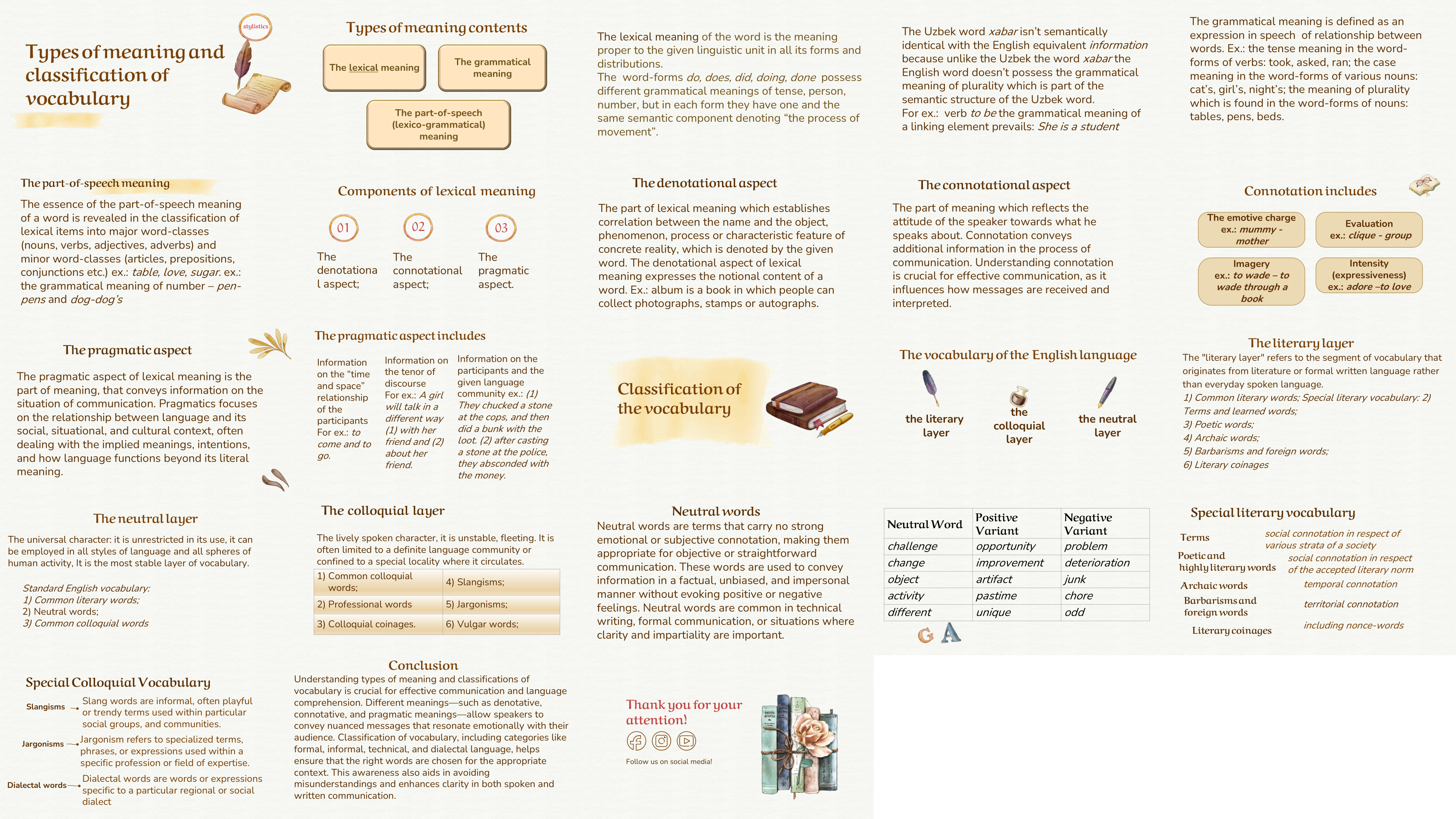
Types of meaning contents
The lexical meaning
The grammatical meaning
The part-of-speech
(lexico-grammatical) meaning
=== Taqdimot 3 ===
The lexical meaning of the word is the meaning proper to the given linguistic unit in all its forms and distributions. The word-forms do, does, did, doing, done possess different grammatical meanings of tense, person, number, but in each form they have one and the same semantic component denoting “the process of movement”.
=== Taqdimot 4 ===
The Uzbek word xabar isn’t semantically identical with the English equivalent information because unlike the Uzbek the word xabar the English word doesn’t possess the grammatical meaning of plurality which is part of the semantic structure of the Uzbek word. For ex.: verb to be the grammatical meaning of a linking element prevails: She is a student
=== Taqdimot 5 ===
The grammatical meaning is defined as an expression in speech of relationship between words. Ex.: the tense meaning in the word-forms of verbs: took, asked, ran; the case meaning in the word-forms of various nouns: cat’s, girl’s, night’s; the meaning of plurality which is found in the word-forms of nouns: tables, pens, beds.
=== Taqdimot 6 ===
The essence of the part-of-speech meaning of a word is revealed in the classification of lexical items into major word-classes (nouns, verbs, adjectives, adverbs) and minor word-classes (articles, prepositions, conjunctions etc.) ex.: table, love, sugar. ex.: the grammatical meaning of number – pen-pens and dog-dog’s
The part-of-speech meaning
=== Taqdimot 7 ===
The denotational aspect;
The connotational aspect;
The pragmatic aspect.
01
02
03
Components of lexical meaning
=== Taqdimot 8 ===
The denotational aspect
The part of lexical meaning which establishes correlation between the name and the object, phenomenon, process or characteristic feature of concrete reality, which is denoted by the given word. The denotational aspect of lexical meaning expresses the notional content of a word. Ex.: album is a book in which people can collect photographs, stamps or autographs.
=== Taqdimot 9 ===
The connotational aspect
The part of meaning which reflects the attitude of the speaker towards what he speaks about. Connotation conveys additional information in the process of communication. Understanding connotation is crucial for effective communication, as it influences how messages are received and interpreted.
=== Taqdimot 10 ===
Connotation includes
=== Taqdimot 11 ===
The pragmatic aspect
The pragmatic aspect of lexical meaning is the part of meaning, that conveys information on the situation of communication. Pragmatics focuses on the relationship between language and its social, situational, and cultural context, often dealing with the implied meanings, intentions, and how language functions beyond its literal meaning.
=== Taqdimot 12 ===
The pragmatic aspect includes
Information on the “time and space” relationship of the participants For ex.: to come and to go.
Information on the tenor of discourse For ex.: A girl will talk in a different way (1) with her friend and (2) about her friend.
Information on the participants and the given language community ex.: (1) They chucked a stone at the cops, and then did a bunk with the loot. (2) after casting a stone at the police, they absconded with the money.
=== Taqdimot 13 ===
Classification of the vocabulary
=== Taqdimot 14 ===
the literary layer
the colloquial layer
the neutral layer
The vocabulary of the English language
=== Taqdimot 15 ===
The literary layer
The «literary layer» refers to the segment of vocabulary that originates from literature or formal written language rather than everyday spoken language.
1) Common literary words; Special literary vocabulary: 2) Terms and learned words;
3) Poetic words;
4) Archaic words;
5) Barbarisms and foreign words;
6) Literary coinages
=== Taqdimot 16 ===
The universal character: it is unrestricted in its use, it can be employed in all styles of language and all spheres of human activity, It is the most stable layer of vocabulary.
Standard English vocabulary: 1) Common literary words; 2) Neutral words; 3) Common colloquial words
The neutral layer
=== Taqdimot 17 ===
The lively spoken character, it is unstable, fleeting. It is often limited to a definite language community or confined to a special locality where it circulates.
The colloquial layer
=== Taqdimot 18 ===
Neutral words are terms that carry no strong emotional or subjective connotation, making them appropriate for objective or straightforward communication. These words are used to convey information in a factual, unbiased, and impersonal manner without evoking positive or negative feelings. Neutral words are common in technical writing, formal communication, or situations where clarity and impartiality are important.
Neutral words
=== Taqdimot 19 ===
=== Taqdimot 20 ===
Special literary vocabulary
Terms
social connotation in respect of various strata of a society
Poetic and highly literary words
social connotation in respect of the accepted literary norm
Archaic words
temporal connotation
Barbarisms and foreign words
territorial connotation
Literary coinages
including nonce-words
=== Taqdimot 21 ===
Special Colloquial Vocabulary
Slang words are informal, often playful or trendy terms used within particular social groups, and communities.
Jargonism refers to specialized terms, phrases, or expressions used within a specific profession or field of expertise.
Slangisms
Jargonisms
Dialectal words are words or expressions specific to a particular regional or social dialect
Dialectal words
=== Taqdimot 22 ===
Conclusion
Understanding types of meaning and classifications of vocabulary is crucial for effective communication and language comprehension. Different meanings—such as denotative, connotative, and pragmatic meanings—allow speakers to convey nuanced messages that resonate emotionally with their audience. Classification of vocabulary, including categories like formal, informal, technical, and dialectal language, helps ensure that the right words are chosen for the appropriate context. This awareness also aids in avoiding misunderstandings and enhances clarity in both spoken and written communication.
=== Taqdimot 23 ===
Thank you for your attention!
Follow us on social media!Additional source (Linguapress article)
Thank you for your attention! Follow us on social media.






Sharhlar
Hali sharhlar mavjud emas.