
- Savatga boshqa "GUIDELINES FOR WRITING" qo'sha olmaysiz. Ko'rish




PROCESS DIAGRAMS
Process Diagrams — Description and Structure
Process diagrams are visual tools used to show the stages and steps in a process. They are common in IELTS Writing Task 1 and academic writing, where the goal is to describe how something works or how it is made. Process diagrams can represent man-made or natural processes, such as how glass is produced or how the water cycle functions.
Types of Process Diagrams
- Man-made process — shows how humans make or produce something (e.g., how glass, paper, or food is made).
- Natural process (cycle) — shows natural phenomena such as the water cycle or the life cycle of a butterfly.
How to Describe a Process Diagram
Describing a process is completely different from describing a graph, bar chart, pie chart, or table. There are no numbers, and you cannot compare or describe trends like increases or decreases.
Instead, you should describe:
- How many steps there are in the process
- Where the process begins and ends
- Each stage or step in the correct order
Steps to Write a Process Description
- Analyze the question
- Generate ideas
- Plan the structure
- Write using appropriate language
- Check, edit, and count your words
Language for Process Descriptions
Process writing uses sequence words and passive verbs to describe stages clearly. Here are some useful phrases:
- At the first stage in the process…
- The process begins with…
- Next, then, after that…
- The second step involves…
- Finally, at the last stage…
Passive vs Active Voice
Process descriptions typically use the passive voice because the focus is on the action, not who performs it.
| Active | Passive |
|---|---|
| People sort the glass by hand. | The glass is sorted by hand. |
| Workers collect used bottles. | Used bottles are collected. |
Example: Glass Production and Recycling
The diagrams below illustrate two processes — how glass containers are produced and how they are recycled.
1. Glass Production
At the first stage in the production of glass, sand, soda ash, limestone, and other chemicals are mixed together.
Next, this mixture is heated in a glass furnace at approximately 1500°C to produce molten glass.
The molten glass is then shaped by blowing to create the final products — glass containers.
2. Glass Recycling
Recycling begins with the collection of used glass. The glass is sorted according to colour and washed to remove impurities.
After that, it is crushed and melted again. Finally, the molten glass is moulded to create new glass products.
Useful Tips
- Always describe the process in order, using linking words like next, then, and finally.
- Use the passive voice to focus on actions rather than people.
- Mention how many steps or stages there are in total.
- Use precise vocabulary such as mixture, heated, melted, moulded.
Conclusion
In summary, process diagrams show how something is made, developed, or recycled through clear stages. A well-written process description demonstrates organization, accurate use of passive structures, and logical sequencing — essential skills for academic and professional English writing.
=== Taqdimot 1 ===
Process diagrams
=== Taqdimot 2 ===
Process diagrams show stages and steps in a process:
Analyze the question
Generate ideas
Plan a structure
Write
Check/edit/count the words
=== Taqdimot 3 ===
Process diagrams show stages and steps in a process
Man made process
Natural process
In process we describe steps one by one
=== Taqdimot 4 ===
Process diagram
Step 1
Step 6
Step 5
Step 4
Step 3
Step 2
e.g how glass is made, how a type of food is produced
=== Taqdimot 5 ===
Process diagram
Step 1
Step 6
Step 5
Step 4
Step 3
Step 2
natural cycles e.g water cycle,life cycle of a butterfly
Cycle
=== Taqdimot 6 ===
Describing process is completely diferent from describing a graph, bar chart, pie chart or table
=== Taqdimot 7 ===
Differences:
no numbers
Can’t compare anything
Can’t describe trends (increase, decrease)
So, what can we describe?
how many steps
where the process begins and ends
each step in the process
=== Taqdimot 8 ===
Language for process descriptions:
‘steps’ language
passive verbs
At the first stage in the process
The process begins with
Secondly, Finally
The second step involves
Next, then, after that
At the following stage
=== Taqdimot 9 ===
Passive:
Glass is collected
Active
Next, people sort the glass by hand
The glass passes through a grinding machine
Passsive
The glass is sorted by hand
=== Taqdimot 10 ===
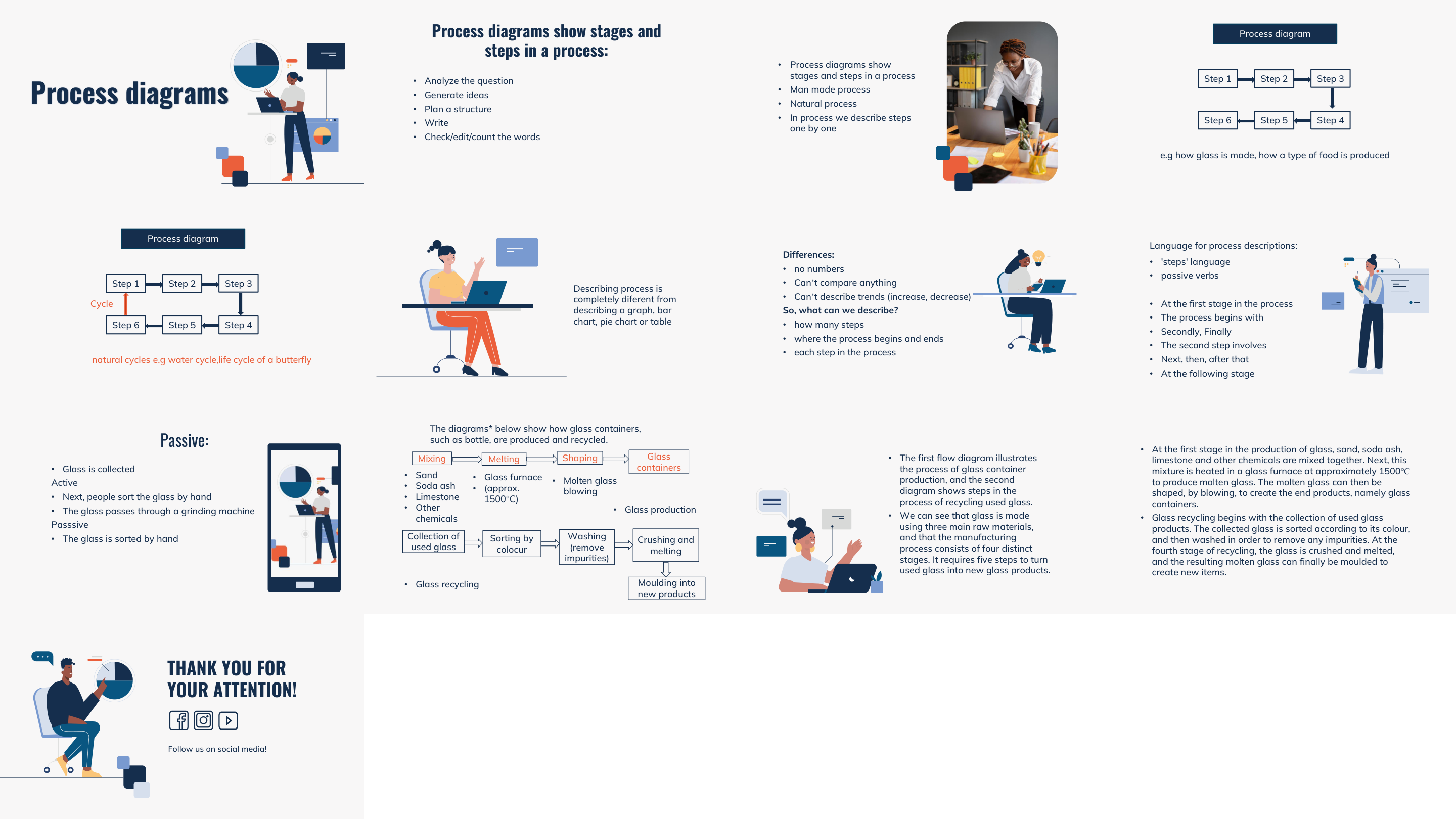
The diagrams* below show how glass containers, such as bottle, are produced and recycled.
Mixing
Melting
Shaping
Glass containers
Sand
Soda ash
Limestone
Other chemicals
Glass furnace
(approx. 1500°C)
Molten glass blowing
Glass production
Collection of used glass
Sorting by colocur
Washing (remove impurities)
Moulding into new products
Crushing and melting
Glass recycling
=== Taqdimot 11 ===
The first flow diagram illustrates the process of glass container production, and the second diagram shows steps in the process of recycling used glass.
We can see that glass is made using three main raw materials, and that the manufacturing process consists of four distinct stages. It requires five steps to turn used glass into new glass products.
=== Taqdimot 12 ===
At the first stage in the production of glass, sand, soda ash, limestone and other chemicals are mixed together. Next, this mixture is heated in a glass furnace at approximately 1500℃ to produce molten glass. The molten glass can then be shaped, by blowing, to create the end products, namely glass containers.
Glass recycling begins with the collection of used glass products. The collected glass is sorted according to its colour, and then washed in order to remove any impurities. At the fourth stage of recycling, the glass is crushed and melted, and the resulting molten glass can finally be moulded to create new items.
=== Taqdimot 13 ===
THANK YOU FOR YOUR ATTENTION!
Follow us on social media!
📊 “Process Diagrams” mavzusidagi to‘liq taqdimotni Slaydchi.uz saytida tomosha qiling.
Slaydchi.uz — IELTS Writing Task 1, akademik ingliz tili va grafik tahlil mavzulari uchun mukammal vizual taqdimotlar platformasi.
Boshqa IELTS mavzulari uchun: slaydchi.uz
Tegishli mahsulotlar

ALL ABOUT LISTENING SKILLS mavzusidagi tayyor PPTX taqdimot. Ingliz tili darsi uchun mavzu, misollar va asosiy tushunchalar jamlangan.
- Slaydlar soni: 33 ta
- Fayl formati: PPTX
- Tili: o‘zbek tili
- Kategoriya: Ingliz tili

HOW TO IMPROVE STUDENTS’ PRONUNCIATION LET US LOOK THROUGH mavzusidagi tayyor PPTX taqdimot. Ingliz tili darsi uchun mavzu, misollar va asosiy tushunchalar jamlangan.
- Slaydlar soni: 48 ta
- Fayl formati: PPTX
- Tili: o‘zbek tili
- Kategoriya: Ingliz tili

TECHNOLOGY INTEGRATED LANGUAGE TEACHING mavzusidagi tayyor PPTX taqdimot. Ingliz tili darsi uchun mavzu, misollar va asosiy tushunchalar jamlangan.
- Slaydlar soni: 21 ta
- Fayl formati: PPTX
- Tili: o‘zbek tili
- Kategoriya: Ingliz tili

CULTURE. TALKING ABOUT FESTIVALS AND HISTORICAL SITES mavzusidagi tayyor PPTX taqdimot. Ingliz tili darsi uchun mavzu, misollar va asosiy tushunchalar jamlangan.
- Slaydlar soni: 29 ta
- Fayl formati: PPTX
- Tili: o‘zbek tili
- Kategoriya: Ingliz tili

CONTINUOUS TENSES IN ENGLISH GRAMMAR mavzusidagi tayyor PPTX taqdimot. Ingliz tili darsi uchun mavzu, misollar va asosiy tushunchalar jamlangan.
- Slaydlar soni: 48 ta
- Fayl formati: PPTX
- Tili: o‘zbek tili
- Kategoriya: Ingliz tili

BINOMIAL PAIRS mavzusidagi tayyor PPTX taqdimot. Ingliz tili darsi uchun mavzu, misollar va asosiy tushunchalar jamlangan.
- Slaydlar soni: 24 ta
- Fayl formati: PPTX
- Tili: o‘zbek tili
- Kategoriya: Ingliz tili

MAYTERIALS DEVELOMENT mavzusidagi tayyor PPTX taqdimot. Ingliz tili darsi uchun mavzu, misollar va asosiy tushunchalar jamlangan.
- Slaydlar soni: 40 ta
- Fayl formati: PPTX
- Tili: o‘zbek tili
- Kategoriya: Ingliz tili

CLASSROOM MANAGEMENT IN WORKING WITH DEFFERENT AGES mavzusidagi tayyor PPTX taqdimot. Ingliz tili darsi uchun mavzu, misollar va asosiy tushunchalar jamlangan.
- Slaydlar soni: 18 ta
- Fayl formati: PPTX
- Tili: o‘zbek tili
- Kategoriya: Ingliz tili
LEXICAL EXPRESSIVE MEANS AND STYLISTIC DEVICES mavzusidagi tayyor PPTX taqdimot. Ingliz tili darsi uchun mavzu, misollar va asosiy tushunchalar jamlangan.
- Slaydlar soni: 25 ta
- Fayl formati: PPTX
- Tili: o‘zbek tili
- Kategoriya: Ingliz tili
WHAT IS LEXICOGRAPHY mavzusidagi tayyor PPTX taqdimot. Ingliz tili darsi uchun mavzu, misollar va asosiy tushunchalar jamlangan.
- Slaydlar soni: 28 ta
- Fayl formati: PPTX
- Tili: o‘zbek tili
- Kategoriya: Ingliz tili

CASE STUDY METHOD IN TEACHING mavzusidagi tayyor PPTX taqdimot. Ingliz tili darsi uchun mavzu, misollar va asosiy tushunchalar jamlangan.
- Slaydlar soni: 36 ta
- Fayl formati: PPTX
- Tili: o‘zbek tili
- Kategoriya: Ingliz tili

THE STRUCTURE OF WORDS IN ENGLISH mavzusidagi tayyor PPTX taqdimot. Ingliz tili darsi uchun mavzu, misollar va asosiy tushunchalar jamlangan.
- Slaydlar soni: 20 ta
- Fayl formati: PPTX
- Tili: o‘zbek tili
- Kategoriya: Ingliz tili
Sharhlar
Hali sharhlar mavjud emas.