




Slayd 1
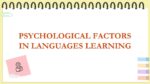
PSYCHOLOGICAL FACTORS IN LANGUAGES LEARNING
Slayd 2
ACTIVITY 1. ANSWER THE QUESTIONS. WARM UP
What is Psychological factor in languages learning
Do they really affect for students?
Are they different for ages?
Slayd 3
PSYCHOLOGICAL FACTORS
Psychological factor is a factor that is mentally or spiritually concerned with the aspects in students’ acquisition.At least four of many factors such as anxiety, attitude, and motivation influence the students’ process of language acquisition.
Slayd 4
Interest
Intelligence
Feelings
Readinesspreparedness
PSYCHOLOGICAL FACTORS
Slayd 5
WHAT ARE THE PSYCHOLOGICAL FACTORS THAT AFFECT LANGUAGE LEARNING?
Some these factors include age, cognition, intelligence, personality, attention, interest, self-confidence and motivation . It is important that we are aware of these factors to address them or minimize some of the negative factors in order to maximize learning of the English-language.
Slayd 6
ATTITUDE
Attitude is defined as a manner of acting, feeling or thinking that shows one’s disposition, opinion, etc. Attitude develops as a result of experience both direct and vicarious which are greatly influenced by people in the immediate environment: parents, teachers, peers; attitude toward self, in the target language and the people who speak it and teacher.
Slayd 7
Slayd 8
There are affective factors such as anxiety and self confidence that can influence English learners. Learning a new language can be stressful because it is new. It may also cause identity conflict, language shock and culture shock.
ANXIETY AND SELF CONFIDENCE
Slayd 9
Slayd 10
MOTIVATION
A social psychological factor frequently used to account for differential success in learning a second language is motivation. This has an intuitive appeal. It makes sense that individuals who are motivated will learn another language faster and to a greater degree. Furthermore, numerous studies have provided statistical evidence that indicates that motivation is a predictor language-learning success.
Slayd 11
Slayd 12
CONCLUSION
The description about student’s psychological factors such as anxiety, aptitude, attitude and motivation contribute the success in learning English as a second language. Those factors have a significant evidence proved by some research findings mentioned earlier. In addition, three kind of motivations also affect language acquisition: integrative motivation, instrumental motivation and social group identification.
Slayd 13
Slayd 14
THANK YOU FOR YOUR ATTENTION!
Follow us on social networks!
Slayd 15
Foydali havolalar
🛒 Barcha taqdimotlar | 📰 Yangiliklar | ℹ️ Biz haqimizda
Tegishli mahsulotlar

CONTINUOUS TENSES IN ENGLISH GRAMMAR mavzusidagi tayyor PPTX taqdimot. Ingliz tili darsi uchun mavzu, misollar va asosiy tushunchalar jamlangan.
- Slaydlar soni: 48 ta
- Fayl formati: PPTX
- Tili: o‘zbek tili
- Kategoriya: Ingliz tili

THE STRUCTURE OF WORDS IN ENGLISH mavzusidagi tayyor PPTX taqdimot. Ingliz tili darsi uchun mavzu, misollar va asosiy tushunchalar jamlangan.
- Slaydlar soni: 20 ta
- Fayl formati: PPTX
- Tili: o‘zbek tili
- Kategoriya: Ingliz tili

HEARING ENGLISH IN CONTEXT mavzusidagi tayyor PPTX taqdimot. Ingliz tili darsi uchun mavzu, misollar va asosiy tushunchalar jamlangan.
- Slaydlar soni: 35 ta
- Fayl formati: PPTX
- Tili: o‘zbek tili
- Kategoriya: Ingliz tili

STRATEGIES FOR READING COMPREHENSION mavzusidagi tayyor PPTX taqdimot. Ingliz tili darsi uchun mavzu, misollar va asosiy tushunchalar jamlangan.
- Slaydlar soni: 33 ta
- Fayl formati: PPTX
- Tili: o‘zbek tili
- Kategoriya: Ingliz tili

MAYTERIALS DEVELOMENT mavzusidagi tayyor PPTX taqdimot. Ingliz tili darsi uchun mavzu, misollar va asosiy tushunchalar jamlangan.
- Slaydlar soni: 40 ta
- Fayl formati: PPTX
- Tili: o‘zbek tili
- Kategoriya: Ingliz tili

METHODOLOGICAL ASPECTS OF TRANSLATION mavzusidagi tayyor PPTX taqdimot. Ingliz tili darsi uchun mavzu, misollar va asosiy tushunchalar jamlangan.
- Slaydlar soni: 31 ta
- Fayl formati: PPTX
- Tili: o‘zbek tili
- Kategoriya: Ingliz tili

HOW TO IMPROVE STUDENTS’ PRONUNCIATION LET US LOOK THROUGH mavzusidagi tayyor PPTX taqdimot. Ingliz tili darsi uchun mavzu, misollar va asosiy tushunchalar jamlangan.
- Slaydlar soni: 48 ta
- Fayl formati: PPTX
- Tili: o‘zbek tili
- Kategoriya: Ingliz tili


ASSESSMENT AND TESTING IN THE CLASSROOM mavzusidagi tayyor PPTX taqdimot. Ingliz tili darsi uchun mavzu, misollar va asosiy tushunchalar jamlangan.
- Slaydlar soni: 37 ta
- Fayl formati: PPTX
- Tili: o‘zbek tili
- Kategoriya: Ingliz tili


CLASSROOM MANAGEMENT IN WORKING WITH DEFFERENT AGES mavzusidagi tayyor PPTX taqdimot. Ingliz tili darsi uchun mavzu, misollar va asosiy tushunchalar jamlangan.
- Slaydlar soni: 18 ta
- Fayl formati: PPTX
- Tili: o‘zbek tili
- Kategoriya: Ingliz tili

BINOMIAL PAIRS mavzusidagi tayyor PPTX taqdimot. Ingliz tili darsi uchun mavzu, misollar va asosiy tushunchalar jamlangan.
- Slaydlar soni: 24 ta
- Fayl formati: PPTX
- Tili: o‘zbek tili
- Kategoriya: Ingliz tili

TEACHING VOCABULARY TO A 2 AND B 1 LEVEL LEARNERS mavzusidagi tayyor PPTX taqdimot. Ingliz tili darsi uchun mavzu, misollar va asosiy tushunchalar jamlangan.
- Slaydlar soni: 39 ta
- Fayl formati: PPTX
- Tili: o‘zbek tili
- Kategoriya: Ingliz tili

WHAT IS LEXICOGRAPHY mavzusidagi tayyor PPTX taqdimot. Ingliz tili darsi uchun mavzu, misollar va asosiy tushunchalar jamlangan.
- Slaydlar soni: 28 ta
- Fayl formati: PPTX
- Tili: o‘zbek tili
- Kategoriya: Ingliz tili
Sharhlar
Hali sharhlar mavjud emas.