


Slayd 1
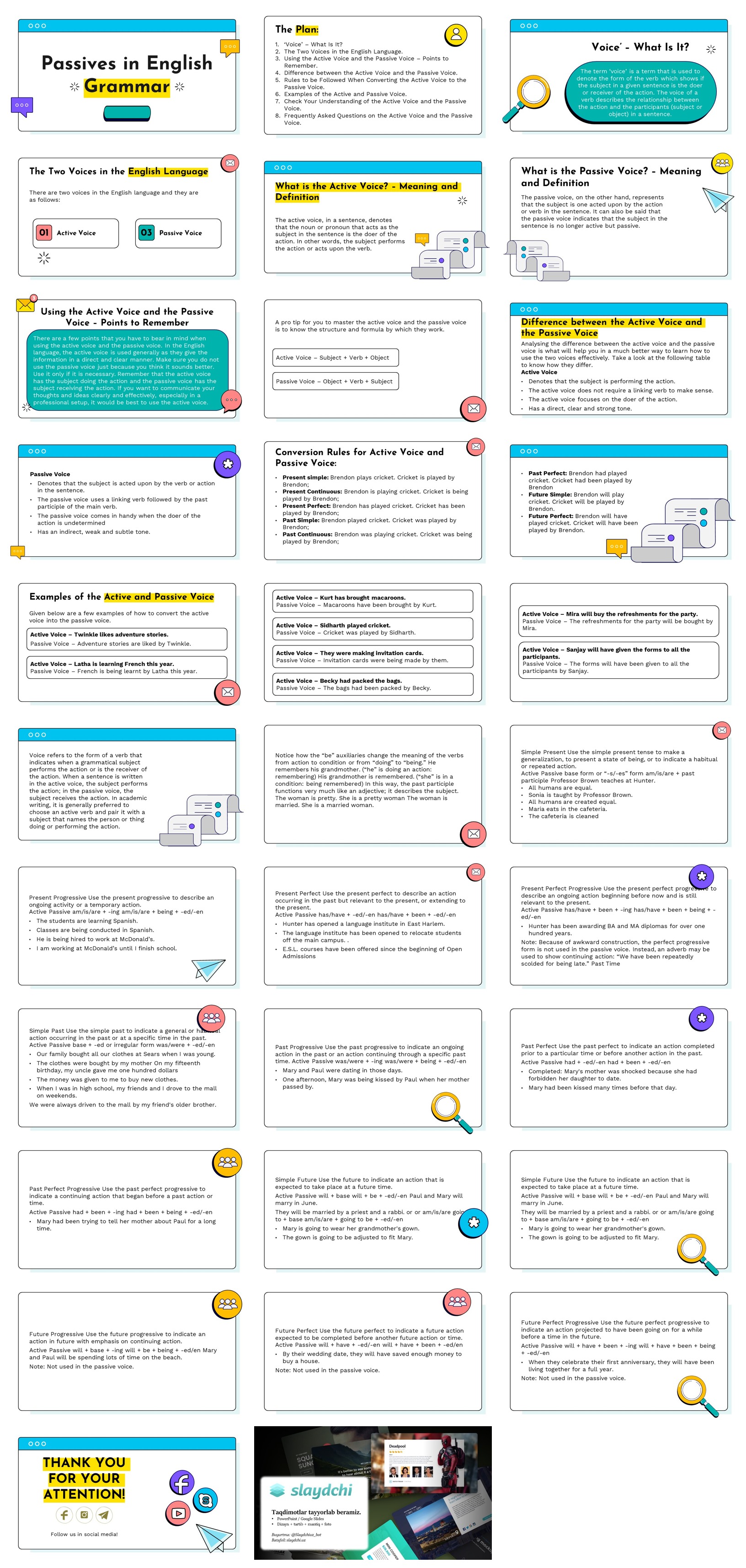
Passives in English Grammar
Slayd 2
The Plan:
‘Voice’ – What Is It?
The Two Voices in the English Language.
Using the Active Voice and the Passive Voice – Points to Remember.
Difference between the Active Voice and the Passive Voice.
Rules to be Followed When Converting the Active Voice to the Passive Voice.
Examples of the Active and Passive Voice.
Check Your Understanding of the Active Voice and the Passive Voice.
Frequently Asked Questions on the Active Voice and the Passive Voice.
Slayd 3
The term ‘voice’ is a term that is used to denote the form of the verb which shows if the subject in a given sentence is the doer or receiver of the action. The voice of a verb describes the relationship between the action and the participants (subject or object) in a sentence.
Voice’ – What Is It?
Slayd 4
Active Voice
There are two voices in the English language and they are as follows:
Passive Voice
The Two Voices in the English Language
01
03
Slayd 5
What is the Active Voice? – Meaning and Definition
The active voice, in a sentence, denotes that the noun or pronoun that acts as the subject in the sentence is the doer of the action. In other words, the subject performs the action or acts upon the verb.
Slayd 6
The passive voice, on the other hand, represents that the subject is one acted upon by the action or verb in the sentence. It can also be said that the passive voice indicates that the subject in the sentence is no longer active but passive.
What is the Passive Voice? – Meaning and Definition
Slayd 7
There are a few points that you have to bear in mind when using the active voice and the passive voice. In the English language, the active voice is used generally as they give the information in a direct and clear manner. Make sure you do not use the passive voice just because you think it sounds better. Use it only if it is necessary. Remember that the active voice has the subject doing the action and the passive voice has the subject receiving the action. If you want to communicate your thoughts and ideas clearly and effectively, especially in a professional setup, it would be best to use the active voice.
Using the Active Voice and the Passive Voice – Points to Remember
Slayd 8
Active Voice – Subject + Verb + Object
A pro tip for you to master the active voice and the passive voice is to know the structure and formula by which they work.
Passive Voice – Object + Verb + Subject
Slayd 9
Difference between the Active Voice and the Passive Voice
Analysing the difference between the active voice and the passive voice is what will help you in a much better way to learn how to use the two voices effectively. Take a look at the following table to know how they differ.
Active Voice
Denotes that the subject is performing the action.
The active voice does not require a linking verb to make sense.
The active voice focuses on the doer of the action.
Has a direct, clear and strong tone.
Slayd 10
Passive Voice
Denotes that the subject is acted upon by the verb or action in the sentence.
The passive voice uses a linking verb followed by the past participle of the main verb.
The passive voice comes in handy when the doer of the action is undetermined
Has an indirect, weak and subtle tone.
Slayd 11
Present simple: Brendon plays cricket. Cricket is played by Brendon;
Present Continuous: Brendon is playing cricket. Cricket is being played by Brendon;
Present Perfect: Brendon has played cricket. Cricket has been played by Brendon;
Past Simple: Brendon played cricket. Cricket was played by Brendon;
Past Continuous: Brendon was playing cricket. Cricket was being played by Brendon;
Conversion Rules for Active Voice and Passive Voice:
Slayd 12
Past Perfect: Brendon had played cricket. Cricket had been played by Brendon
Future Simple: Brendon will play cricket. Cricket will be played by Brendon.
Future Perfect: Brendon will have played cricket. Cricket will have been played by Brendon.
Slayd 13
Active Voice – Twinkle likes adventure stories.
Passive Voice – Adventure stories are liked by Twinkle.
Given below are a few examples of how to convert the active voice into the passive voice.
Examples of the Active and Passive Voice
Active Voice – Latha is learning French this year.
Passive Voice – French is being learnt by Latha this year.
Slayd 14
Active Voice – Kurt has brought macaroons.
Passive Voice – Macaroons have been brought by Kurt.
Active Voice – Sidharth played cricket.
Passive Voice – Cricket was played by Sidharth.
Active Voice – They were making invitation cards.
Passive Voice – Invitation cards were being made by them.
Active Voice – Becky had packed the bags.
Passive Voice – The bags had been packed by Becky.
Slayd 15
Active Voice – Mira will buy the refreshments for the party.
Passive Voice – The refreshments for the party will be bought by Mira.
Active Voice – Sanjay will have given the forms to all the participants.
Passive Voice – The forms will have been given to all the participants by Sanjay.
Slayd 16
Voice refers to the form of a verb that indicates when a grammatical subject performs the action or is the receiver of the action. When a sentence is written in the active voice, the subject performs the action; in the passive voice, the subject receives the action. In academic writing, it is generally preferred to choose an active verb and pair it with a subject that names the person or thing doing or performing the action.
Slayd 17
Notice how the “be” auxiliaries change the meaning of the verbs from action to condition or from “doing” to “being.” He remembers his grandmother. (“he” is doing an action: remembering) His grandmother is remembered. (“she” is in a condition: being remembered) In this way, the past participle functions very much like an adjective; it describes the subject. The woman is pretty. She is a pretty woman The woman is married. She is a married woman.
Slayd 18
Simple Present Use the simple present tense to make a generalization, to present a state of being, or to indicate a habitual or repeated action.
Active Passive base form or “-s/-es” form am/is/are + past participle Professor Brown teaches at Hunter.
All humans are equal.
Sonia is taught by Professor Brown.
All humans are created equal.
Maria eats in the cafeteria.
The cafeteria is cleaned
Slayd 19
Present Progressive Use the present progressive to describe an ongoing activity or a temporary action.
Active Passive am/is/are + -ing am/is/are + being + -ed/-en
The students are learning Spanish.
Classes are being conducted in Spanish.
He is being hired to work at McDonald’s.
I am working at McDonald’s until I finish school.
Slayd 20
Present Perfect Use the present perfect to describe an action occurring in the past but relevant to the present, or extending to the present.
Active Passive has/have + -ed/-en has/have + been + -ed/-en
Hunter has opened a language institute in East Harlem.
The language institute has been opened to relocate students off the main campus. .
E.S.L. courses have been offered since the beginning of Open Admissions
Slayd 21
Present Perfect Progressive Use the present perfect progressive to describe an ongoing action beginning before now and is still relevant to the present.
Active Passive has/have + been + -ing has/have + been + being + -ed/-en
Hunter has been awarding BA and MA diplomas for over one hundred years.
Note: Because of awkward construction, the perfect progressive form is not used in the passive voice. Instead, an adverb may be used to show continuing action: “We have been repeatedly scolded for being late.” Past Time
Slayd 22
Simple Past Use the simple past to indicate a general or habitual action occurring in the past or at a specific time in the past.
Active Passive base + -ed or irregular form was/were + -ed/-en
Our family bought all our clothes at Sears when I was young.
The clothes were bought by my mother On my fifteenth birthday, my uncle gave me one hundred dollars
The money was given to me to buy new clothes.
When I was in high school, my friends and I drove to the mall on weekends.
We were always driven to the mall by my friend’s older brother.
Slayd 23
Past Progressive Use the past progressive to indicate an ongoing action in the past or an action continuing through a specific past time. Active Passive was/were + -ing was/were + being + -ed/-en
Mary and Paul were dating in those days.
One afternoon, Mary was being kissed by Paul when her mother passed by.
Slayd 24
Past Perfect Use the past perfect to indicate an action completed prior to a particular time or before another action in the past.
Active Passive had + -ed/-en had + been + -ed/-en
Completed: Mary’s mother was shocked because she had forbidden her daughter to date.
Mary had been kissed many times before that day.
Slayd 25
Past Perfect Progressive Use the past perfect progressive to indicate a continuing action that began before a past action or time.
Active Passive had + been + -ing had + been + being + -ed/-en
Mary had been trying to tell her mother about Paul for a long time.
Slayd 26
Simple Future Use the future to indicate an action that is expected to take place at a future time.
Active Passive will + base will + be + -ed/-en Paul and Mary will marry in June.
They will be married by a priest and a rabbi. or or am/is/are going to + base am/is/are + going to be + -ed/-en
Mary is going to wear her grandmother’s gown.
The gown is going to be adjusted to fit Mary.
Slayd 27
Simple Future Use the future to indicate an action that is expected to take place at a future time.
Active Passive will + base will + be + -ed/-en Paul and Mary will marry in June.
They will be married by a priest and a rabbi. or or am/is/are going to + base am/is/are + going to be + -ed/-en
Mary is going to wear her grandmother’s gown.
The gown is going to be adjusted to fit Mary.
Slayd 28
Future Progressive Use the future progressive to indicate an action in future with emphasis on continuing action.
Active Passive will + base + -ing will + be + being + -ed/en Mary and Paul will be spending lots of time on the beach.
Note: Not used in the passive voice.
Slayd 29
Future Perfect Use the future perfect to indicate a future action expected to be completed before another future action or time. Active Passive will + have + -ed/-en will + have + been + -ed/en
By their wedding date, they will have saved enough money to buy a house.
Note: Not used in the passive voice.
Slayd 30
Future Perfect Progressive Use the future perfect progressive to indicate an action projected to have been going on for a while before a time in the future.
Active Passive will + have + been + -ing will + have + been + being + -ed/-en
When they celebrate their first anniversary, they will have been living together for a full year.
Note: Not used in the passive voice.
Slayd 31
THANK YOU FOR YOUR ATTENTION!
Follow us in social media!
Slayd 32
Foydali havolalar
🛒 Barcha taqdimotlar | 📰 Yangiliklar | ℹ️ Biz haqimizda











Sharhlar
Hali sharhlar mavjud emas.