




Slayd 1
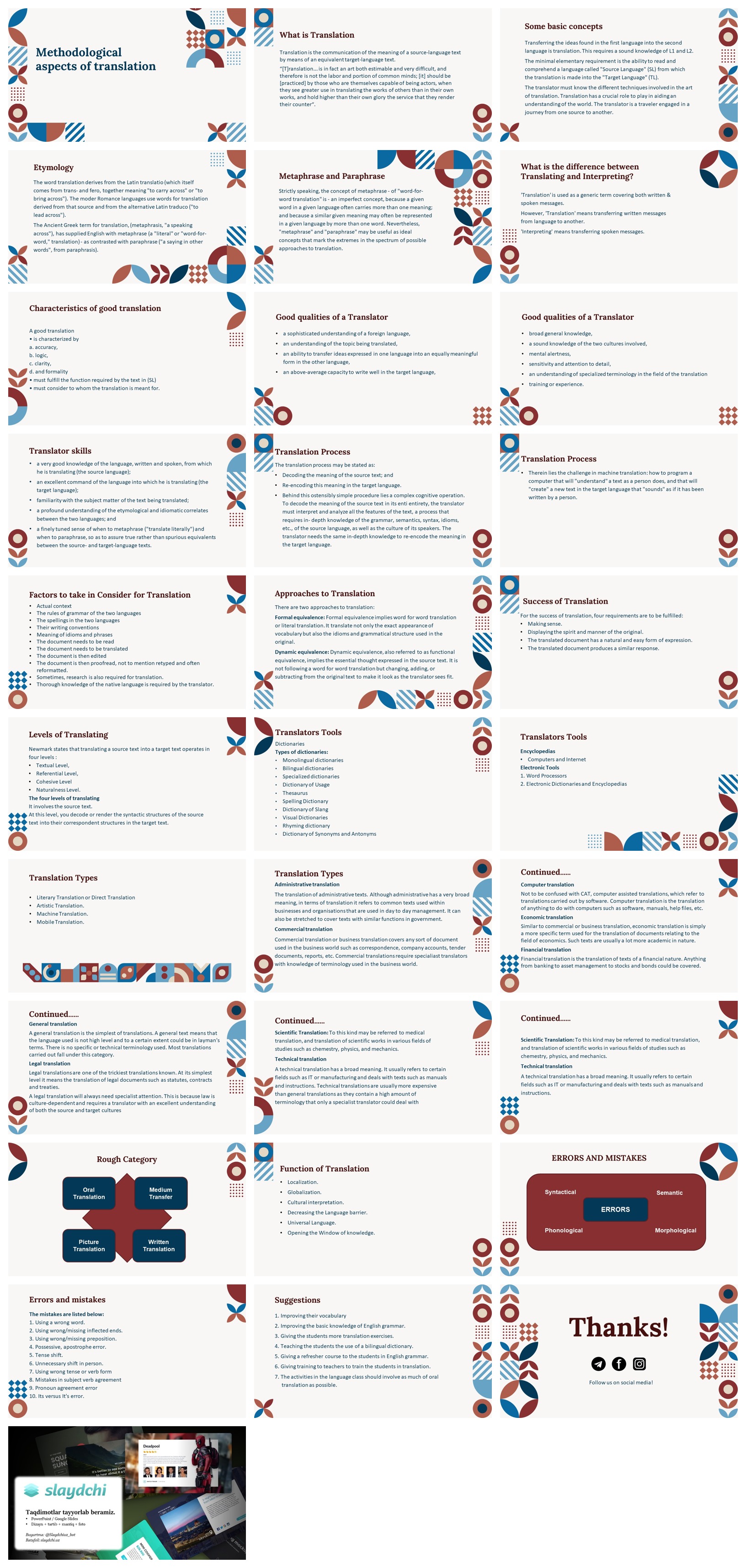
Methodological aspects of translation
Slayd 2
What is Translation
Translation is the communication of the meaning of a source-language text by means of an equivalent target-language text.
“[T]ranslation… is in fact an art both estimable and very difficult, and therefore is not the labor and portion of common minds; [it] should be [practiced] by those who are themselves capable of being actors, when they see greater use in translating the works of others than in their own works, and hold higher than their own glory the service that they render their counter“.
Slayd 3
Some basic concepts
Transferring the ideas found in the first language into the second language is translation. This requires a sound knowledge of L1 and L2.
The minimal elementary requirement is the ability to read and comprehend a language called «Source Language» (SL) from which the translation is made into the «Target Language» (TL).
The translator must know the different techniques involved in the art of translation. Translation has a crucial role to play in aiding an understanding of the world. The translator is a traveler engaged in a journey from one source to another.
Slayd 4
Etymology
The word translation derives from the Latin translatio (which itself comes from trans- and fero, together meaning «to carry across» or «to bring across»). The moder Romance languages use words for translation derived from that source and from the alternative Latin traduco («to lead across»).
The Ancient Greek term for translation, (metaphrasis, «a speaking across»), has supplied English with metaphrase (a «literal» or «word-for-word,» translation) – as contrasted with paraphrase («a saying in other words», from paraphrasis).
Slayd 5
Metaphrase and Paraphrase
Strictly speaking, the concept of metaphrase – of «word-for-word translation» is – an imperfect concept, because a given word in a given language often carries more than one meaning; and because a similar given meaning may often be represented in a given language by more than one word. Nevertheless, «metaphrase» and «paraphrase» may be useful as ideal concepts that mark the extremes in the spectrum of possible approaches to translation.
Slayd 6
What is the difference between Translating and Interpreting?
‘Translation’ is used as a generic term covering both written & spoken messages.
However, ‘Translation’ means transferring written messages from language to another.
‘Interpreting’ means transferring spoken messages.
Slayd 7
A good translation
• is characterized by
a. accuracy,
b. logic,
c. clarity,
d. and formality
• must fulfill the function required by the text in (SL)
• must consider to whom the translation is meant for.
Characteristics of good translation
Slayd 8
Good qualities of a Translator
a sophisticated understanding of a foreign language,
an understanding of the topic being translated,
an ability to transfer ideas expressed in one language into an equally meaningful form in the other language,
an above-average capacity to write well in the target language,
Slayd 9
Good qualities of a Translator
broad general knowledge,
a sound knowledge of the two cultures involved,
mental alertness,
sensitivity and attention to detail,
an understanding of specialized terminology in the field of the translation
training or experience.
Slayd 10
Translator skills
a very good knowledge of the language, written and spoken, from which he is translating (the source language);
an excellent command of the language into which he is translating (the target language);
familiarity with the subject matter of the text being translated;
a profound understanding of the etymological and idiomatic correlates between the two languages; and
a finely tuned sense of when to metaphrase («translate literally») and when to paraphrase, so as to assure true rather than spurious equivalents between the source- and target-language texts.
Slayd 11
Translation Process
The translation process may be stated as:
Decoding the meaning of the source text; and
Re-encoding this meaning in the target language.
Behind this ostensibly simple procedure lies a complex cognitive operation. To decode the meaning of the source text in its enti entirety, the translator must interpret and analyze all the features of the text, a process that requires in- depth knowledge of the grammar, semantics, syntax, idioms, etc., of the source language, as well as the culture of its speakers. The translator needs the same in-depth knowledge to re-encode the meaning in the target language.
Slayd 12
Translation Process
Therein lies the challenge in machine translation: how to program a computer that will «understand» a text as a person does, and that will «create» a new text in the target language that «sounds» as if it has been written by a person.
Slayd 13
Factors to take in Consider for Translation
Actual context
The rules of grammar of the two languages
The spellings in the two languages
Their writing conventions
Meaning of idioms and phrases
The document needs to be read
The document needs to be translated
The document is then edited
The document is then proofread, not to mention retyped and often reformatted.
Sometimes, research is also required for translation.
Thorough knowledge of the native language is required by the translator.
Slayd 14
Approaches to Translation
There are two approaches to translation:
Formal equivalence: Formal equivalence implies word for word translation or literal translation. It translate not only the exact appearance of vocabulary but also the idioms and grammatical structure used in the original.
Dynamic equivalence: Dynamic equivalence, also referred to as functional equivalence, implies the essential thought expressed in the source text. It is not following a word for word translation but changing, adding, or subtracting from the original text to make it look as the translator sees fit.
Slayd 15
Success of Translation
For the success of translation, four requirements are to be fulfilled:
Making sense.
Displaying the spirit and manner of the original.
The translated document has a natural and easy form of expression.
The translated document produces a similar response.
Slayd 16
Levels of Translating
Newmark states that translating a source text into a target text operates in four levels :
Textual Level,
Referential Level,
Cohesive Level
Naturalness Level.
The four levels of translating
It involves the source text.
At this level, you decode or render the syntactic structures of the source text into their correspondent structures in the target text.
Slayd 17
Translators Tools
Dictionaries
Types of dictionaries:
Monolingual dictionaries
Bilingual dictionaries
Specialized dictionaries
Dictionary of Usage
Thesaurus
Spelling Dictionary
Dictionary of Slang
Visual Dictionaries
Rhyming dictionary
Dictionary of Synonyms and Antonyms
Slayd 18
Encyclopedias
Computers and Internet
Electronic Tools
1. Word Processors
2. Electronic Dictionaries and Encyclopedias
Translators Tools
Slayd 19
Translation Types
Literary Translation or Direct Translation
Artistic Translation.
Machine Translation.
Mobile Translation.
Slayd 20
Translation Types
Administrative translation
The translation of administrative texts. Although administrative has a very broad meaning, in terms of translation it refers to common texts used within businesses and organisations that are used in day to day management. It can also be stretched to cover texts with similar functions in government.
Commercial translation
Commercial translation or business translation covers any sort of document used in the business world such as correspondence, company accounts, tender documents, reports, etc. Commercial translations require specialiast translators with knowledge of terminology used in the business world.
Slayd 21
Continued……
Computer translation
Not to be confused with CAT, computer assisted translations, which refer to translations carried out by software. Computer translation is the translation of anything to do with computers such as software, manuals, help files, etc.
Economic translation
Similar to commercial or business translation, economic translation is simply a more specific term used for the translation of documents relating to the field of economics. Such texts are usually a lot more academic in nature.
Financial translation
Financial translation is the translation of texts of a financial nature. Anything from banking to asset management to stocks and bonds could be covered.
Slayd 22
Continued……
General translation
A general translation is the simplest of translations. A general text means that the language used is not high level and to a certain extent could be in layman’s terms. There is no specific or technical terminology used. Most translations carried out fall under this category.
Legal translation
Legal translations are one of the trickiest translations known. At its simplest level it means the translation of legal documents such as statutes, contracts and treaties.
A legal translation will always need specialist attention. This is because law is culture-dependent and requires a translator with an excellent understanding of both the source and target cultures
Slayd 23
Scientific Translation: To this kind may be referred to medical translation, and translation of scientific works in various fields of studies such as chemestry, physics, and mechanics.
Technical translation
A technical translation has a broad meaning. It usually refers to certain fields such as IT or manufacturing and deals with texts such as manuals and instructions. Technical translations are usually more expensive than general translations as they contain a high amount of terminology that only a specialist translator could deal with
Continued……
Slayd 24
Continued……
Scientific Translation: To this kind may be referred to medical translation, and translation of scientific works in various fields of studies such as chemestry, physics, and mechanics.
Technical translation
A technical translation has a broad meaning. It usually refers to certain fields such as IT or manufacturing and deals with texts such as manuals and instructions.
Slayd 25
Rough Category
Oral Translation
Picture Translation
Medium Transfer
Written Translation
Slayd 26
Function of Translation
Localization.
Globalization.
Cultural interpretation.
Decreasing the Language barrier.
Universal Language.
Opening the Window of knowledge.
Slayd 27
ERRORS AND MISTAKES
Phonological
Semantic
Morphological
Syntactical
ERRORS
Slayd 28
Errors and mistakes
The mistakes are listed below:
1. Using a wrong word.
2. Using wrong/missing inflected ends.
3. Using wrong/missing preposition.
4. Possessive, apostrophe error.
5. Tense shift.
6. Unnecessary shift in person.
7. Using wrong tense or verb form
8. Mistakes in subject verb agreement
9. Pronoun agreement error
10. Its versus It’s error.
Slayd 29
Suggestions
1. Improving their vocabulary
2. Improving the basic knowledge of English grammar.
3. Giving the students more translation exercises.
4. Teaching the students the use of a bilingual dictionary.
5. Giving a refresher course to the students in English grammar.
6. Giving training to teachers to train the students in translation.
7. The activities in the language class should involve as much of oral translation as possible.
Slayd 30
Thanks!
Follow us on social media!
Slayd 31
Foydali havolalar
🛒 Barcha taqdimotlar | 📰 Yangiliklar | ℹ️ Biz haqimizda








Sharhlar
Hali sharhlar mavjud emas.