
Slayd 1
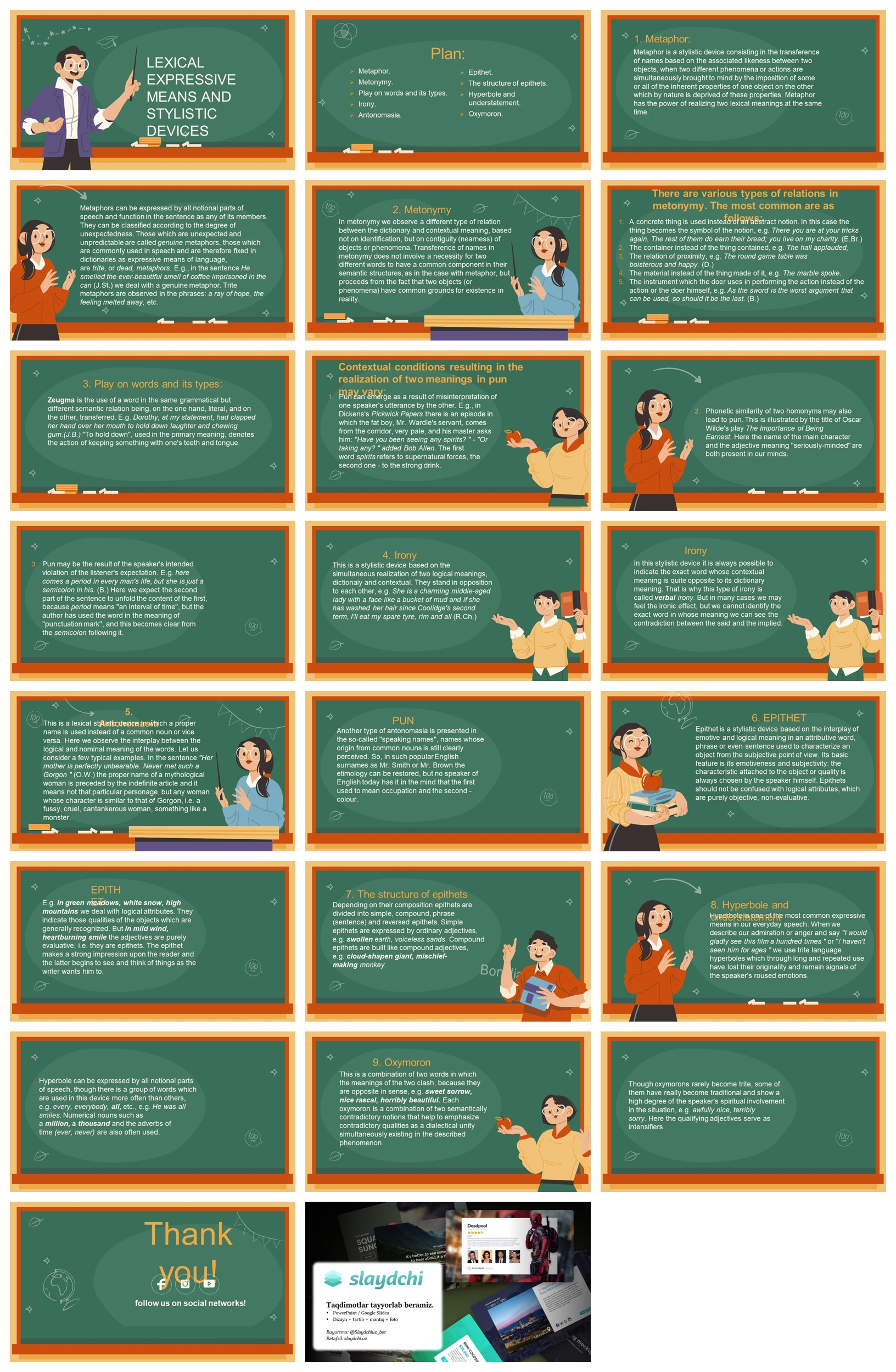
LEXICAL EXPRESSIVE MEANS AND STYLISTIC DEVICES
Slayd 2
Plan:
Metaphor.
Metonymy.
Play on words and its types.
Irony.
Antonomasia.
Epithet.
The structure of epithets.
Hyperbole and understatement.
Oxymoron.
Slayd 3
1. Metaphor:
Metaphor is a stylistic device consisting in the transference of names based on the associated likeness between two objects, when two different phenomena or actions are simultaneously brought to mind by the imposition of some or all of the inherent properties of one object on the other which by nature is deprived of these properties. Metaphor has the power of realizing two lexical meanings at the same time.
Slayd 4
Metaphors can be expressed by all notional parts of speech and function in the sentence as any of its members. They can be classified according to the degree of unexpectedness. Those which are unexpected and unpredictable are called genuine metaphors, those which are commonly used in speech and are therefore fixed in dictionaries as expressive means of language, are trite, or dead, metaphors. E.g., in the sentence He smelled the ever-beautiful smell of coffee imprisoned in the can (J.St.) we deal with a genuine metaphor. Trite metaphors are observed in the phrases: a ray of hope, the feeling melted away, etc.
Slayd 5
2. Metonymy
In metonymy we observe a different type of relation between the dictionary and contextual meaning, based not on identification, but on contiguity (nearness) of objects or phenomena. Transference of names in metonymy does not involve a necessity for two different words to have a common component in their semantic structures, as in the case with metaphor, but proceeds from the fact that two objects (or phenomena) have common grounds for existence in reality.
Slayd 6
There are various types of relations in metonymy. The most common are as follows:
A concrete thing is used instead of an abstract notion. In this case the thing becomes the symbol of the notion, e.g. There you are at your tricks again. The rest of them do earn their bread; you live on my charity. (E.Br.)
The container instead of the thing contained, e.g. The hall applauded,
The relation of proximity, e.g. The round game table wasboisterous and happy. (D.)
The material instead of the thing made of it, e.g. The marble spoke.
The instrument which the doer uses in performing the action instead of the action or the doer himself, e.g. As the sword is the worst argument that can be used, so should it be the last. (B.)
Slayd 7
3. Play on words and its types:
Zeugma is the use of a word in the same grammatical but different semantic relation being, on the one hand, literal, and on the other, transferred. E.g. Dorothy, at my statement, had clapped her hand over her mouth to hold down laughter and chewing gum.(J.B.) «To hold down», used in the primary meaning, denotes the action of keeping something with one’s teeth and tongue.
Slayd 8
Contextual conditions resulting in the realization of two meanings in pun may vary:
Pun can emerge as a result of misinterpretation of one speaker’s utterance by the other. E.g., in Dickens’s Pickwick Papers there is an episode in which the fat boy, Mr. Wardle’s servant, comes from the corridor, very pale, and his master asks him: «Have you been seeing any spirits? » – «Or taking any? » added Bob Allen. The first word spirits refers to supernatural forces, the second one – to the strong drink.
Slayd 9
Phonetic similarity of two homonyms may also lead to pun. This is illustrated by the title of Oscar Wilde’s play The Importance of Being Earnest. Here the name of the main character and the adjective meaning «seriously-minded» are both present in our minds.
Slayd 10
Pun may be the result of the speaker’s intended violation of the listener’s expectation. E.g. here comes a period in every man’s life, but she is just a semicolon in his. (B.) Here we expect the second part of the sentence to unfold the content of the first, because period means «an interval of time», but the author has used the word in the meaning of «punctuation mark», and this becomes clear from the semicolon following it.
Slayd 11
4. Irony
This is a stylistic device based on the simultaneous realization of two logical meanings, dictionaiy and contextual. They stand in opposition to each other, e.g. She is a charming middle-aged lady with a face like a bucket of mud and if she has washed her hair since Coolidge’s second term, I’ll eat my spare tyre, rim and all (R.Ch.)
Slayd 12
Irony
In this stylistic device it is always possible to indicate the exact word whose contextual meaning is quite opposite to its dictionary meaning. That is why this type of irony is called verbal irony. But in many cases we may feel the ironic effect, but we cannot identify the exact word in whose meaning we can see the contradiction between the said and the implied.
Slayd 13
5. Antonomasia
This is a lexical stylistic device in which a proper name is used instead of a common noun or vice versa. Here we observe the interplay between the logical and nominal meaning of the words. Let us consider a few typical examples. In the sentence «Her mother is perfectly unbearable. Never met such a Gorgon » (O.W.) the proper name of a mythological woman is preceded by the indefinite article and it means not that particular personage, but any woman whose character is similar to that of Gorgon, i.e. a fussy, cruel, cantankerous woman, something like a monster.
Slayd 14
PUN
Another type of antonomasia is presented in the so-called «speaking names», names whose origin from common nouns is still clearly perceived. So, in such popular English surnames as Mr. Smith or Mr. Brown the etimology can be restored, but no speaker of English today has it in the mind that the first used to mean occupation and the second – colour.
Slayd 15
Epithet is a stylistic device based on the interplay of emotive and logical meaning in an attributive word, phrase or even sentence used to characterize an object from the subjective point of view. Its basic feature is its emotiveness and subjectivity: the characteristic attached to the object or quality is always chosen by the speaker himself. Epithets should not be confused with logical attributes, which are purely objective, non-evaluative.
6. EPITHET
Slayd 16
EPITHET
E.g. in green meadows, white snow, high mountains we deal with logical attributes. They indicate those qualities of the objects which are generally recognized. But in mild wind, heartburning smile the adjectives are purely evaluative, i.e. they are epithets. The epithet makes a strong impression upon the reader and the latter begins to see and think of things as the writer wants him to.
Slayd 17
7. The structure of epithets
Depending on their composition epithets are divided into simple, compound, phrase (sentence) and reversed epithets. Simple epithets are expressed by ordinary adjectives, e.g. swollen earth, voiceless sands. Compound epithets are built like compound adjectives, e.g. cloud-shapen giant, mischief-making monkey.
Bon dia!
Slayd 18
Hyperbole is one of the most common expressive means in our everyday speech. When we describe our admiration or anger and say «I would gladly see this film a hundred times » or «/ haven’t seen him for ages » we use trite language hyperboles which through long and repeated use have lost their originality and remain signals of the speaker’s roused emotions.
8. Hyperbole and understatement
Slayd 19
Hyperbole can be expressed by all notional parts of speech, though there is a group of words which are used in this device more often than others, e.g. every, everybody, all, etc., e.g. He was all smiles. Numerical nouns such as a million, a thousand and the adverbs of time (ever, never) are also often used.
Slayd 20
9. Oxymoron
This is a combination of two words in which the meanings of the two clash, because they are opposite in sense, e.g. sweet sorrow, nice rascal, horribly beautiful. Each oxymoron is a combination of two semantically contradictory notions that help to emphasize contradictory qualities as a dialectical unity simultaneously existing in the described phenomenon.
Slayd 21
Though oxymorons rarely become trite, some of them have really become traditional and show a high degree of the speaker’s spiritual involvement in the situation, e.g. awfully nice, terribly sorry. Here the qualifying adjectives serve as intensifiers.
Slayd 22
Thank you!
follow us on social networks!
Slayd 23
Foydali havolalar
🛒 Barcha taqdimotlar | 📰 Yangiliklar | ℹ️ Biz haqimizda
Tegishli mahsulotlar
ALL ABOUT LISTENING SKILLS mavzusidagi tayyor PPTX taqdimot. Ingliz tili darsi uchun mavzu, misollar va asosiy tushunchalar jamlangan.
- Slaydlar soni: 33 ta
- Fayl formati: PPTX
- Tili: o‘zbek tili
- Kategoriya: Ingliz tili

CLASSROOM MANAGEMENT IN WORKING WITH DEFFERENT AGES mavzusidagi tayyor PPTX taqdimot. Ingliz tili darsi uchun mavzu, misollar va asosiy tushunchalar jamlangan.
- Slaydlar soni: 18 ta
- Fayl formati: PPTX
- Tili: o‘zbek tili
- Kategoriya: Ingliz tili

ASSESSMENT CHECK EVALUATE mavzusidagi tayyor PPTX taqdimot. Ingliz tili darsi uchun mavzu, misollar va asosiy tushunchalar jamlangan.
- Slaydlar soni: 22 ta
- Fayl formati: PPTX
- Tili: o‘zbek tili
- Kategoriya: Ingliz tili
TECHNOLOGY INTEGRATED LANGUAGE TEACHING mavzusidagi tayyor PPTX taqdimot. Ingliz tili darsi uchun mavzu, misollar va asosiy tushunchalar jamlangan.
- Slaydlar soni: 21 ta
- Fayl formati: PPTX
- Tili: o‘zbek tili
- Kategoriya: Ingliz tili
DISCUSSION ESSAYS mavzusidagi tayyor PPTX taqdimot. Ingliz tili darsi uchun mavzu, misollar va asosiy tushunchalar jamlangan.
- Slaydlar soni: 19 ta
- Fayl formati: PPTX
- Tili: o‘zbek tili
- Kategoriya: Ingliz tili
METHODOLOGICAL ASPECTS OF TRANSLATION mavzusidagi tayyor PPTX taqdimot. Ingliz tili darsi uchun mavzu, misollar va asosiy tushunchalar jamlangan.
- Slaydlar soni: 31 ta
- Fayl formati: PPTX
- Tili: o‘zbek tili
- Kategoriya: Ingliz tili


RECYCLING THE RUBBISH mavzusidagi tayyor PPTX taqdimot. Ingliz tili darsi uchun mavzu, misollar va asosiy tushunchalar jamlangan.
- Slaydlar soni: 16 ta
- Fayl formati: PPTX
- Tili: o‘zbek tili
- Kategoriya: Ingliz tili
DIFFERENCES BETWEEN BRITISH AND AMERICAN ENGLISH mavzusidagi tayyor PPTX taqdimot. Ingliz tili darsi uchun mavzu, misollar va asosiy tushunchalar jamlangan.
- Slaydlar soni: 40 ta
- Fayl formati: PPTX
- Tili: o‘zbek tili
- Kategoriya: Ingliz tili

DESCRIBING PEOPLE mavzusidagi tayyor PPTX taqdimot. Ingliz tili darsi uchun mavzu, misollar va asosiy tushunchalar jamlangan.
- Slaydlar soni: 33 ta
- Fayl formati: PPTX
- Tili: o‘zbek tili
- Kategoriya: Ingliz tili

MAYTERIALS DEVELOMENT mavzusidagi tayyor PPTX taqdimot. Ingliz tili darsi uchun mavzu, misollar va asosiy tushunchalar jamlangan.
- Slaydlar soni: 40 ta
- Fayl formati: PPTX
- Tili: o‘zbek tili
- Kategoriya: Ingliz tili

HEARING ENGLISH IN CONTEXT mavzusidagi tayyor PPTX taqdimot. Ingliz tili darsi uchun mavzu, misollar va asosiy tushunchalar jamlangan.
- Slaydlar soni: 35 ta
- Fayl formati: PPTX
- Tili: o‘zbek tili
- Kategoriya: Ingliz tili
BINOMIAL PAIRS mavzusidagi tayyor PPTX taqdimot. Ingliz tili darsi uchun mavzu, misollar va asosiy tushunchalar jamlangan.
- Slaydlar soni: 24 ta
- Fayl formati: PPTX
- Tili: o‘zbek tili
- Kategoriya: Ingliz tili
Sharhlar
Hali sharhlar mavjud emas.