


Slayd 1
Innovative forms of organizing classes
Slayd 2
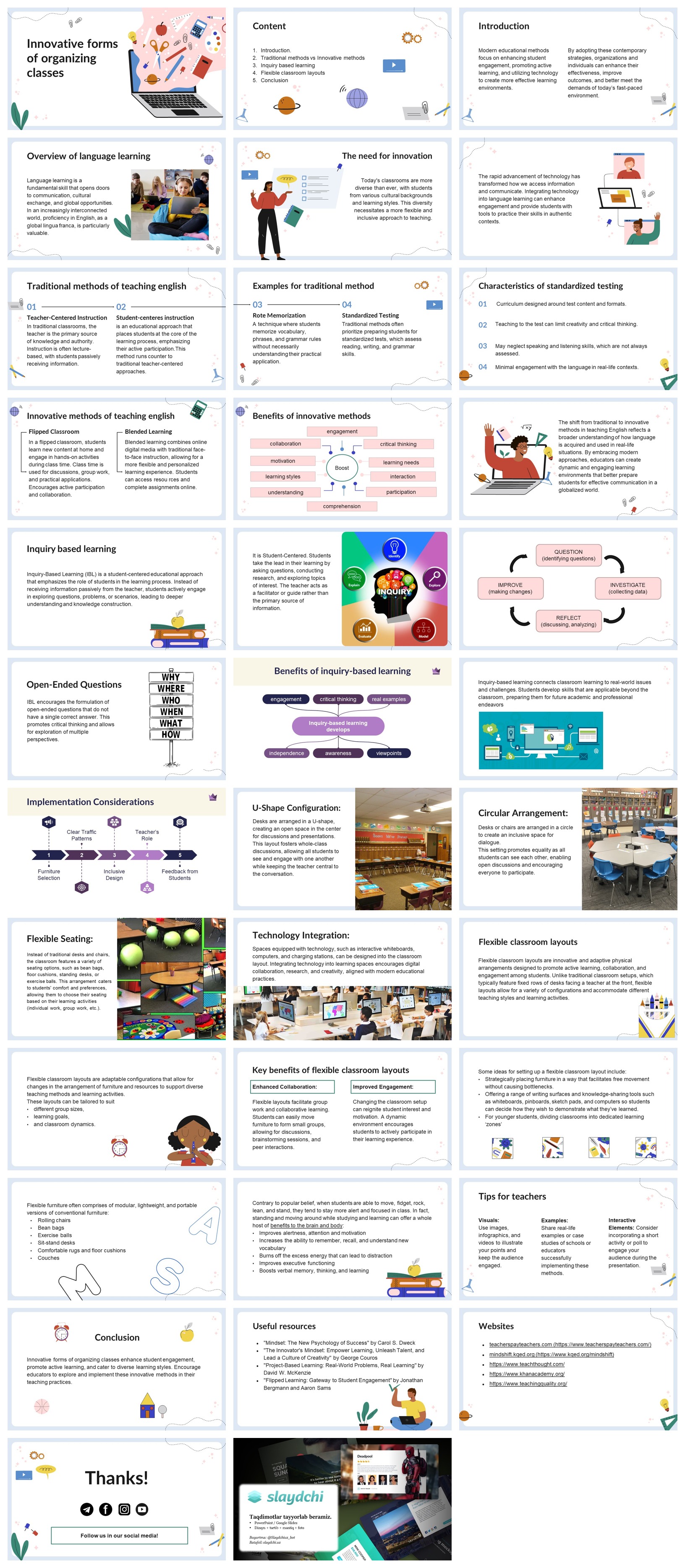
Content
Introduction.
Traditional methods vs Innovative methods
Inquiry based learning
Flexible classroom layouts
Conclusion
Slayd 3
Introduction
Modern educational methods focus on enhancing student engagement, promoting active learning, and utilizing technology to create more effective learning environments.
By adopting these contemporary strategies, organizations and individuals can enhance their effectiveness, improve outcomes, and better meet the demands of today’s fast-paced environment.
Slayd 4
Overview of language learning
Language learning is a fundamental skill that opens doors to communication, cultural exchange, and global opportunities. In an increasingly interconnected world, proficiency in English, as a global lingua franca, is particularly valuable.
Slayd 5
The need for innovation
Today’s classrooms are more diverse than ever, with students from various cultural backgrounds and learning styles. This diversity necessitates a more flexible and inclusive approach to teaching.
Slayd 6
The rapid advancement of technology has transformed how we access information and communicate. Integrating technology into language learning can enhance engagement and provide students with tools to practice their skills in authentic contexts.
Slayd 7
Traditional methods of teaching english
01
Teacher-Centered Instruction
In traditional classrooms, the teacher is the primary source of knowledge and authority. Instruction is often lecture-based, with students passively receiving information.
02
Student-centeres instruction
is an educational approach that places students at the core of the learning process, emphasizing their active participation.This method runs counter to traditional teacher-centered approaches.
Slayd 8
Examples for traditional method
03
Rote Memorization
A technique where students memorize vocabulary, phrases, and grammar rules without necessarily understanding their practical application.
04
Standardized Testing
Traditional methods often prioritize preparing students for standardized tests, which assess reading, writing, and grammar skills.
Slayd 9
Characteristics of standardized testing
01
Curriculum designed around test content and formats.
02
Teaching to the test can limit creativity and critical thinking.
03
May neglect speaking and listening skills, which are not always assessed.
04
Minimal engagement with the language in real-life contexts.
Slayd 10
Innovative methods of teaching english
Flipped Classroom
In a flipped classroom, students learn new content at home and engage in hands-on activities during class time. Class time is used for discussions, group work, and practical applications.
Encourages active participation and collaboration.
Blended Learning
Blended learning combines online digital media with traditional face-to-face instruction, allowing for a more flexible and personalized learning experience. Students can access resou rces and complete assignments online.
Slayd 11
Benefits of innovative methods
collaboration
critical thinking
learning needs
motivation
participation
understanding
learning styles
interaction
engagement
comprehension
Boost
Slayd 12
The shift from traditional to innovative methods in teaching English reflects a broader understanding of how language is acquired and used in real-life situations. By embracing modern approaches, educators can create dynamic and engaging learning environments that better prepare students for effective communication in a globalized world.
Slayd 13
Inquiry based learning
Inquiry-Based Learning (IBL) is a student-centered educational approach that emphasizes the role of students in the learning process. Instead of receiving information passively from the teacher, students actively engage in exploring questions, problems, or scenarios, leading to deeper understanding and knowledge construction.
Slayd 14
It is Student-Centered. Students take the lead in their learning by asking questions, conducting research, and exploring topics of interest. The teacher acts as a facilitator or guide rather than the primary source of information.
Slayd 15
QUESTION
(identifying questions)
INVESTIGATE
(collecting data)
IMPROVE
(making changes)
REFLECT
(discussing, analyzing)
Slayd 16
Open-Ended Questions
IBL encourages the formulation of open-ended questions that do not have a single correct answer. This promotes critical thinking and allows for exploration of multiple perspectives.
Slayd 17
Benefits of inquiry-based learning
Inquiry-based learning develops
viewpoints
independence
awareness
engagement
critical thinking
real examples
Slayd 18
Inquiry-based learning connects classroom learning to real-world issues and challenges. Students develop skills that are applicable beyond the classroom, preparing them for future academic and professional endeavors
Slayd 19
Implementation Considerations
Furniture Selection
1
Clear Traffic Patterns
2
Inclusive
Design
3
Teacher’s
Role
4
Feedback from Students
5
Slayd 20
U-Shape Configuration:
Desks are arranged in a U-shape, creating an open space in the center for discussions and presentations.
This layout fosters whole-class discussions, allowing all students to see and engage with one another while keeping the teacher central to the conversation.
Slayd 21
Circular Arrangement:
Desks or chairs are arranged in a circle to create an inclusive space for dialogue.
This setting promotes equality as all students can see each other, enabling open discussions and encouraging everyone to participate.
Slayd 22
Flexible Seating:
Instead of traditional desks and chairs, the classroom features a variety of seating options, such as bean bags, floor cushions, standing desks, or exercise balls. This arrangement caters to students’ comfort and preferences, allowing them to choose their seating based on their learning activities (individual work, group work, etc.).
Slayd 23
Technology Integration:
Spaces equipped with technology, such as interactive whiteboards, computers, and charging stations, can be designed into the classroom layout. Integrating technology into learning spaces encourages digital collaboration, research, and creativity, aligned with modern educational practices.
Slayd 24
Flexible classroom layouts
Flexible classroom layouts are innovative and adaptive physical arrangements designed to promote active learning, collaboration, and engagement among students. Unlike traditional classroom setups, which typically feature fixed rows of desks facing a teacher at the front, flexible layouts allow for a variety of configurations and accommodate different teaching styles and learning activities.
Slayd 25
Flexible classroom layouts are adaptable configurations that allow for changes in the arrangement of furniture and resources to support diverse teaching methods and learning activities.
These layouts can be tailored to suit
different group sizes,
learning goals,
and classroom dynamics.
Slayd 26
Key benefits of flexible classroom layouts
Changing the classroom setup can reignite student interest and motivation. A dynamic environment encourages students to actively participate in their learning experience.
Improved Engagement:
Enhanced Collaboration:
Flexible layouts facilitate group work and collaborative learning. Students can easily move furniture to form small groups, allowing for discussions, brainstorming sessions, and peer interactions.
Slayd 27
Some ideas for setting up a flexible classroom layout include:
Strategically placing furniture in a way that facilitates free movement without causing bottlenecks.
Offering a range of writing surfaces and knowledge-sharing tools such as whiteboards, pinboards, sketch pads, and computers so students can decide how they wish to demonstrate what they’ve learned.
For younger students, dividing classrooms into dedicated learning ‘zones’
Slayd 28
Flexible furniture often comprises of modular, lightweight, and portable versions of conventional furniture:
Rolling chairs
Bean bags
Exercise balls
Sit-stand desks
Comfortable rugs and floor cushions
Couches
Slayd 29
Contrary to popular belief, when students are able to move, fidget, rock, lean, and stand, they tend to stay more alert and focused in class. In fact, standing and moving around while studying and learning can offer a whole host of benefits to the brain and body:
Improves alertness, attention and motivation
Increases the ability to remember, recall, and understand new vocabulary
Burns off the excess energy that can lead to distraction
Improves executive functioning
Boosts verbal memory, thinking, and learning
Slayd 30
Tips for teachers
Visuals:
Use images, infographics, and videos to illustrate your points and keep the audience engaged.
Examples:
Share real-life examples or case studies of schools or educators successfully implementing these methods.
Interactive Elements: Consider incorporating a short activity or poll to engage your audience during the presentation.
Slayd 31
Conclusion
Innovative forms of organizing classes enhance student engagement, promote active learning, and cater to diverse learning styles. Encourage educators to explore and implement these innovative methods in their teaching practices.
Slayd 32
Useful resources
«Mindset: The New Psychology of Success» by Carol S. Dweck
«The Innovator’s Mindset: Empower Learning, Unleash Talent, and Lead a Culture of Creativity» by George Couros
«Project-Based Learning: Real-World Problems, Real Learning» by David W. McKenzie
«Flipped Learning: Gateway to Student Engagement» by Jonathan Bergmann and Aaron Sams
Slayd 33
Websites
teacherspayteachers.com (https://www.teacherspayteachers.com/)
mindshift.kqed.org (https://www.kqed.org/mindshift)
https://www.khanacademy.org/
https://www.teachingquality.org/
Slayd 34
Thanks!
Por favor, conserva esta diapositiva para atribuirnos
Follow us in our social media!
Slayd 35
Foydali havolalar
🛒 Barcha taqdimotlar | 📰 Yangiliklar | ℹ️ Biz haqimizda
Tegishli mahsulotlar


CANADA mavzusidagi tayyor PPTX taqdimot. Ingliz tili darsi uchun mavzu, misollar va asosiy tushunchalar jamlangan.
- Slaydlar soni: 54 ta
- Fayl formati: PPTX
- Tili: o‘zbek tili
- Kategoriya: Ingliz tili

CASE STUDY METHOD IN TEACHING mavzusidagi tayyor PPTX taqdimot. Ingliz tili darsi uchun mavzu, misollar va asosiy tushunchalar jamlangan.
- Slaydlar soni: 36 ta
- Fayl formati: PPTX
- Tili: o‘zbek tili
- Kategoriya: Ingliz tili

CLASSROOM MANAGEMENT IN WORKING WITH DEFFERENT AGES mavzusidagi tayyor PPTX taqdimot. Ingliz tili darsi uchun mavzu, misollar va asosiy tushunchalar jamlangan.
- Slaydlar soni: 18 ta
- Fayl formati: PPTX
- Tili: o‘zbek tili
- Kategoriya: Ingliz tili


HOW TO IMPROVE STUDENTS’ PRONUNCIATION LET US LOOK THROUGH mavzusidagi tayyor PPTX taqdimot. Ingliz tili darsi uchun mavzu, misollar va asosiy tushunchalar jamlangan.
- Slaydlar soni: 48 ta
- Fayl formati: PPTX
- Tili: o‘zbek tili
- Kategoriya: Ingliz tili

BINOMIAL PAIRS mavzusidagi tayyor PPTX taqdimot. Ingliz tili darsi uchun mavzu, misollar va asosiy tushunchalar jamlangan.
- Slaydlar soni: 24 ta
- Fayl formati: PPTX
- Tili: o‘zbek tili
- Kategoriya: Ingliz tili

DISCUSSION ESSAYS mavzusidagi tayyor PPTX taqdimot. Ingliz tili darsi uchun mavzu, misollar va asosiy tushunchalar jamlangan.
- Slaydlar soni: 19 ta
- Fayl formati: PPTX
- Tili: o‘zbek tili
- Kategoriya: Ingliz tili
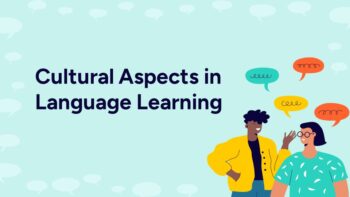
CULTURAL ASPECTS IN LANGUAGE LEARNING mavzusidagi tayyor PPTX taqdimot. Ingliz tili darsi uchun mavzu, misollar va asosiy tushunchalar jamlangan.
- Slaydlar soni: 24 ta
- Fayl formati: PPTX
- Tili: o‘zbek tili
- Kategoriya: Ingliz tili

ALL ABOUT LISTENING SKILLS mavzusidagi tayyor PPTX taqdimot. Ingliz tili darsi uchun mavzu, misollar va asosiy tushunchalar jamlangan.
- Slaydlar soni: 33 ta
- Fayl formati: PPTX
- Tili: o‘zbek tili
- Kategoriya: Ingliz tili

LEXICAL EXPRESSIVE MEANS AND STYLISTIC DEVICES mavzusidagi tayyor PPTX taqdimot. Ingliz tili darsi uchun mavzu, misollar va asosiy tushunchalar jamlangan.
- Slaydlar soni: 25 ta
- Fayl formati: PPTX
- Tili: o‘zbek tili
- Kategoriya: Ingliz tili
WHAT IS LEXICOGRAPHY mavzusidagi tayyor PPTX taqdimot. Ingliz tili darsi uchun mavzu, misollar va asosiy tushunchalar jamlangan.
- Slaydlar soni: 28 ta
- Fayl formati: PPTX
- Tili: o‘zbek tili
- Kategoriya: Ingliz tili

ASSESSMENT CHECK EVALUATE mavzusidagi tayyor PPTX taqdimot. Ingliz tili darsi uchun mavzu, misollar va asosiy tushunchalar jamlangan.
- Slaydlar soni: 22 ta
- Fayl formati: PPTX
- Tili: o‘zbek tili
- Kategoriya: Ingliz tili
MAYTERIALS DEVELOMENT mavzusidagi tayyor PPTX taqdimot. Ingliz tili darsi uchun mavzu, misollar va asosiy tushunchalar jamlangan.
- Slaydlar soni: 40 ta
- Fayl formati: PPTX
- Tili: o‘zbek tili
- Kategoriya: Ingliz tili
Sharhlar
Hali sharhlar mavjud emas.