




Slayd 1
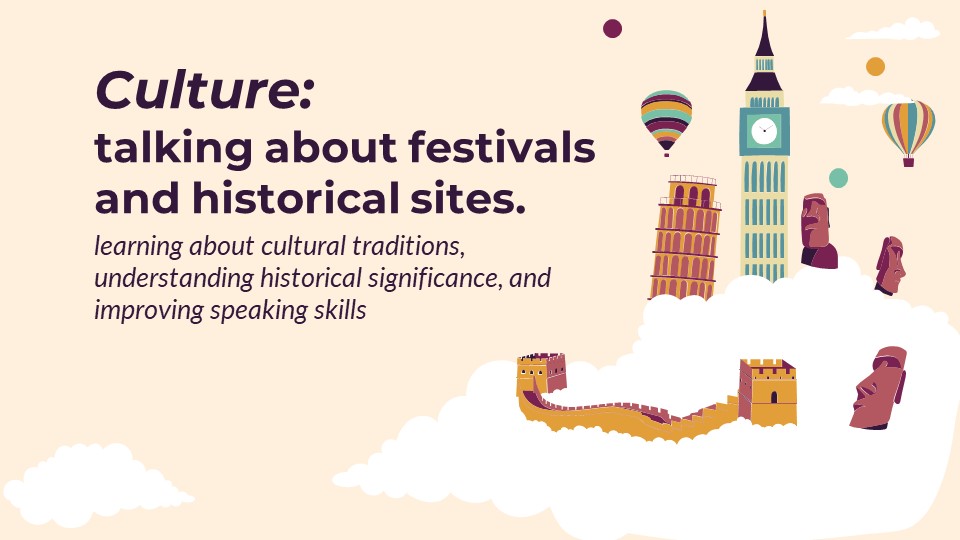
Culture:talking about festivals and historical sites.
learning about cultural traditions, understanding historical significance, and improving speaking skills
Slayd 2
Content of the lesson
Vocabulary
Festivals: origins, cultural significance, how it’s celebrated. Historical sites: when and why they were built, significance in world history.
Interactive Comparison
1. What is it in honour of? 2. How is it celebrated? 3. Do you enjoy? 4. What is your country’s biggest festival?
Slayd 3
Contents:
Speaking activity
Describing landmarks
Useful words and phrases
These can be used in the template, and their size and color can be edited
Wrapping-up (Conclusion)
«How do festivals and historical sites help us understand a country’s culture?»
Slayd 4
improving speaking skills by the help of words and phrases
Historical sites
understanding historical significance
Useful vocabulary
learning about cultural traditions
Festivals and Historical Sites
Culture
Festivals
Table of contents
Slayd 5
WHOA!
“Think about a festival or a historical site you know.”
Slayd 6
Describe them
Try to guess what festivals are they? 👇
Slayd 7
Slayd 8
Slayd 9
The concept of cultural heritage
But which festivals emerge as the biggest celebrations in the world?
The world is filled with different cultures and heritages, and festivals are windows into the soul of a culture, pulsating with vibrant traditions, music, and parties. From ancient rituals to modern extravaganzas, they bring people together in a kaleidoscope of sights, sounds, and shared experiences.
Slayd 10
What is culture?
Culture is a concept that encompasses the social behavior, institutions, and norms found in human societies, as well as the knowledge, beliefs, arts, laws, customs, capabilities, attitude, and habits of the individuals in these groups. Culture is often originated from or attributed to a specific region or location.
Slayd 11
Cultural preservation
Ethics
Rationale
Culture helps shape who we are. It gives us a sense of identity by connecting us to our family, community, and nation.
It gives us a feeling of belonging, whether through traditions, shared values, or common practices
Slayd 12
Festivals
A festival is a special event or celebration that is usually held to mark an important occasion, holiday, or cultural tradition. Festivals are often a time for people to come together and participate in activities such as music, dancing, feasting, and ceremonies.
They can be religious, cultural, or community-based, and they help people celebrate shared values, beliefs, and traditions.
Slayd 13
Types of heritage
The legacy passed down from the past
Something valuable or cherished
Ancient mosques, madrasahs
Cultural property
Intangible culture
Natural heritage
Slayd 14
Key Features of a Festival:
Festivals are joyful events that often involve large gatherings of people.
Common activities include parades, performances, special foods, decorations, and rituals.
Festivals often reflect the culture and traditions of a community, country, or religion.
Many festivals are held every year, passed down through generations.
Celebration
Cultural Significance
Activities
Tradition
Slayd 15
Examples of Festivals:
Religious Festivals: Christmas, Eid, Diwali
Cultural Festivals: Chinese New Year, Thanksgiving, Holi
Community Festivals: Harvest festivals, national days
Slayd 16
Awesome words
Slayd 17
Useful vocabulary
celebrations
anniversary
marks
street parties
national anthem
day off
banners
Slayd 18
A picture more than words
Slayd 19
It’s all too unusual for archeology to make the news but the other day there was a news item about an (1) excavation/exhumation not far from where I live. An archeologist proudly announced that he and his team had found the (2) leftovers/remains of a group of Bronze Age roundhouses. In fact, all they had (3) displayed/unearthed of the buildings themselves were post-holes, but they were clearly chuffed by the discovery. They had also found a large number of (4) ruins/artefacts, and by carbon dating some substance from inside a pot they were able to (5 ) date/time the site to around 2000 (6) Be/AD. Although peeple tend to think of prehistoric man as (7) illiterate/primitive, the archeologist explained that they were more sophisticated than we many imagine.
Slayd 20
Protecting our heritage
In the UK, our heritage is protected with the help of the system of listing buildings. A listed building is one that is considered to have historical significance. It cannot be altered or demolished without permission from the local planning authority. As well as houses, other structures can also be protected, such as bridges and even bunkers.
Slayd 21
UNESCO helps protect the world’s natural and cultural heritage by designating places as UNESCO World Heritage Sites. Such a designation means that the site is considered of great importance to the common heritage of mankind. The sites can sometimes receive funding. Examples of World Heritage Sites are the Pyramids of Giza, Venice and the Statue of Liberty.
Slayd 22
Do you have a similar system in your country?
Slayd 23
Example:
In Uzbekistan, our cultural heritage is protected through a system of historical and architectural site registration. A registered site is one that holds cultural, historical, or architectural importance and cannot be modified, restored, or demolished without approval from the Ministry of Culture. Along with historical buildings, other culturally significant structures can also be protected, including mosques, madrasahs, ancient city walls, and caravanserais. For example, the “Registan Square” in Samarkand is a protected site and cannot undergo changes without proper authorization.
Slayd 24
Activities
04
Easy quizz to answer!
Slayd 25
Statements
True
False
Heritage is the cultural legacy which we receive from the past
Natural heritage only includes biodiversity and landscapes
Intangible cultural heritage consists of non-physical aspects of a culture
True or false
Instructions: Read the statements and indicate whether they are
true or false
Slayd 26
Museology is a discipline of the conservation of tangible culture
Cultural heritage is limited to monuments and collections of objects
Cultural heritage conservation began in the 21st century
Slayd 27
Answer the questions
Using what you have learned, answer the following questions
What is natural heritage?
01
You can tell your answer here…
What is digital cultural heritage?
02
Name five world heritage sites:
03
Slayd 28
THANK YOU FOR YOUR ATTENTION!
Follow us on social networks!
Slayd 29
Foydali havolalar
🛒 Barcha taqdimotlar | 📰 Yangiliklar | ℹ️ Biz haqimizda























Sharhlar
Hali sharhlar mavjud emas.