




Slayd 1
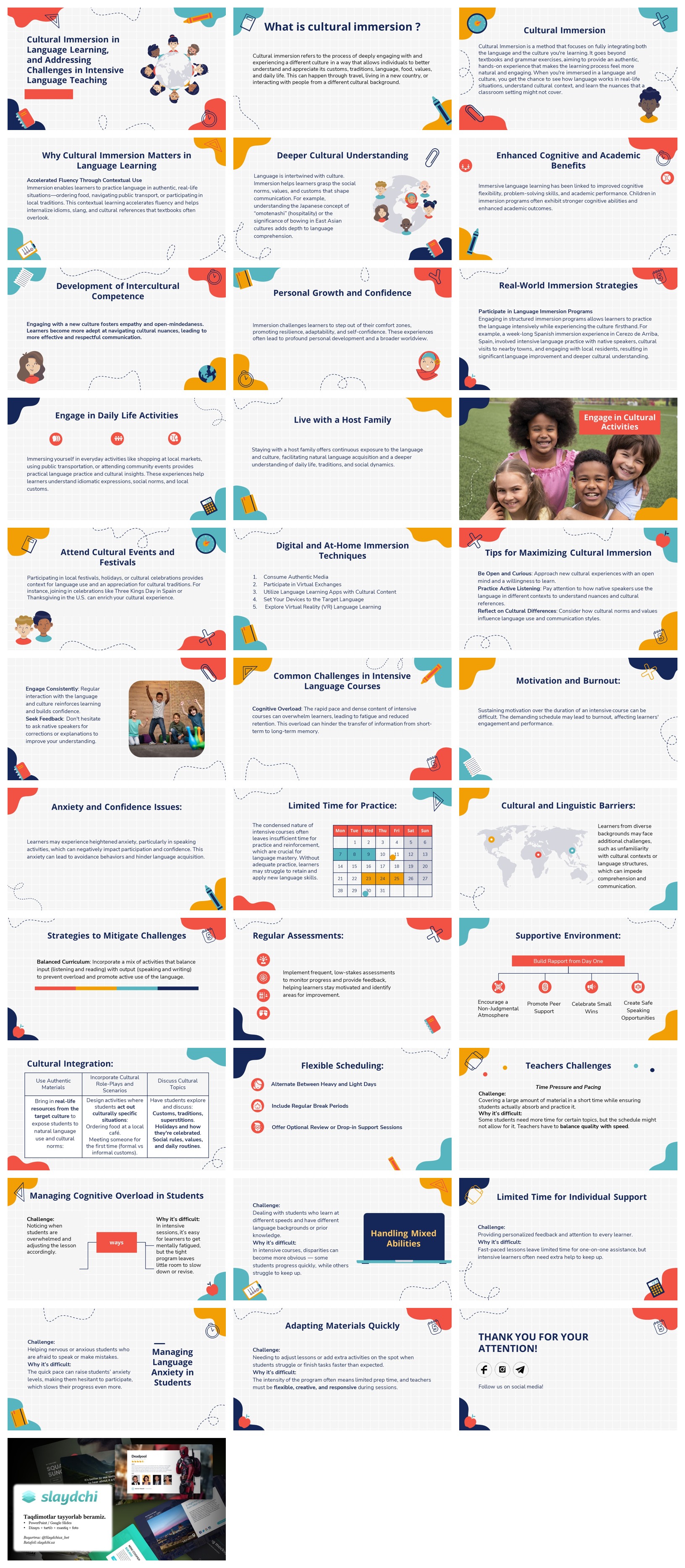
Cultural Immersion in Language Learning, and Addressing Challenges in Intensive Language Teaching
Slayd 2
What is cultural immersion ?
Cultural immersion refers to the process of deeply engaging with and experiencing a different culture in a way that allows individuals to better understand and appreciate its customs, traditions, language, food, values, and daily life. This can happen through travel, living in a new country, or interacting with people from a different cultural background.
Slayd 3
Cultural Immersion
Cultural Immersion is a method that focuses on fully integrating both the language and the culture you’re learning. It goes beyond textbooks and grammar exercises, aiming to provide an authentic, hands-on experience that makes the learning process feel more natural and engaging. When you’re immersed in a language and culture, you get the chance to see how language works in real-life situations, understand cultural context, and learn the nuances that a classroom setting might not cover.
Slayd 4
Why Cultural Immersion Matters in Language Learning
Accelerated Fluency Through Contextual UseImmersion enables learners to practice language in authentic, real-life situations—ordering food, navigating public transport, or participating in local traditions. This contextual learning accelerates fluency and helps internalize idioms, slang, and cultural references that textbooks often overlook.
Slayd 5
Deeper Cultural Understanding
Language is intertwined with culture. Immersion helps learners grasp the social norms, values, and customs that shape communication. For example, understanding the Japanese concept of “omotenashi” (hospitality) or the significance of bowing in East Asian cultures adds depth to language comprehension.
Slayd 6
Enhanced Cognitive and Academic Benefits
Immersive language learning has been linked to improved cognitive flexibility, problem-solving skills, and academic performance. Children in immersion programs often exhibit stronger cognitive abilities and enhanced academic outcomes.
Slayd 7
Development of Intercultural Competence
Engaging with a new culture fosters empathy and open-mindedaness. Learners become more adept at navigating cultural nuances, leading to more effective and respectful communication.
Slayd 8
Personal Growth and Confidence
Immersion challenges learners to step out of their comfort zones, promoting resilience, adaptability, and self-confidence. These experiences often lead to profound personal development and a broader worldview.
Slayd 9
Real-World Immersion Strategies
Participate in Language Immersion ProgramsEngaging in structured immersion programs allows learners to practice the language intensively while experiencing the culture firsthand. For example, a week-long Spanish immersion experience in Cerezo de Arriba, Spain, involved intensive language practice with native speakers, cultural visits to nearby towns, and engaging with local residents, resulting in significant language improvement and deeper cultural understanding.
Slayd 10
Engage in Daily Life Activities
Immersing yourself in everyday activities like shopping at local markets, using public transportation, or attending community events provides practical language practice and cultural insights. These experiences help learners understand idiomatic expressions, social norms, and local customs.
Slayd 11
Live with a Host Family
Staying with a host family offers continuous exposure to the language and culture, facilitating natural language acquisition and a deeper understanding of daily life, traditions, and social dynamics.
Slayd 12
Engage in Cultural Activities
Slayd 13
Participating in local festivals, holidays, or cultural celebrations provides context for language use and an appreciation for cultural traditions. For instance, joining in celebrations like Three Kings Day in Spain or Thanksgiving in the U.S. can enrich your cultural experience.
Attend Cultural Events and Festivals
Slayd 14
Digital and At-Home Immersion Techniques
Consume Authentic Media
Participate in Virtual Exchanges
Utilize Language Learning Apps with Cultural Content
Set Your Devices to the Target Language
Explore Virtual Reality (VR) Language Learning
Slayd 15
Be Open and Curious: Approach new cultural experiences with an open mind and a willingness to learn.
Practice Active Listening: Pay attention to how native speakers use the language in different contexts to understand nuances and cultural references.
Reflect on Cultural Differences: Consider how cultural norms and values influence language use and communication styles.
Tips for Maximizing Cultural Immersion
Slayd 16
Engage Consistently: Regular interaction with the language and culture reinforces learning and builds confidence.
Seek Feedback: Don’t hesitate to ask native speakers for corrections or explanations to improve your understanding.
Slayd 17
Common Challenges in Intensive Language Courses
Cognitive Overload: The rapid pace and dense content of intensive courses can overwhelm learners, leading to fatigue and reduced retention. This overload can hinder the transfer of information from short-term to long-term memory.
Slayd 18
Motivation and Burnout:
Sustaining motivation over the duration of an intensive course can be difficult. The demanding schedule may lead to burnout, affecting learners’ engagement and performance.
Slayd 19
Learners may experience heightened anxiety, particularly in speaking activities, which can negatively impact participation and confidence. This anxiety can lead to avoidance behaviors and hinder language acquisition.
Anxiety and Confidence Issues:
Slayd 20
Limited Time for Practice:
Mon
Tue
Wed
Thu
Fri
Sat
Sun
1
2
3
4
5
6
7
8
9
10
11
12
13
14
15
16
17
18
19
20
21
22
23
24
25
26
27
28
29
30
31
The condensed nature of intensive courses often leaves insufficient time for practice and reinforcement, which are crucial for language mastery. Without adequate practice, learners may struggle to retain and apply new language skills.
Slayd 21
Cultural and Linguistic Barriers:
Learners from diverse backgrounds may face additional challenges, such as unfamiliarity with cultural contexts or language structures, which can impede comprehension and communication.
Slayd 22
Strategies to Mitigate Challenges
Balanced Curriculum: Incorporate a mix of activities that balance input (listening and reading) with output (speaking and writing) to prevent overload and promote active use of the language.
Slayd 23
Regular Assessments:
Implement frequent, low-stakes assessments to monitor progress and provide feedback, helping learners stay motivated and identify areas for improvement.
Slayd 24
Supportive Environment:
Build Rapport from Day One
Promote Peer Support
Encourage a Non-Judgmental Atmosphere
Create Safe Speaking Opportunities
Celebrate Small Wins
Slayd 25
Cultural Integration:
Use Authentic Materials
Incorporate Cultural Role-Plays and Scenarios
Discuss Cultural Topics
Bring in real-life resources from the target culture to expose students to natural language use and cultural norms:
Design activities where students act out culturally specific situations: Ordering food at a local café. Meeting someone for the first time (formal vs informal customs).
Have students explore and discuss: Customs, traditions, superstitions. Holidays and how they’re celebrated. Social rules, values, and daily routines.
Slayd 26
Alternate Between Heavy and Light Days
Include Regular Break Periods
Flexible Scheduling:
Offer Optional Review or Drop-in Support Sessions
Slayd 27
Teachers Challenges
Time Pressure and Pacing
Challenge:Covering a large amount of material in a short time while ensuring students actually absorb and practice it.
Why it’s difficult:Some students need more time for certain topics, but the schedule might not allow for it. Teachers have to balance quality with speed.
Slayd 28
Managing Cognitive Overload in Students
ways
Challenge:Noticing when students are overwhelmed and adjusting the lesson accordingly.
Why it’s difficult:In intensive sessions, it’s easy for learners to get mentally fatigued, but the tight program leaves little room to slow down or revise.
Slayd 29
Handling Mixed Abilities
Challenge:
Dealing with students who learn at
different speeds and have different
language backgrounds or prior
knowledge.
Why it’s difficult:
In intensive courses, disparities can
become more obvious — some students progress quickly, while others struggle to keep up.
Slayd 30
Limited Time for Individual Support
Challenge:
Providing personalized feedback and attention to every learner.
Why it’s difficult:
Fast-paced lessons leave limited time for one-on-one assistance, but intensive learners often need extra help to keep up.
Slayd 31
Managing Language Anxiety in Students
Challenge:
Helping nervous or anxious students who are afraid to speak or make mistakes.
Why it’s difficult:
The quick pace can raise students’ anxiety levels, making them hesitant to participate, which slows their progress even more.
Slayd 32
Adapting Materials Quickly
Challenge:
Needing to adjust lessons or add extra activities on the spot when students struggle or finish tasks faster than expected.
Why it’s difficult:
The intensity of the program often means limited prep time, and teachers must be flexible, creative, and responsive during sessions.
Slayd 33
THANK YOU FOR YOUR ATTENTION!
Follow us on social media!
Slayd 34
Foydali havolalar
🛒 Barcha taqdimotlar | 📰 Yangiliklar | ℹ️ Biz haqimizda

















Sharhlar
Hali sharhlar mavjud emas.