



Slayd 1
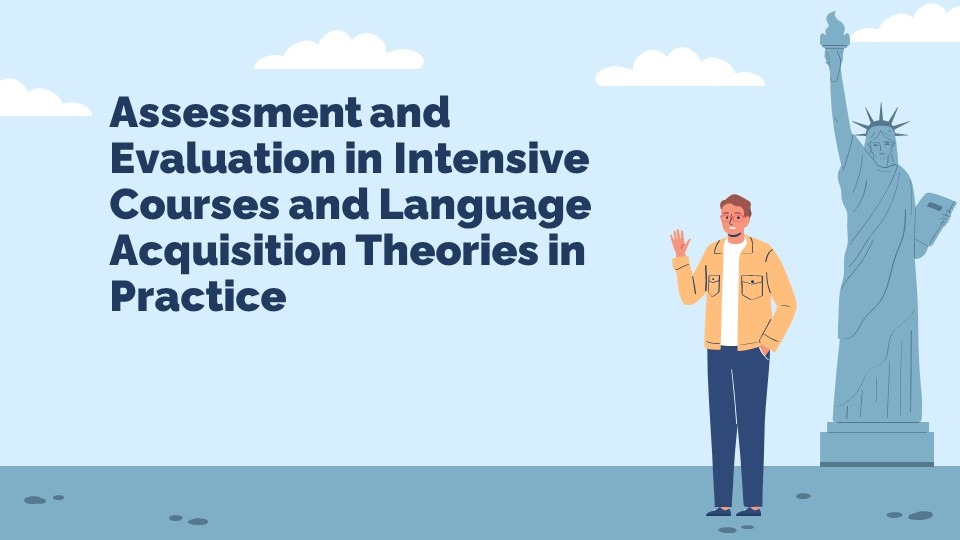
Assessment and Evaluation in Intensive Courses and Language Acquisition Theories in Practice
Slayd 2
Assessment vs. Evaluation — What’s the Difference?
Assessment: The process of collecting information about learners’ knowledge, skills, attitudes, and beliefs — typically for the purpose of improving learning.
Evaluation: The broader judgment of the overall effectiveness of a course, teaching methods, materials, and learning outcomes.
Slayd 3
Aspect
Assessment
Evaluation
Purpose
Monitor and support student learning in real-time
Measure course effectiveness and teaching quality
Timing
Frequent, embedded within short sessions
End of course or module; sometimes mid-course
Challenges
Limited time for in-depth assessments
Fewer data points for long-term outcomes
Slayd 4
Types of Assessment
Formative Assessment
Purpose: To monitor student learning and provide ongoing feedback during the learning process.
Examples:
Quizzes, Class discussions, Draft submissions, Exit tickets
Homework checks
Key Feature: Low-stakes, aimed at identifying areas for improvement.
Slayd 5
Summative Assessment
Purpose: To evaluate student learning at the end of an instructional unit by comparing it against a standard or benchmark.
Examples:
Final exams, End-of-term projects, Standardized tests
Research papers, Performances
Key Feature: High-stakes, used for final grading.
Slayd 6
Diagnostic Assessment
Purpose: To identify students’ existing knowledge, skills, strengths, and weaknesses before instruction begins.
Examples:
Pre-tests, Skills inventories, Placement tests
Surveys about prior knowledge
Key Feature: Helps tailor teaching strategies to student needs.
Slayd 7
Ipsative Assessment
Purpose: To measure a student’s current performance against their previous work.
Examples:
Comparing first and final drafts
Personal learning journals
Skill progress checklists over time
Key Feature: Focused on personal improvement rather than comparison with others.
Slayd 8
Norm-Referenced Assessment
Purpose: To compare a student’s performance against the performance of a larger group.
Examples:
National standardized tests (like SAT, ACT, etc.)
Admission exams
Key Feature: Shows where a student ranks in relation to peers.
Slayd 9
Criterion-Referenced Assessment
Purpose: To measure a student’s performance against a fixed set of criteria or learning standards.
Examples:
Driving tests
End-of-unit tests based on syllabus outcomes
Rubric-based essays
Key Feature: Focused on what a student can do, not how they compare to others.
Slayd 10
Alternative & Authentic Assessments
Assessments that go beyond traditional tests to include real world, practical applications.
Examples:
Portfolios, Role-plays, Case studies, Debates, Multimedia projects
Key Feature: Engages students in meaningful, often hands-on, tasks.
Slayd 11
Types of Evaluation
Placement Evaluation
Purpose: To determine a learner’s current language ability before placing them into an appropriate class or level.
Example: A grammar and speaking test before enrolling in an English course to decide if the learner should join Beginner, Intermediate, or Advanced level.
Slayd 12
Diagnostic Evaluation
Purpose: To identify learners’ specific strengths and weaknesses before instruction starts.
Example: A pre-course writing test to see if students need extra support in grammar or vocabulary.
Achievement Evaluation
Purpose: To measure how well learners have mastered specific language objectives after instruction.
Example: A mid-term test covering specific grammar structures and vocabulary taught in class.
Slayd 13
Proficiency Evaluation
Purpose: To assess a learner’s general ability to use a language, regardless of what course they have taken.
Example: International language tests like IELTS, TOEFL, or Cambridge English exams
Impact (or Washback) Evaluation
Purpose: To assess how testing and evaluation affect teaching and learning practices.
Example: Studying how preparing for a big language exam influences classroom activities and student motivation.
Slayd 14
Key Language Acquisition Theories
Acquisition Theories that explain how people learn languages. These theories help teachers, linguists, and learners understand the processes behind picking up a language, whether it’s a first language (L1) or a second language (L2).
Slayd 15
Behaviorist Theory
B.F. Skinner, a leading behaviorist psychologist, proposed that language learning is a behavior learned through interaction with the environment. He believed that language is not innate but acquired through a system of stimulus, response, and reinforcement — a process known as operant conditioning.
Slayd 16
Imitation
Children learn language by copying the sounds, words, and sentences they hear from adults or others in their environment.
The child repeats what they hear and, over time, forms language habits.
📌 Example: A parent says “Say ‘mama’,” and the baby repeats “mama.”
Habit Formation
Language learning is viewed as the formation of habits.
Repeated exposure to specific language patterns leads to automatic use.
📌 Example: A child consistently hears “Good morning” and eventually uses it habitually in the morning.
Slayd 17
Stimulus-Response Learning
A stimulus in the environment prompts a verbal response from the learner.
Over time, certain verbal behaviors are strengthened through rewards or consequences.
Slayd 18
Reinforcement
When a child uses language correctly or appropriately, they receive positive reinforcement (like praise, a smile, or the desired object).
Incorrect language use might be ignored or corrected (negative reinforcement).
📌 Example: A child says “milk” and is given milk, reinforcing the association between the word and the object.
Slayd 19
Nativist TheoryThe Nativist Theory suggests that humans are biologically programmed to acquire language. According to Noam Chomsky, language learning isn’t just about imitation and reinforcement (as behaviorists believed) — instead, every human is born with a natural ability to learn language.He introduced the idea of a built-in system in our brains called the Language Acquisition Device (LAD) — an innate mental structure that helps us recognize and use the rules of language.
Slayd 20
Language Acquisition Device (LAD)
A hypothetical part of the brain that contains the universal rules of grammar.
It allows children to easily pick up language by being exposed to it.
Helps explain why kids learn language quickly and creatively even with limited input.
📌 Example: A child can form new sentences they’ve never heard before, like “The cat is jumping on the moon.”
Slayd 21
Universal Grammar
Chomsky proposed that all human languages share a common structural basis (universal grammar).
Children don’t need to learn grammar rules from scratch — their minds are already equipped with a framework to understand language structures.
📌 Example: All languages have ways to ask questions, use negation, and express actions — even though the specific words and sounds differ.
Slayd 22
Poverty of the Stimulus
Chomsky argued that the language children hear around them is often incomplete, ungrammatical, or unclear — yet they still manage to learn it flawlessly.
This suggests that some aspects of language are innate and not entirely learned from the environment.
Slayd 23
Social Interactionist Theory
The Social Interactionist Theory proposes that language is acquired through social interaction. According to Lev Vygotsky, children learn language by interacting with more knowledgeable people (like parents, teachers, or peers) in their environment. Vygotsky believed that language development happens because of communication and social experiences, not just because of innate ability or habit formation.
Slayd 24
Importance of Social ContextLanguage development happens naturally during social routines like playing, storytelling, and conversations.Interactions with caregivers, peers, and others help children learn new words, grammar, and communication skills.📌 Example: A child learns how to greet people by watching and practicing greetings in daily life.
Slayd 25
The gap between what a learner can do alone and what they can do with help from a more skilled partner.
Language is learned best when children are supported just beyond their current ability.
📌 Example: A child may not be able to describe a story on their own but can do it with help from a parent guiding them.
Zone of Proximal Development (ZPD)
Slayd 26
Cognitive Theory (Jean Piaget)
Jean Piaget’s Cognitive Theory suggests that language development is closely linked to a child’s overall cognitive development. In other words, a child must first develop certain mental abilities and understand concepts before they can learn and use language to express those ideas.
Piaget believed that thinking (cognition) comes before language. Language is a tool children use to express what they already know through mental development.
Slayd 27
Loan example and meaning
Stage
Age Range
Key Features
Sensorimotor
0-2
Learning through senses and actions
Preoperational
2-7
Use of symbols (like words), egocentric thinking
Concrete Operational
7-11
Logical thinking about concrete objects
Formal Operational
7+
Abstract, logical, and hypothetical thinking
Slayd 28
Conceptual Understanding Before Language
Language develops after children understand certain concepts.
For example, a child won’t use words like «bigger» or «smaller» until they grasp the idea of comparison.
📌 Example: A child learns the word “under” after understanding spatial relationships.
Slayd 29
Krashen’s theory explains how people acquire a second language (L2). He believed that language learning happens best in natural, meaningful, and low-stress situations. Instead of focusing on grammar rules and memorization, language acquisition occurs when learners are exposed to comprehensible input — language they can mostly understand but is slightly beyond their current level.
Slayd 30
Acquisition-Learning Hypothesis
Differentiates between:
Acquisition: Subconscious, natural language development (like how children learn their first language).
Learning: Conscious knowledge about a language (like grammar rules in a classroom).
Acquisition is more important for fluency than formal learning.
📌 Example: A person picks up expressions naturally by watching movies vs. studying verb tenses in a textbook.
Slayd 31
Monitor Hypothesis
Learned knowledge acts as a monitor or editor to correct or plan language use.
Only works when the speaker:
Knows the rule.
Has time to think.
Focuses on correctness.
Fluency relies more on acquired language than conscious correction.
📌 Example: A student corrects themselves mid-sentence by recalling a grammar rule.
Slayd 32
Natural Order Hypothesis
Language structures are acquired in a predictable order, no matter how they’re taught.
Some grammar points are naturally acquired earlier, others later.
📌 Example: Learners often acquire present continuous tense before third-person singular -s.
Slayd 33
Input Hypothesis
Language develops when learners are exposed to comprehensible input that is just a little beyond their current level, called i+1.
The “i” is what they already know, and “+1” is the next step up.
Focus is on understanding messages, not memorizing rules.
Slayd 34
Affective Filter Hypothesis
Emotional factors like motivation, confidence, and anxiety affect language acquisition.
A high affective filter (stress or fear) blocks input.
A low affective filter (relaxed, motivated, comfortable environment) allows learning to happen more naturally.
Slayd 35
THANK YOU FOR YOUR ATTENTION!
Follow us on social media!
Slayd 36
Foydali havolalar
🛒 Barcha taqdimotlar | 📰 Yangiliklar | ℹ️ Biz haqimizda


















Sharhlar
Hali sharhlar mavjud emas.