



=== Taqdimot: Types of assessment in different age groups.pptx ===
=== Slayd 1 ===
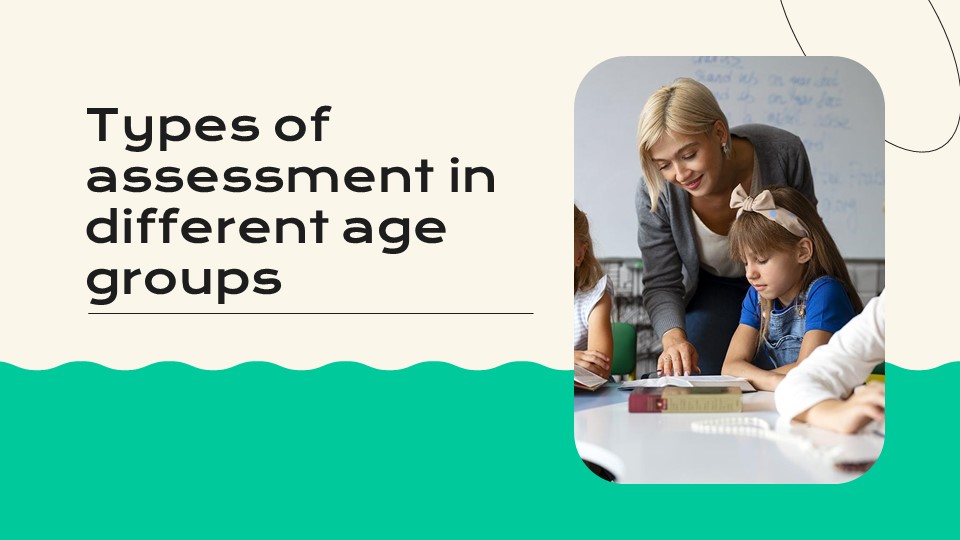
Types of assessment in different age groups
=== Slayd 2 ===
Assessment is the process of documenting in measurable terms, knowledge, skills, attitudes and beliefs. Assessment data can be obtained from directly examining student work to assess the achievement of learning outcomes or can be based on data from which one can make inferences about learning. The term assessment is generally used to refer to all activities of the learners. It can focus on the individual learner and also on the learning community (class, workshop or other organized group of learners). The word ‘assessment’ came into use in an educational context after the Second World War.
Assessment in education is an action to determine the importance, size, or value of gained knowledge and speech skills and subskills. The final purpose of assessment practiced in education depends on the theoretical framework of the practitioners and researchers, their assumptions and beliefs about the nature of human mind, the origin of knowledge and the process of learning.
=== Slayd 3 ===
Assessment is the process of documenting in measurable terms, knowledge, skills, attitudes and beliefs. Assessment data can be obtained from directly examining student work to assess the achievement of learning outcomes or can be based on data from which one can make inferences about learning. The term assessment is generally used to refer to all activities of the learners. It can focus on the individual learner and also on the learning community (class, workshop or other organized group of learners). The word ‘assessment’ came into use in an educational context after the Second World War.
Assessment in education is an action to determine the importance, size, or value of gained knowledge and speech skills and subskills. The final purpose of assessment practiced in education depends on the theoretical framework of the practitioners and researchers, their assumptions and beliefs about the nature of human mind, the origin of knowledge and the process of learning.
=== Slayd 4 ===
Assessment brings benefit to both the teachers and learners. By controlling the process of teaching, learners’ knowledge, skills and subskills a teacher is able to work out new, more effective ways, methods of teaching a foreign language.
Assessment helps the teacher to prove his ideas, methods on organizing teaching to foreign languages. It is beneficial for learners too. Feeling their success in learning a foreign language motivates the learners and inspires them for new activities. It should be stressed that learners have different motivation. Some of them (we mean pupils) are eager to get good grades in all school subjects including a foreign language and the others learn foreign languages with the hope to find a good job in future.
=== Slayd 5 ===
The characteristic feature of assessment in school education is that unlike the other school subjects in controlling teaching a foreign language the main attention is focused on assessing the degrees of oral speech skills and also reading and writing skills. In teaching a foreign language assessment includes the following types of controlling speech skills and subskills:
Continuous assessment is everyday assessment. Teacher evaluates it at every lesson and it is one of the effective means of teaching and assessing. It positively influences on the learners and makes them to revise the learned material. Continuous assessment can help students learn in the following ways:
1. Continuous assessment can provide early indications of the performance of students.
2. An increased sense of inclusiveness: Continuous assessment provides students with a constant stream of opportunities to prove their mastery of material and sends the message that everyone can succeed if given enough time and practice. This reduces the anxiety around testing and heightens the emphasis on the learning itself.
=== Slayd 6 ===
3. Higher learning standards for all: In a system of continuous assessment, advanced students can progress through material at their own pace and remain engaged by pursuing more challenging work as they master the basics.
Continuous assessment will often include some form of formative assessment. The formative assessment covers the range of informal diagnostic tests a teacher can use to assist the process of learning by their students. This may include activities such as weekly pop quizzes or preparatory assignments.
Thematic assessment. This type of assessment aimed to control the gained knowledge, formed speech skills on the learned theme. It is carried out after completing the work on studying the theme. The time given to assessment depends on the size and complexity of the teaching material.
Periodic assessment. Periodic assessment aimed to evaluate the learners’ knowledge, speech skills and subskills after some period of time. For example after each quarter or a month within a school year. The materials for assessment are prepared by the teacher.
=== Slayd 7 ===
Total assessment is carried out at the end of a school year in the form of an examination. It may have oral and written forms. This type of assessment is aimed to evaluate the learner’s knowledge, speech skills and subskills.
Assessment is often divided for the sake of convenience into the following types:
– Initial;
– formative and summative;
– Objective and subjective;
=== Slayd 8 ===
Initial assessment refers to as pre — assessment or diagnostic assessment. It is conducted prior to instruction to establish a baseline from which individual learner’s progress can be measured.
Formative assessment is carried out throughout a course or project. This type of assessment also refers to as “educative assessment” and is used to aid learning. It should be stressed that formative assessment would not necessary be used for grading purposes. Formative assessment can take the form of diagnostic, standardized tests. Formative assessment techniques monitor student learning during the learning process. Prescriptive but ungraded feedback, Instructional Research and Curriculum Evaluation, likens formative assessment to a cook tasting a soup before serving it to a guest. Despite its advantages, formative assessment can be time-consuming, and incentives in education systems tend to favor more objective assessmentsAn advantage of formative assessment for learning is that it is ongoing.
=== Slayd 9 ===
This allows for incremental feedback to identify problems at their earliest stages. For example, a student can correct conceptual errors before undertaking work on a term paper. As a student works on a topic, input from the teacher can inform, guide, and validate each step of the process. Cheating and plagiarism remain significant problems in academic settings. Compared to graded summative assessments like final exams, ungraded formative assessments reduce the temptation to cheat. This allows students to focus on learning instead of grades.
Summative assessment is generally carried out at the end of course or project is typically used to assign a course grade of learners. It evaluates student learning. The difference between the formative and summative assessment can be explained with the following analogy: When teacher prepares test tasks that’s formative. And when the learners have these tasks (or tests) that’s summative.
=== Slayd 10 ===
The goal of summative assessment is to evaluate student learning at the end of an instructional unit by comparing it against a standard or benchmark. Summative assessments may be distributed throughout a course or often after a particular unit (or collection of topics) . Summative assessment usually involves students receiving a grade that indicates their level of performance. Grading systems can include a percentage, pass/fail, or some other form of scale grade. Summative assessments are weighted more than formative assessments.
=== Slayd 11 ===
Summative assessments are often high stakes, which means that they have a high point value. Examples of summative assessments include: a midterm exam, a final project, a paper, a senior recital, or another format.
Summative assessment is used as an evaluation technique in instructional design. It can provide information on the efficacy of an educational unit of study. Summative evaluation judges the worth, or value, of an educational unit of study at its conclusion. Summative assessments also serve the purpose of evaluating student learning. In schools, these assessments can be in a variety of formats: traditional written tests, essays, presentations, discussions, or reports using other formats.[3] There are several factors for designers of summative assessments to take into account. A summative assessment must have validity. That is, it must evaluate the standards or learning objectives that were taught over the course of the unit. Second, a summative assessment must be reliable: the results of the assessment should be consistent. In other words, the assessment should be designed to be as objective as possible, though this can be challenging in certain disciplines.[4]
=== Slayd 12 ===
Summative assessments are usually given at the end of a unit, and they are usually high stakes with the grade being weighted more heavily than formative assessments taken during the unit. Many educators and school administrators use data from summative assessments to help identify learning gaps. This information can come from both summative assessments taken in the classroom or from district-wide, school-wide or statewide standardized tests.[5] Once educators and administrators have student summative assessment data, many districts place students into educational interventions or enrichment programs. Intervention programs are designed to teach students skills in which they are not yet proficient in order to help them make progress and lessen learning gaps. Enrichment programs are designed to challenge students who have mastered many skills and have high summative assessment scores
=== Slayd 13 ===
A common form of formative assessment is diagnostic assessment, it measures a student’s current knowledge. And skill for the purpose of identifying a suitable program of learning. (1, p.76)
Self — assessment is a form of diagnostic assessment. It involves the learners to assess themselves. In social psychology, self-assessment is the process of looking at oneself in order to assess aspects that are important to one’s identity. It is one of the motives that drive self-evaluation, along with self-verification and self-enhancement.
=== Slayd 14 ===
Sedikides (1993) suggests that the self-assessment motive will prompt people to seek information to confirm their uncertain self-concept rather than their certain self-concept and at the same time people use self-assessment to enhance their certainty of their own self-knowledge.[1][2] However, the self-assessment motive could be seen as quite different from the other two self-evaluation motives. Unlike the other two motives, through self-assessment people are interested in the accuracy of their current self view, rather than improving their self-view. This makes self-assessment the only self-evaluative motive that may cause a person’s self-esteem to be damaged.
Assessment is often categorized as either objective or subjective.
Objective assessment is a form of questioning which has a single correct answer. And Subjective assessment is a form of questioning which may have more than one correct answer or more than one way of expressing the correct answer. (2, p. 35)
=== Slayd 15 ===
An Informal assessment may include observation, inventories, checklists, rating skills, performance or portfolio assessments, participation, peer and self — evaluation and discussion. This type of assessment does not contribute to a student’s final grade. Informal assessment involves observing the learners as they learn and evaluating them from the data gathered. It can be compared to formal assessment, which involves evaluating a learner’s level of language in a formal way, such as through an exam or structured continuous assessment.
Assessment can also be divided into internal and external.
Internal assessment is set by the teachers. Students get the mark and feedback regarding the assessment. In this process, schools and teachers judge the student’s performance based on their understanding of the course curriculum. This process of evaluating students does not require the involvement of any person outside the institute.
=== Slayd 16 ===
External assessment is set by the governing body and is marked by non — based personal. For example entering tests for high school can be included into such tests i.e such assessment. It is also a kind of process and method of assessment developed and used by an examination body or agency other than the learner’s school. This process commonly involves standardized testing, and often serves to grade candidates for further educational opportunities and/or for certification purposes.
=== Slayd 17 ===
THANK YOU FOR YOUR ATTENTION!
Follow us on social networks!
Slaydchi.uz — tarix, metodika va fan taqdimotlari uchun vizual platforma.
Boshqa darslar uchun: slaydchi.uz




















Sharhlar
Hali sharhlar mavjud emas.