


=== Taqdimot: The life and work of Franz Kafka.pptx ===
=== Slayd 1 ===
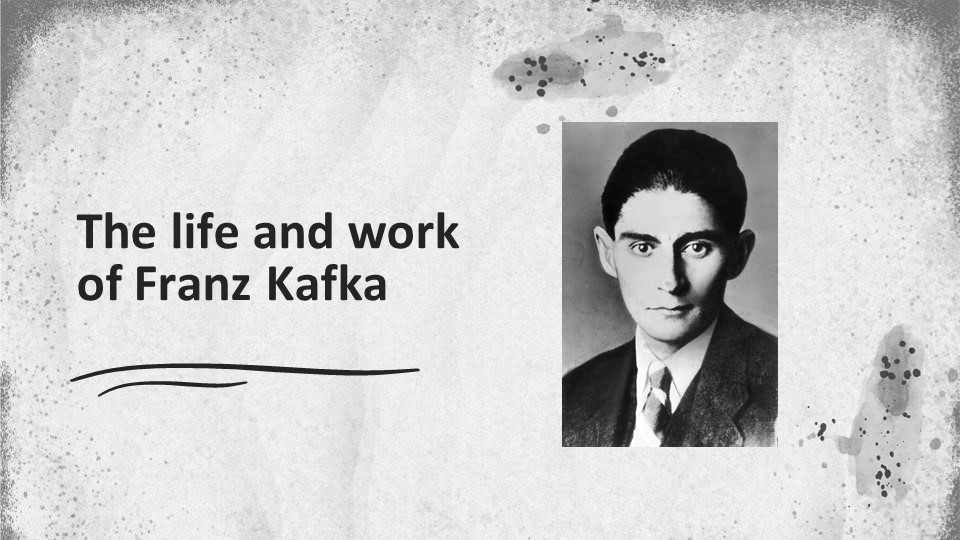
The life and work of Franz Kafka
=== Slayd 2 ===
Franz Kafka was born in Prague, 13th July 1883, into a family of German Jews. The family was of German culture but as they belonged to the Ghetto, they were excluded from relationships with the German minority in Prague. Franz Kafka’s father ruled the family with great Authority. “Faced with intolerance and the tyranny of my parents, I live with my family more as a stranger than a foreigner” he writes, and, in fact, he was doubly aware of feeling a foreigner, within his family and in his own City. In 1901, after having attended the Chemistry Course for two weeks and that of Germanic studies for six months, he decided to transfer to the Faculty of Law, considered to be less exacting, and which allowed him to find a job and to start his writing. He gained his degree at the German University, in Prague, on 18th June, l906. It was at about that time that the early signs of lung tuberculosis became apparent which eventually led to his early death at just 41 years old.
=== Slayd 3 ===
Two years after gaining his degree, he was offered a contract with Arbeiter-Unfall Versicherungs Anstalt (Institute of Insurance for Accidents at Work, at the Prague Office of “Assicurazioni di Trieste”) which allowed him to be free in the afternoon and to dedicate his time to writing. Unfortunately, due to fatigue, he had to rest and, therefore, he did most of his intellectual work at night. He began to suffer from insomnia and became intolerant to noise. Changes occurred in his clinical picture, with onset of furuncolosis, asthenia, constipation as well as neuro-vegetative disorders. He turned to “crude-vegetarian” treatment. In 1912, he wrote to his friend Max Brod telling him that he had come very close to suicide.
=== Slayd 4 ===
In 1909 and 1913, he spent some time in Riva del Garda in a Clinic which was well known for the treatment of neuro-asthenia, assimilation disorders, as well as heart and lung diseases. A few years later, his nerves had gone completely to pieces, he suffered from severe and frequent headaches and lived in a state of deep depression, with a tendency to self destruction. On August 9th l917, tuberculosis was clearly evident, becoming manifest with haemoptysis. He spoke of the onset as follows: “It was about 4 o’clock in the morning. I woke up and was surprised by the strange amount of saliva in my mouth, I spat it out then decided to turn on the light. That is how it began. Crleni, I don’t know if that is how it’s written, but it is a suitable expression for this clearing of the throat. I thought it was never going to finish. How was I going to stop this fountain if I had never started it (…) This, then is the situation of this spiritual disease, tuberculosis”
=== Slayd 5 ===
Franz Kafka
Five years earlier, he had met Felice Bauer with whom he corresponded frequently (these were the years of “Metamorphosis” and “The Trial”. In 1919, he meets Julie Wohryzeck, but leaves her after only a few months when he meets Milena Jesenska. His love-life is a reflection of his insecurity, of his state of mind; he dreads losing his freedom, but is afraid, at the same time, of being left on his own.
=== Slayd 6 ===
The tuberculosis becomes more severe and he is then hospitalised in Merano where the fever becomes not only continuous, but also increases, and his cough, dry and annoying. It was in Merano that he began to correspond with Milena Jesenska who was to become a precious source of information regarding his state of physical and mental health. There were now clear signs of “the self-destructive mania, the need to torment and humiliate himself, the sense of personal emptiness and helplessness”. In 1920, he went into a Sanatorium in the mountains. He was suffering so much that he asked Dr. Klopstock to give him a fatal dose of opium: “kill me or else you are a murderer”. But, fortunately he recovered and returned to Prague. Here he meets Dora Dyamant (16th June, 1923) and goes to live with her in Berlin.
=== Slayd 7 ===
In February 1924, his state of health deteriorated and he was taken to the Clinic of Prof. Hajek in Vienna; the tuberculosis had invaded the larynx so he was transferred to the small Sanatorium in Kierling where Prof. Hofmann proceeded with alcoholisation of the superior laryngeal nerve.
Due to the lack of any aetiological treatment for the Koch bacteria, the only possibility, at that time, was palliative treatment. As far as concerns the specific localisations in the larynx, responsible not only for violent crises of coughing, resembling whooping-cough, but also intense pain due to involvement of the arytenoids, making it difficult both to eat and to sleep, it was decided to proceed with cervical infiltrations of the superior laryngeal nerve with a solution of 1% cocaine, plus alcohol (60-80%) and possibly 1% Stovaine. The infiltrations had a beneficial effect on the symptoms, but had to be repeated every 8-10 days. The patient’s general conditions, however, were so poor that after a few months – 3rd June 1924 – Kafka died.
=== Slayd 8 ===
Franz Kafka is a complex, even absurd, Author, difficult to understand unless you are prepared to penetrate the meanders of his personality. Some elements come to light as possible clues of his work. First of all, he is the son of Jews, long since part of the Germanic ambient, thus partly detached from their original traditions, yet not accepted for the very fact that they are Jews.
=== Slayd 9 ===
Then, another aspect having a strong influence on the development of young Kafka’s character is the relationship with his family, with a domineering father which would certainly not have contributed favourably to the correct development of a delicate personality. A third factor concerns the onset of psychological disorders which blossom into neurosis, complicated by psychosomatic disorders, associated with an organic disease, tuberculosis of the lungs. Any approach to his works cannot disregard the psychological factors. Kafka is a connoisseur of Freud’s work and he too practices analysis, recalling episodes of his childhood, reconstructing the relationship with his parents, especially his father.
=== Slayd 10 ===
The physical disease does not come into his works whilst the mental disorders are well represented, often by the principal male characters, most of which autobiographical. In fact, the leading figures in Das Schloss, Der Prozess or Amerika, are gloomily alone, affected by a sense of guilt which crushes them completely and condemns them to a desolate existence, on the outskirts of society, just like their Creator. Like Him, they share an important characteristic: uncertainty. They are unable to choose, they are condemned to a non-life. Kafka himself in his diaries refers to himself as a non-born, condemned to die, without having lived. His physical illness, on the other hand, is not represented in his works, tuberculosis is never mentioned, even if, reading between the lines, several characters resemble figures condemned to death, but carry on completely ignorant of their fate, sick people who continue on their way, not caring and incurable.
=== Slayd 11 ===
Another very important topic, on a par with the disease, is Hebraism which is never explicitly mentioned in any of his works, but which, again reading between the lines, is constantly referred to.
=== Slayd 12 ===
The key figures in his stories are healthy men, who, however, are weakened by their mental state as, for example, the land-surveyor K. In The Castle: at the very moment when the high government official Brugel can miraculously help him, he is so deprived of energy that he drops fast asleep. The topic of insomnia and the impossibility of being able to sleep is constantly found in his writings. The Kafka characters, like their Author, are never at peace, not even in everyday and the simplest of activities, such as eating and sleeping.
=== Slayd 13 ===
As far as concerns the fact that, in the works of Kafka, no direct mention is made of the disease, it should be pointed out that sometimes the problem of the body as a foreign element, in itself, emerges, as for instance in Metamorphosis, in which the leading character is transformed into a horrendous insect. In other stories, gross figures appear which are enormous in size, like, for example, the father in The Sentence or the singer Brunelda, or vice versa, the thin and tiny people, like the fasting artist, the second self of Kafka who dies of starvation.
The entire work is the translation of the sense of estrangement of Kafka, with respect to the outside world, of his desire and, at the same time, the impossibility to live everyday reality like anybody else, to partake of the enjoyment of affection and the opportunities that life offers. He lives this state of uneasiness, as if guilty, convinced that he is the cause. He escapes, therefore, into his own world, that of literature, living a condition as if alienated by society.
=== Slayd 14 ===
As far as concerns the tuberculosis, this was considered as positive, something that created situations allowing him to live an existence in which he feels at ease. It was not the physical disorder that was advanced and severe, but rather the mental disease that, in order not to overcome the individual with the force of torment, found a way of escape in the physical disorder.
Kafka writes to Milena: “There – the brain no longer tolerated the worries and the pain inflicted upon it. He said: I can suffer this no longer; but, if there is still someone who is interested in preserving everything, may he relieve me of some of the weight, and it will be possible to still live for a little while. Then the lungs came forth, that – anyway – had nothing to lose. This negotiation between the brain and the lungs, which, not to my knowledge, was going on, must have been frightening”.
=== Slayd 15 ===
And he writes again to Milena: “I am mentally handicapped, the lung disease is none other than an overflow of the mental disease”. Kafka goes as far as defining the lung tuberculosis, from which he is suffering, as spiritual disease 1. Regarding the way in which Kafka interprets the relationship between his physical disease and the mental disease, according to the psychoanalysts, this is an ambiguity which is part of poetic licence. Kafka, like Freud, sees the disease from a psychoanalytical viewpoint, with the only difference that Freud, in his analysis, made use of instruments of a scientific nature, whilst Kafka uses instruments only of a poetic kind. Kafka is not just an ordinary person, he is different, he lives in a state of anxious solitude, foreign to everyone, he is not “at home” in his own city, nor with his own people, nor within his family, nor will he ever find a woman with whom to share his life. This difference is expressed in the form of a mental disorder.
=== Slayd 16 ===
He, therefore, anxiously awaits, and positively accepts, the physical illness, which releases some of the interior suffering onto the body and which underlines his being different, his uniqueness. According to Kafka, someone who is different and a lone wolf cannot be healthy, it has to show also in the body.
As already mentioned, Kafka first had the idea of suicide in 1912. Even though he was continuously dissatisfied with himself and his life, due to a constant sense of fault, he would not appear to have seriously contemplated suicide (i.e., a rapid and sudden end to life). The only time he seriously considered this choice was after having quarrelled with his family, when his dearly loved sister Ottla (the only person really able to communicate with him and to peep a little into his soul) took the side of his parents against him.
=== Slayd 17 ===
Moreover, throughout his life, the delusions he endured had always been calculated and expected, resulting from his constant state of indecision; they were part of the prolonged and daily sufferance of Kafka, they were not extraordinary and sudden, as in the case of the quarrel with his sister. Within the context of daily suffering, another form of suicide, less obvious, but no less terrible, surrounds Kafka: the long illness which takes the form of a long and accepted suicide. Kafka, burdened as he is with a sense of guilt, cannot put a sudden end to his life, he has to make amends before he dies. As a result, he no longer adheres to his treatment, he refuses food, at least he eats very little and in a disorganized fashion. In much the same way, he has difficulty in accepting his own body which he often regards as something not belonging to him, that interferes with his problems and his weariness, distracting him from his literary activities.
=== Slayd 18 ===
We know from his letters of his fears, not only towards other people’s bodies but, in particular, sexual relationships with women. The topics death-suffering-amendments were admirably dealt with in one of his most horrific stories: In the Penal Colony. Those condemned to death were submitted to prolonged torture, their skin is cut into with a harrow, the incisions, initially, not being easily deciphered, but with time, they become visible to their eyes, together with the suffering flesh.
=== Slayd 19 ===
Now, in agony, they manage to decipher them: it is the explanation of the guilt, which makes them die with the suffering, “intelligence emerges even in the most slow-witted. It begins to spread from the eyes. The sight would be enough to make anyone lie down alongside the condemned person under the harrow”. Perhaps, this is what Kafka hopes to achieve, with his slow and painful suicide: that the truth will emerge, that he will be able to understand the meaning of his life and of his suffering. But this will certainly not happen in the painful agony, as for the commander in the story cited above, he will perish under the harrow and in his eyes “there was no sign of the promised transfiguration”.
=== Slayd 20 ===
Works of Franz Kafka
Kafka published a few of his writings during his lifetime. These publications include two sections (1909) from Beschreibung eines Kampfes (1936; Description of a Struggle) and Betrachtung (1913; Meditation), a collection of short prose pieces. They also include other works representative of Kafka’s maturity as an artist: The Judgment, written in 1912 and published a year later; two other long stories, The Metamorphosis (published in 1915) and In der Strafkolonie (1919; In the Penal Colony); and a collection of short prose, Ein Landarzt (1919; A Country Doctor). Ein Hungerkünstler (1924; A Hunger Artist), four stories exhibiting the concision and lucidity characteristic of Kafka’s late style, had been prepared by the author but did not appear until after his death.
=== Slayd 21 ===
In fact, misgivings about his work caused Kafka before his death to request that all of his unpublished manuscripts be destroyed; Brod, as his literary executor, disregarded his instructions and published the novels The Trial, The Castle, and Amerika in 1925, 1926, and 1927, respectively, and a collection of shorter pieces, Beim Bau der chinesischen Mauer (The Great Wall of China), in 1931. Such early works by Kafka as Description of a Struggle (begun about 1904) and Meditation, though their style is more concretely imaged and their structure more incoherent than that of the later works, are already original in a characteristic way. The characters in these works fail to establish communication with others, they follow a hidden logic that flouts normal everyday logic, and their world erupts in grotesque incidents and violence. Each character is only an anguished voice, vainly questing for information and understanding of the world and for a way to believe in his own identity and purpose.
=== Slayd 22 ===
Many of Kafka’s fables contain an inscrutable, baffling mixture of the normal and the fantastic, though occasionally the strangeness may be understood as the outcome of a literary or verbal device, as when the delusions of a pathological state are given the status of reality or when the metaphor of a common figure of speech is taken literally. Thus, in The Judgment a son unquestioningly commits suicide at the behest of his aged father. In The Metamorphosis the son, Gregor Samsa, wakes up to find himself transformed into a monstrous and repulsive insect; he slowly dies, not only because of his family’s shame and its neglect of him but because of his own guilty despair. Many of the tales are even more unfathomable. In the Penal Colony presents an officer who demonstrates his devotion to duty by submitting himself to the appalling (and clinically described) mutilations of his own instrument of torture. This theme, the ambiguity of a task’s value and the horror of devotion to it—one of Kafka’s constant preoccupations—appears again in A Hunger Artist.
=== Slayd 23 ===
The fable Vor dem Gesetz (1914; Before the Law, later incorporated into The Trial) presents both the inaccessibility of meaning (the “law”) and humankind’s tenacious longing for it. A group of fables written in 1923–24, the last year of Kafka’s life, all centre on the individual’s vain but undaunted struggle for understanding and security. Many of the motifs in the short fables recur in the novels. In the unfinished Amerika, for example, the boy Karl Rossmann has been sent by his family to America. There he seeks shelter with a number of father figures. His innocence and simplicity are everywhere exploited, and a last chapter describes his admission to a dreamworld, the “nature-theatre of Oklahoma”; Kafka made a note that Rossmann was ultimately to perish. In The Trial, Joseph K., an able and conscientious bank official and a bachelor, is awakened by bailiffs, who arrest him.
=== Slayd 24 ===
The investigation in the magistrate’s court turns into a squalid farce, the charge against him is never defined, and from this point the courts take no further initiative. But Joseph K. consumes himself in a search for inaccessible courts and for an acquittal from his unknown offense. He appeals to intermediaries whose advice and explanations produce new bewilderment; he adopts absurd stratagems; squalor, darkness, and lewdness attend his search. Resting in a cathedral, he is told by a priest that his protestations of innocence are themselves a sign of guilt and that the justice he is forced to seek must forever be barred to him. A last chapter describes his execution as, still looking around desperately for help, he protests to the last. This is Kafka’s blackest work: evil is everywhere, acquittal or redemption is inaccessible, and frenzied effort only indicates an individual’s real impotence. In The Castle, one of Kafka’s last works and also unfinished, the setting is a village dominated by a castle.
=== Slayd 25 ===
Time seems to have stopped in this wintry landscape, and nearly all the scenes occur in the dark. K. arrives at the village claiming to be a land surveyor appointed by the castle authorities. His claim is rejected by the village officials, and the novel recounts K.’s efforts to gain recognition from an authority that is as elusive as Joseph K.’s courts. But K. is not a victim: he is an aggressor, challenging both the petty, arrogant officials and the villagers who accept their authority. All of his stratagems fail. Like Joseph K., he makes love to a servant, the barmaid Frieda, but she leaves him when she discovers that he is simply using her.
Brod observes that Kafka intended that K. should die exhausted by his efforts but that on his deathbed he was to receive a permit to stay. There are new elements in this novel. It is tragic, not desolate. While the majority of Kafka’s characters are mere functions, Frieda is a resolute person, calm and matter-of-fact.
=== Slayd 26 ===
K. gains through her personality some insight into a possible solution of his quest, and, when he speaks of her with affection, he seems himself to be breaking through his sense of isolation. Kafka’s stories and novels have provoked a wealth of interpretations. Brod and Kafka’s first English translators, Edwin Muir and his wife, Willa, viewed the novels as allegories of divine grace. Existentialists have seen Kafka’s environment of guilt and despair as the ground upon which to construct an authentic existence. Some have seen his neurotic involvement with his father as the heart of his work. Others have emphasized the social criticism, the inhumanity of the powerful and their agents, the violence and barbarity that lurk beneath normal routine. Some have found an imaginative anticipation of totalitarianism in the random and faceless bureaucratic terror of The Trial. The Surrealists delighted in the persistent intrusions of the absurd. There is evidence in both the works and the diaries for each of these interpretations, but Kafka’s work as a whole transcends them all.
=== Slayd 27 ===
One critic may have put it most accurately when he wrote of the works as “open parables” whose final meanings can never be rounded off. But Kafka’s oeuvre is also limited. Each of his works bears the marks of a man suffering in spirit and body, searching desperately, but always inwardly, for meaning, security, self-worth, and a sense of purpose. Kafka himself looked upon his writing and the creative act it signified as a means of “redemption,” as a “form of prayer” through which he might be reconciled to the world or might transcend his negative experience of it.
=== Slayd 28 ===
The lucidly described but inexplicable darkness of his works reveal Kafka’s own frustrated personal struggles, but through his powerless characters and the strange incidents that befall them the author achieved a compelling symbolism that more broadly signifies the anxiety and alienation of the 20th-century world itself. At the time of his death, Kafka was appreciated only by a small literary coterie. His name and work would not have survived if Brod had honoured Kafka’s testament—two notes requiring his friend to destroy all unpublished manuscripts and to refrain from republishing the works that had already appeared in print. Brod took the opposite course, and thus the name and work of Kafka gained worldwide posthumous fame.
=== Slayd 29 ===
This development took place first in France and the English-speaking countries during the regime of Adolf Hitler, at the very time when Kafka’s three sisters were deported and killed in concentration camps. After 1945 Kafka was rediscovered in Germany and Austria and began to greatly influence German literature. By the 1960s this influence became global and extended even to the intellectual, literary, and political life of Kafka’s place of birth, what had become communist Czechoslovakia.
=== Slayd 30 ===
THANK YOU FOR YOUR ATTENTION!
Follow us on social networks!
Slaydchi.uz — tarix, metodika va fan taqdimotlari uchun vizual platforma.
Boshqa darslar uchun: slaydchi.uz














Sharhlar
Hali sharhlar mavjud emas.