

SEMASIOLOGY
Types of Word Meanings – Semasiology
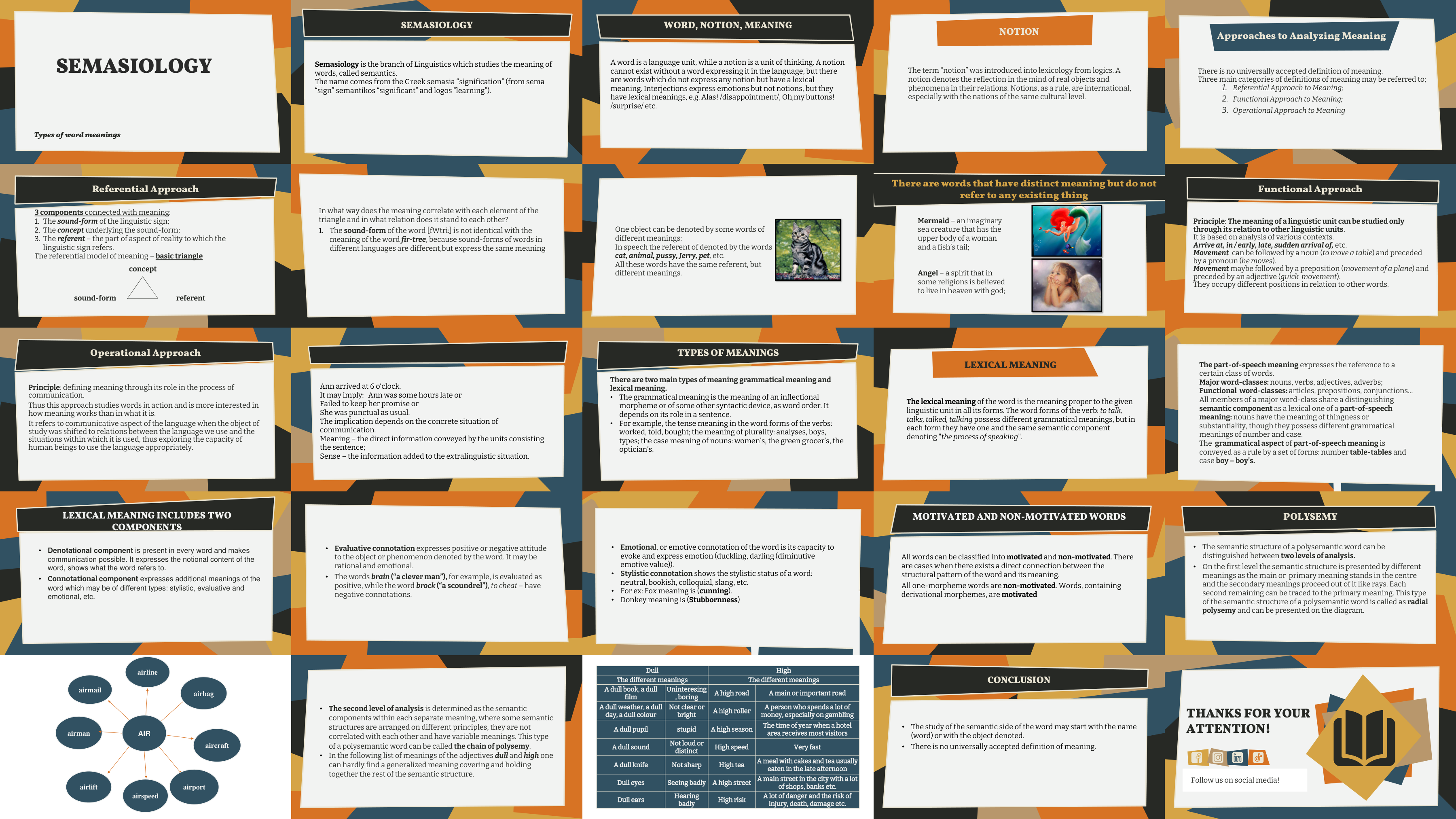
Semasiology is a branch of linguistics that studies the meaning of words and how meaning changes depending on context, structure, and use. The term originates from Greek — “semasia” meaning “signification”. It explores how words connect concepts with real-world objects and ideas.
Word, Notion, and Meaning
A word is a linguistic unit, while a notion is a mental concept. Notions reflect real objects and phenomena, whereas words express them in language. Some words, such as interjections (Oh! Alas!), do not convey notions but express emotions — showing that lexical meaning does not always equal logical meaning.
Approaches to Analyzing Meaning
There are three main approaches to the study of meaning:
- Referential Approach – explores the link between sound-form, concept, and referent (object of reality);
- Functional Approach – studies meaning through how words function and combine in sentences;
- Operational Approach – focuses on meaning in communication, i.e., how words express ideas in context.
Each approach reveals a different aspect of how words acquire, develop, and express meaning.
Types of Word Meanings
Word meaning divides into two main categories:
- Grammatical Meaning – shows relationships between words in a sentence (e.g., tense, number, case: worked, boys, women’s);
- Lexical Meaning – expresses the conceptual content of the word, e.g., talk, talks, talking all denote “the process of speaking”.
Lexical Meaning Components
Denotational Component conveys the core idea or reference of a word.
Connotational Component adds emotional, evaluative, or stylistic nuances.
For example:
- Brain – positive connotation (intelligent person);
- Scoundrel – negative connotation;
- Duckling, darling – emotive or affectionate connotations.
Motivated and Non-Motivated Words
Words can be motivated (where structure suggests meaning, e.g., blackbird – black + bird) or non-motivated (where no direct connection exists between form and meaning, e.g., table).
Polysemy – Multiple Meanings
Polysemy refers to a word having several related meanings. For example, the word air can appear in airplane, airmail, airman, airspeed.
Two main patterns of polysemy include:
- Radial Polysemy – secondary meanings develop from a central one (like rays from a center);
- Chain Polysemy – meanings follow one another in a sequence with loose connections.
Conclusion
The study of semasiology reveals that there is no single universal definition of meaning. However, exploring referential, functional, and communicative aspects of language helps us understand how words carry, transform, and express meaning in human communication.
=== Taqdimot 1 ===
Types of word meanings
SEMASIOLOGY
=== Taqdimot 2 ===
SEMASIOLOGY
Semasiology is the branch of Linguistics which studies the meaning of words, called semantics.
The name comes from the Greek semasia “signification” (from sema “sign” semantikos “significant” and logos “learning”).
=== Taqdimot 3 ===
WORD, NOTION, MEANING
A word is a language unit, while a notion is a unit of thinking. A notion cannot exist without a word expressing it in the language, but there are words which do not express any notion but have a lexical meaning. Interjections express emotions but not notions, but they have lexical meanings, e.g. Alas! /disappointment/, Oh,my buttons! /surprise/ etc.
=== Taqdimot 4 ===
NOTION
The term “notion” was introduced into lexicology from logics. A notion denotes the reflection in the mind of real objects and phenomena in their relations. Notions, as a rule, are international, especially with the nations of the same cultural level.
=== Taqdimot 5 ===
There is no universally accepted definition of meaning.
Three main categories of definitions of meaning may be referred to;
Referential Approach to Meaning;
Functional Approach to Meaning;
Operational Approach to Meaning
Approaches to Analyzing Meaning
=== Taqdimot 6 ===
Referential Approach
3 components connected with meaning:
The sound-form of the linguistic sign;
The concept underlying the sound-form;
The referent – the part of aspect of reality to which the linguistic sign refers.
The referential model of meaning – basic triangle
concept
referent
sound-form
=== Taqdimot 7 ===
In what way does the meaning correlate with each element of the triangle and in what relation does it stand to each other?
The sound-form of the word [fWtri:] is not identical with the meaning of the word fir-tree, because sound-forms of words in different languages are different,but express the same meaning
=== Taqdimot 8 ===
One object can be denoted by some words of different meanings:
In speech the referent of denoted by the words
cat, animal, pussy, Jerry, pet, etc.
All these words have the same referent, but different meanings.
=== Taqdimot 9 ===
There are words that have distinct meaning but do not refer to any existing thing
Mermaid – an imaginary sea creature that has the upper body of a woman and a fish’s tail;
Angel – a spirit that in some religions is believed to live in heaven with god;
=== Taqdimot 10 ===
Functional Approach
Principle: The meaning of a linguistic unit can be studied only through its relation to other linguistic units.
It is based on analysis of various contexts.
Arrive at, in / early, late, sudden arrival of, etc.
Movement can be followed by a noun (to move a table) and preceded by a pronoun (he moves).
Movement maybe followed by a preposition (movement of a plane) and preceded by an adjective (quick movement).
They occupy different positions in relation to other words.
=== Taqdimot 11 ===
Operational Approach
Principle: defining meaning through its role in the process of communication.
Thus this approach studies words in action and is more interested in how meaning works than in what it is.
It refers to communicative aspect of the language when the object of study was shifted to relations between the language we use and the situations within which it is used, thus exploring the capacity of human beings to use the language appropriately.
=== Taqdimot 12 ===
Ann arrived at 6 o‘clock.
It may imply: Ann was some hours late or
Failed to keep her promise or
She was punctual as usual.
The implication depends on the concrete situation of communication.
Meaning – the direct information conveyed by the units consisting the sentence;
Sense – the information added to the extralinguistic situation.
=== Taqdimot 13 ===
TYPES OF MEANINGS
There are two main types of meaning grammatical meaning and lexical meaning.
The grammatical meaning is the meaning of an inflectional morpheme or of some other syntactic device, as word order. It depends on its role in a sentence.
For example, the tense meaning in the word forms of the verbs: worked, told, bought; the meaning of plurality: analyses, boys, types; the case meaning of nouns: women’s, the green grocer’s, the optician’s.
=== Taqdimot 14 ===
LEXICAL MEANING
The lexical meaning of the word is the meaning proper to the given linguistic unit in all its forms. The word forms of the verb: to talk, talks, talked, talking possess different grammatical meanings, but in each form they have one and the same semantic component denoting «the process of speaking».
=== Taqdimot 15 ===
The part-of-speech meaning expresses the reference to a certain class of words.
Major word-classes: nouns, verbs, adjectives, adverbs;
Functional word-classes: articles, prepositions, conjunctions…
All members of a major word-class share a distinguishing semantic component as a lexical one of a part-of-speech meaning: nouns have the meaning of thingness or substantiality, though they possess different grammatical meanings of number and case.
The grammatical aspect of part-of-speech meaning is conveyed as a rule by a set of forms: number table-tables and case boy – boy’s.
=== Taqdimot 16 ===
LEXICAL MEANING INCLUDES TWO COMPONENTS
Denotational component is present in every word and makes communication possible. It expresses the notional content of the word, shows what the word refers to.
Connotational component expresses additional meanings of the word which may be of different types: stylistic, evaluative and emotional, etc.
=== Taqdimot 17 ===
Evaluative connotation expresses positive or negative attitude to the object or phenomenon denoted by the word. It may be rational and emotional.
The words brain (“a clever man”), for example, is evaluated as positive, while the word brock (“a scoundrel”), to cheat – have negative connotations.
=== Taqdimot 18 ===
Emotional, or emotive connotation of the word is its capacity to evoke and express emotion (duckling, darling (diminutive emotive value)).
Stylistic connotation shows the stylistic status of a word: neutral, bookish, colloquial, slang, etc.
For ex: Fox meaning is (cunning).
Donkey meaning is (Stubbornness)
=== Taqdimot 19 ===
MOTIVATED AND NON-MOTIVATED WORDS
All words can be classified into motivated and non-motivated. There are cases when there exists a direct connection between the structural pattern of the word and its meaning.
All one-morpheme words are non-motivated. Words, containing derivational morphemes, are motivated
=== Taqdimot 20 ===
POLYSEMY
The semantic structure of a polysemantic word can be distinguished between two levels of analysis.
On the first level the semantic structure is presented by different meanings as the main or primary meaning stands in the centre and the secondary meanings proceed out of it like rays. Each second remaining can be traced to the primary meaning. This type of the semantic structure of a polysemantic word is called as radial polysemy and can be presented on the diagram.
=== Taqdimot 21 ===
airmail
airman
AIR
airline
airbag
aircraft
airport
airspeed
airlift
=== Taqdimot 22 ===
The second level of analysis is determined as the semantic components within each separate meaning, where some semantic structures are arranged on different principles, they are not correlated with each other and have variable meanings. This type of a polysemantic word can be called the chain of polysemy.
In the following list of meanings of the adjectives dull and high one can hardly find a generalized meaning covering and holding together the rest of the semantic structure.
=== Taqdimot 23 ===
=== Taqdimot 24 ===
CONCLUSION
The study of the semantic side of the word may start with the name (word) or with the object denoted.
There is no universally accepted definition of meaning.
=== Taqdimot 25 ===
THANKS FOR YOUR ATTENTION!
Follow us on social media!
📘 “Types of Word Meanings – Semasiology” mavzusidagi to‘liq taqdimotni Slaydchi.uz saytida ko‘ring
Slaydchi.uz — ingliz tili, lingvistika va filologiya fanlari uchun tayyor taqdimotlar, dars ishlanmalari va ilmiy materiallar manbasi.
Boshqa ingliz tili ta’limiy mavzulari uchun: slaydchi.uz saytiga tashrif buyuring.





Sharhlar
Hali sharhlar mavjud emas.