


Slayd 1
Pronouns
Slayd 2
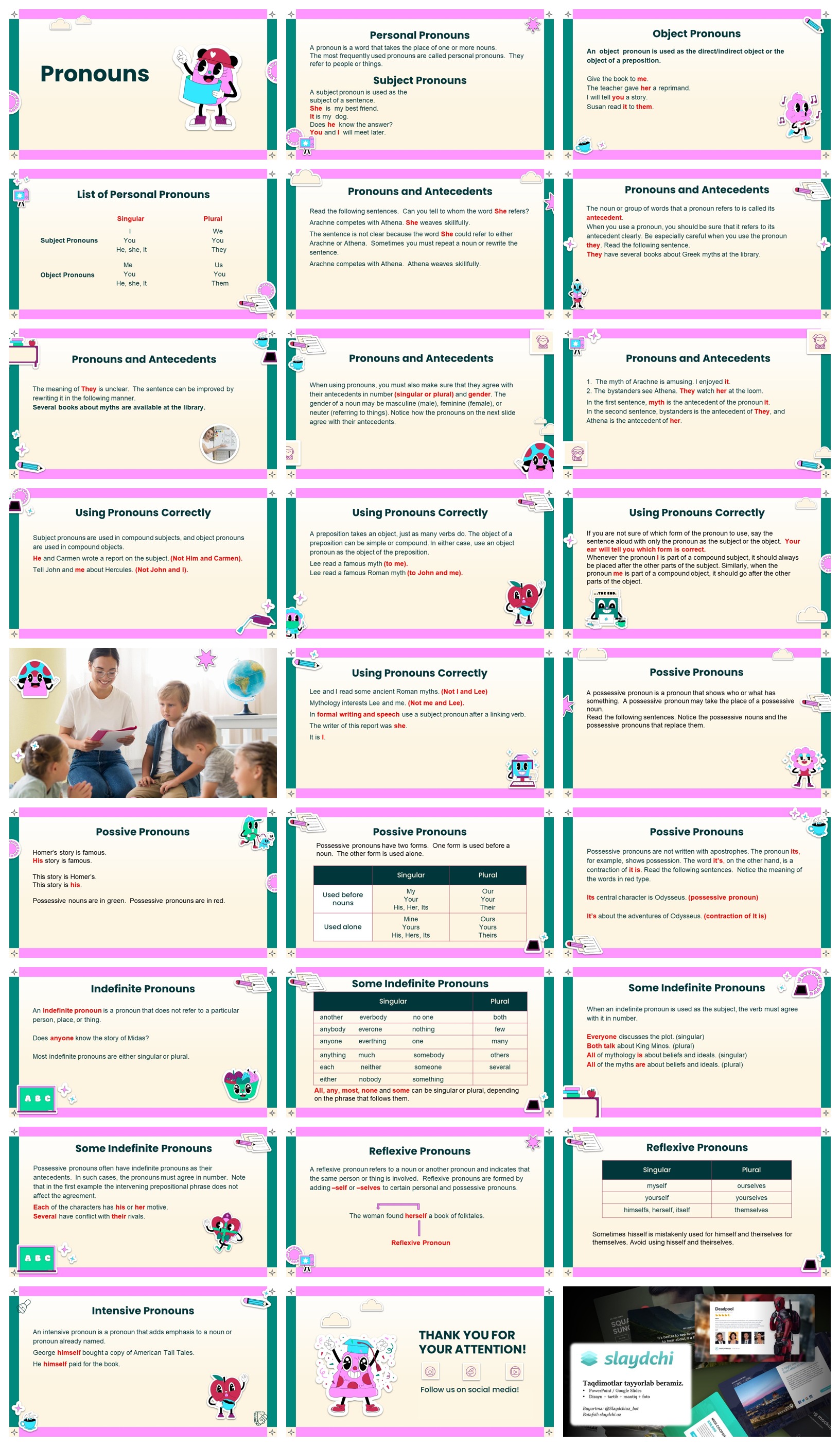
Personal Pronouns
A pronoun is a word that takes the place of one or more nouns.
The most frequently used pronouns are called personal pronouns. They refer to people or things.
Subject Pronouns
A subject pronoun is used as the
subject of a sentence.
She is my best friend.
It is my dog.
Does he know the answer?
You and I will meet later.
Slayd 3
Object Pronouns
An object pronoun is used as the direct/indirect object or the object of a preposition.
Give the book to me.
The teacher gave her a reprimand.
I will tell you a story.
Susan read it to them.
Slayd 4
List of Personal Pronouns
I We
You You
He, she, It They
Subject Pronouns
Plural
Singular
Object Pronouns
Me Us
He, she, It Them
Slayd 5
Pronouns and Antecedents
Read the following sentences. Can you tell to whom the word She refers?
Arachne competes with Athena. She weaves skillfully.
The sentence is not clear because the word She could refer to either Arachne or Athena. Sometimes you must repeat a noun or rewrite the sentence.
Arachne competes with Athena. Athena weaves skillfully.
Slayd 6
Pronouns and Antecedents
The noun or group of words that a pronoun refers to is called its antecedent.
When you use a pronoun, you should be sure that it refers to its antecedent clearly. Be especially careful when you use the pronoun they. Read the following sentence.
They have several books about Greek myths at the library.
Slayd 7
Pronouns and Antecedents
The meaning of They is unclear. The sentence can be improved by rewriting it in the following manner.
Several books about myths are available at the library.
Slayd 8
When using pronouns, you must also make sure that they agree with their antecedents in number (singular or plural) and gender. The gender of a noun may be masculine (male), feminine (female), or neuter (referring to things). Notice how the pronouns on the next slide agree with their antecedents.
Pronouns and Antecedents
Slayd 9
1. The myth of Arachne is amusing. I enjoyed it.
2. The bystanders see Athena. They watch her at the loom.
In the first sentence, myth is the antecedent of the pronoun it.
In the second sentence, bystanders is the antecedent of They, and Athena is the antecedent of her.
Pronouns and Antecedents
Slayd 10
Using Pronouns Correctly
Subject pronouns are used in compound subjects, and object pronouns are used in compound objects.
He and Carmen wrote a report on the subject. (Not Him and Carmen).
Tell John and me about Hercules. (Not John and I).
Slayd 11
Using Pronouns Correctly
A preposition takes an object, just as many verbs do. The object of a preposition can be simple or compound. In either case, use an object pronoun as the object of the preposition.
Lee read a famous myth (to me).
Lee read a famous Roman myth (to John and me).
Slayd 12
Using Pronouns Correctly
If you are not sure of which form of the pronoun to use, say the sentence aloud with only the pronoun as the subject or the object. Your ear will tell you which form is correct.
Whenever the pronoun I is part of a compound subject, it should always be placed after the other parts of the subject. Similarly, when the pronoun me is part of a compound object, it should go after the other parts of the object.
Slayd 13
Slayd 14
Using Pronouns Correctly
Lee and I read some ancient Roman myths. (Not I and Lee)
Mythology interests Lee and me. (Not me and Lee).
In formal writing and speech use a subject pronoun after a linking verb.
The writer of this report was she.
It is I.
Slayd 15
Possive Pronouns
A possessive pronoun is a pronoun that shows who or what has something. A possessive pronoun may take the place of a possessive noun.
Read the following sentences. Notice the possessive nouns and the possessive pronouns that replace them.
Slayd 16
Possive Pronouns
Homer’s story is famous.
His story is famous.
This story is Homer’s.
This story is his.
Possessive nouns are in green. Possessive pronouns are in red.
Slayd 17
Possive Pronouns
Singular
Plural
Used before nouns
My Your His, Her, Its
Our Your Their
Used alone
Mine Yours His, Hers, Its
Ours Yours Theirs
Possessive pronouns have two forms. One form is used before a noun. The other form is used alone.
Slayd 18
Possessive pronouns are not written with apostrophes. The pronoun its, for example, shows possession. The word it’s, on the other hand, is a contraction of it is. Read the following sentences. Notice the meaning of the words in red type.
Its central character is Odysseus. (possessive pronoun)
It’s about the adventures of Odysseus. (contraction of It is)
Possive Pronouns
Slayd 19
Indefinite Pronouns
An indefinite pronoun is a pronoun that does not refer to a particular person, place, or thing.
Does anyone know the story of Midas?
Most indefinite pronouns are either singular or plural.
Slayd 20
Some Indefinite Pronouns
Singular
Plural
another everbody no one
both
anybody everone nothing
few
anyone everthing one
many
anything much somebody
others
each neither someone
several
either nobody something
All, any, most, none and some can be singular or plural, depending on the phrase that follows them.
Slayd 21
Some Indefinite Pronouns
When an indefinite pronoun is used as the subject, the verb must agree with it in number.
Everyone discusses the plot. (singular)
Both talk about King Minos. (plural)
All of mythology is about beliefs and ideals. (singular)
All of the myths are about beliefs and ideals. (plural)
Slayd 22
Some Indefinite Pronouns
Possessive pronouns often have indefinite pronouns as their antecedents. In such cases, the pronouns must agree in number. Note that in the first example the intervening prepositional phrase does not affect the agreement.
Each of the characters has his or her motive.
Several have conflict with their rivals.
Slayd 23
Reflexive Pronouns
A reflexive pronoun refers to a noun or another pronoun and indicates that the same person or thing is involved. Reflexive pronouns are formed by adding –self or –selves to certain personal and possessive pronouns.
The woman found herself a book of folktales.
Reflexive Pronoun
Slayd 24
Reflexive Pronouns
Singular
Plural
myself
ourselves
yourself
yourselves
himselfs, herself, itself
themselves
Sometimes hisself is mistakenly used for himself and theirselves for themselves. Avoid using hisself and theirselves.
Slayd 25
Intensive Pronouns
An intensive pronoun is a pronoun that adds emphasis to a noun or pronoun already named.
George himself bought a copy of American Tall Tales.
He himself paid for the book.
Slayd 26
THANK YOU FOR YOUR ATTENTION!
Please keep this slide for attribution
Follow us on social media!
Slayd 27
Foydali havolalar
🛒 Barcha taqdimotlar | 📰 Yangiliklar | ℹ️ Biz haqimizda








Sharhlar
Hali sharhlar mavjud emas.