


Slayd 1
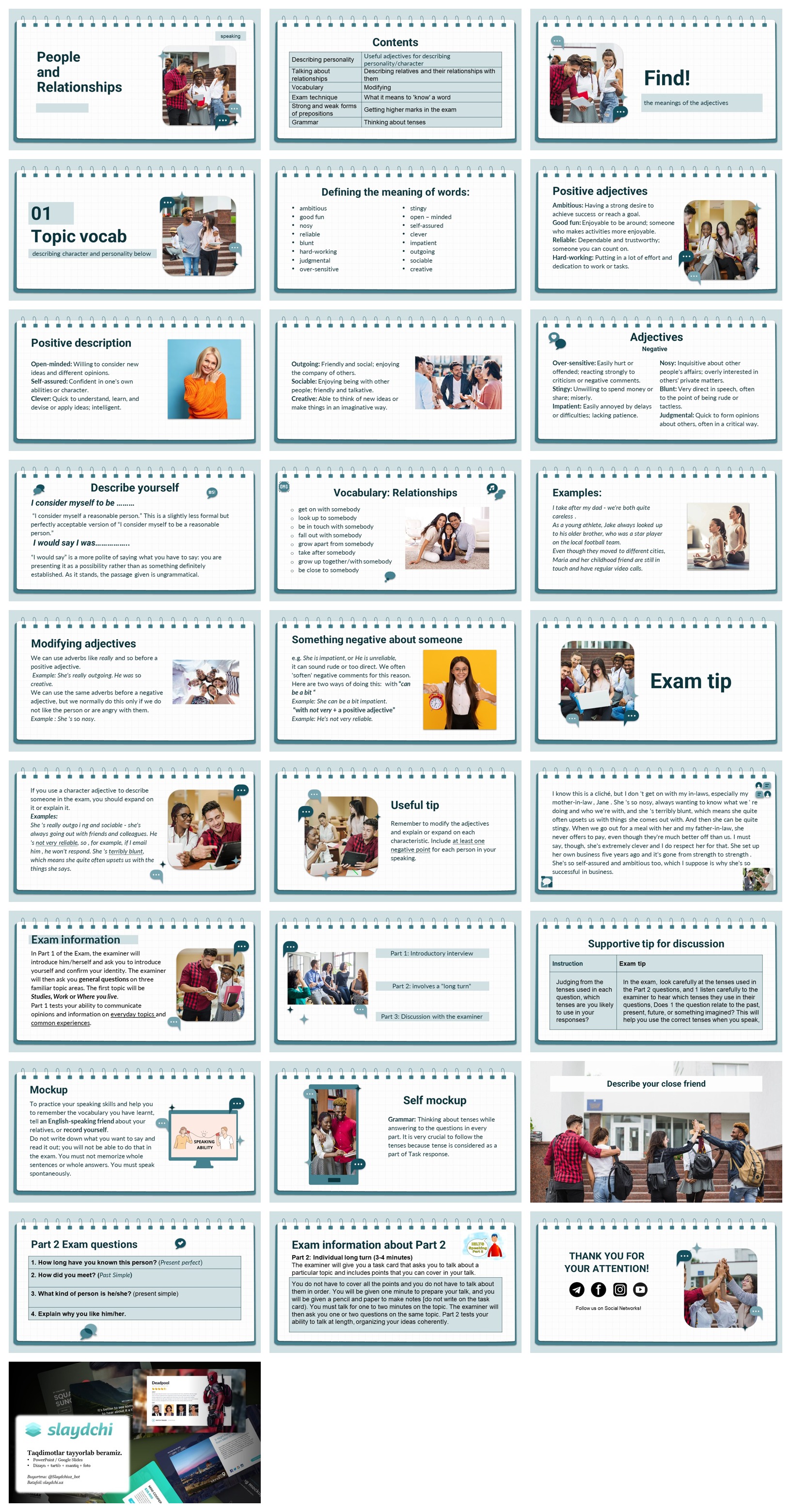
People and Relationships
speaking
Slayd 2
Contents
Describing personality
Useful adjectives for describing personality/character
Talking about relationships
Describing relatives and their relationships with them
Vocabulary
Modifying
Exam technique
What it means to ‘know’ a word
Strong and weak forms of prepositions
Getting higher marks in the exam
Grammar
Thinking about tenses
Slayd 3
Find!
the meanings of the adjectives
Slayd 4
Topic vocab
01
describing character and personality below
Slayd 5
Defining the meaning of words:
stingy
open – minded
self-assured
clever
impatient
outgoing
sociable
creative
ambitious
good fun
nosy
reliable
blunt
hard-working
judgmental
over-sensitive
Slayd 6
Positive adjectives
Ambitious: Having a strong desire to achieve success or reach a goal.
Good fun: Enjoyable to be around; someone who makes activities more enjoyable.
Reliable: Dependable and trustworthy; someone you can count on.
Hard-working: Putting in a lot of effort and dedication to work or tasks.
Slayd 7
Open-minded: Willing to consider new ideas and different opinions.
Self-assured: Confident in one’s own abilities or character.
Clever: Quick to understand, learn, and devise or apply ideas; intelligent.
Positive description
Slayd 8
Outgoing: Friendly and social; enjoying the company of others.
Sociable: Enjoying being with other people; friendly and talkative.
Creative: Able to think of new ideas or make things in an imaginative way.
Slayd 9
Adjectives
Nosy: Inquisitive about other people’s affairs; overly interested in others’ private matters.
Blunt: Very direct in speech, often to the point of being rude or tactless.
Judgmental: Quick to form opinions about others, often in a critical way.
Over-sensitive: Easily hurt or offended; reacting strongly to criticism or negative comments.
Stingy: Unwilling to spend money or share; miserly.
Impatient: Easily annoyed by delays or difficulties; lacking patience.
Negative
Slayd 10
Describe yourself
“I consider myself a reasonable person.” This is a slightly less formal but perfectly acceptable version of “I consider myself to be a reasonable person.”
“I would say” is a more polite of saying what you have to say: you are presenting it as a possibility rather than as something definitely established. As it stands, the passage given is ungrammatical.
I consider myself to be ………
I would say I was……………..
Slayd 11
get on with somebody
look up to somebody
be in touch with somebody
fall out with somebody
grow apart from somebody
take after somebody
grow up together/with somebody
be close to somebody
Vocabulary: Relationships
Slayd 12
I take after my dad – we’re both quite careless .
As a young athlete, Jake always looked up to his older brother, who was a star player on the local football team.
Even though they moved to different cities, Maria and her childhood friend are still in touch and have regular video calls.
Examples:
Slayd 13
We can use adverbs like really and so before a positive adjective.
Example: She’s really outgoing. He was so creative.
We can use the same adverbs before a negative adjective, but we normally do this only if we do not like the person or are angry with them. Example : She ‘s so nosy.
Modifying adjectives
Slayd 14
e.g. She is impatient, or He is unreliable,
it can sound rude or too direct. We often ‘soften’ negative comments for this reason. Here are two ways of doing this: with “can be a bit “
Example: She can be a bit impatient.
“with not very + a positive adjective”
Example: He’s not very reliable.
Something negative about someone
Slayd 15
Exam tip
Slayd 16
If you use a character adjective to describe someone in the exam, you should expand on it or explain it.
Examples:
She ‘s really outgo i ng and sociable – she’s always going out with friends and colleagues. He ‘s not very reliable, so , for example, if I email him , he won’t respond. She ‘s terribly blunt, which means she quite often upsets us with the things she says.
Slayd 17
Useful tip
Remember to modify the adjectives and explain or expand on each characteristic. Include at least one negative point for each person in your speaking.
Slayd 18
I know this is a cliché, but I don ‘t get on with my in-laws, especially my mother-in-law , Jane . She ‘s so nosy, always wanting to know what we ‘ re doing and who we’re with, and she ‘s terribly blunt, which means she quite often upsets us with things she comes out with. And then she can be quite stingy. When we go out for a meal with her and my father-in-law, she never offers to pay, even though they’re much better off than us. I must say, though, she’s extremely clever and I do respect her for that. She set up her own business five years ago and it’s gone from strength to strength . She’s so self-assured and ambitious too, which I suppose is why she’s so successful in business.
Slayd 19
Exam information
In Part 1 of the Exam, the examiner will introduce him/herself and ask you to introduce yourself and confirm your identity. The examiner will then ask you general questions on three familiar topic areas. The first topic will be Studies, Work or Where you live.
Part 1 tests your ability to communicate opinions and information on everyday topics and common experiences.
Slayd 20
Part 1: Introductory interview
Part 2: involves a «long turn»
Part 3: Discussion with the examiner
Slayd 21
Supportive tip for discussion
Instruction
Exam tip
Judging from the tenses used in each question, which tenses are you likely to use in your responses?
In the exam, look carefully at the tenses used in the Part 2 questions, and 1 listen carefully to the examiner to hear which tenses they use in their questions, Does 1 the question relate to the past, present, future, or something imagined? This will help you use the correct tenses when you speak,
Slayd 22
Mockup
To practice your speaking skills and help you to remember the vocabulary you have learnt, tell an English-speaking friend about your relatives, or record yourself.
Do not write down what you want to say and read it out; you will not be able to do that in the exam. You must not memorize whole sentences or whole answers. You must speak spontaneously.
Slayd 23
Self mockup
Grammar: Thinking about tenses while answering to the questions in every part. It is very crucial to follow the tenses because tense is considered as a part of Task response.
Slayd 24
Describe your close friend
Slayd 25
Part 2 Exam questions
1. How long have you known this person? (Present perfect)
2. How did you meet? (Past Simple)
3. What kind of person is he/she? (present simple)
4. Explain why you like him/her.
Slayd 26
Exam information about Part 2
Part 2: Individual long turn (3-4 minutes)
The examiner will give you a task card that asks you to talk about a particular topic and includes points that you can cover in your talk.
You do not have to cover all the points and you do not have to talk about them in order. You will be given one minute to prepare your talk, and you will be given a pencil and paper to make notes [do not write on the task card). You must talk for one to two minutes on the topic. The examiner will then ask you one or two questions on the same topic. Part 2 tests your ability to talk at length, organizing your ideas coherently.
Slayd 27
THANK YOU FOR YOUR ATTENTION!
Follow us on Social Networks!
Slayd 28
Foydali havolalar
🛒 Barcha taqdimotlar | 📰 Yangiliklar | ℹ️ Biz haqimizda
Tegishli mahsulotlar
LEXICAL EXPRESSIVE MEANS AND STYLISTIC DEVICES mavzusidagi tayyor PPTX taqdimot. Ingliz tili darsi uchun mavzu, misollar va asosiy tushunchalar jamlangan.
- Slaydlar soni: 25 ta
- Fayl formati: PPTX
- Tili: o‘zbek tili
- Kategoriya: Ingliz tili

CULTURE. TALKING ABOUT FESTIVALS AND HISTORICAL SITES mavzusidagi tayyor PPTX taqdimot. Ingliz tili darsi uchun mavzu, misollar va asosiy tushunchalar jamlangan.
- Slaydlar soni: 29 ta
- Fayl formati: PPTX
- Tili: o‘zbek tili
- Kategoriya: Ingliz tili
ALL ABOUT LISTENING SKILLS mavzusidagi tayyor PPTX taqdimot. Ingliz tili darsi uchun mavzu, misollar va asosiy tushunchalar jamlangan.
- Slaydlar soni: 33 ta
- Fayl formati: PPTX
- Tili: o‘zbek tili
- Kategoriya: Ingliz tili

ASSESSMENT AND TESTING IN THE CLASSROOM mavzusidagi tayyor PPTX taqdimot. Ingliz tili darsi uchun mavzu, misollar va asosiy tushunchalar jamlangan.
- Slaydlar soni: 37 ta
- Fayl formati: PPTX
- Tili: o‘zbek tili
- Kategoriya: Ingliz tili

RECYCLING THE RUBBISH mavzusidagi tayyor PPTX taqdimot. Ingliz tili darsi uchun mavzu, misollar va asosiy tushunchalar jamlangan.
- Slaydlar soni: 16 ta
- Fayl formati: PPTX
- Tili: o‘zbek tili
- Kategoriya: Ingliz tili
DIFFERENCES BETWEEN BRITISH AND AMERICAN ENGLISH mavzusidagi tayyor PPTX taqdimot. Ingliz tili darsi uchun mavzu, misollar va asosiy tushunchalar jamlangan.
- Slaydlar soni: 40 ta
- Fayl formati: PPTX
- Tili: o‘zbek tili
- Kategoriya: Ingliz tili
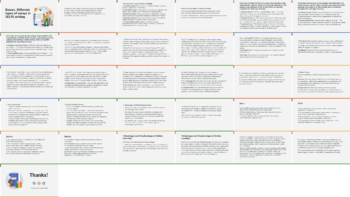
ESSAYS. DIFFERENT TYPES OF ESSAYS IN IELTS WRITING mavzusidagi tayyor PPTX taqdimot. Ingliz tili darsi uchun mavzu, misollar va asosiy tushunchalar jamlangan.
- Slaydlar soni: 31 ta
- Fayl formati: PPTX
- Tili: o‘zbek tili
- Kategoriya: Ingliz tili

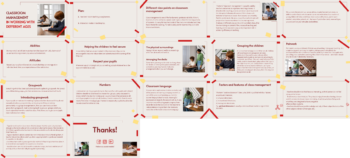
CLASSROOM MANAGEMENT IN WORKING WITH DEFFERENT AGES mavzusidagi tayyor PPTX taqdimot. Ingliz tili darsi uchun mavzu, misollar va asosiy tushunchalar jamlangan.
- Slaydlar soni: 18 ta
- Fayl formati: PPTX
- Tili: o‘zbek tili
- Kategoriya: Ingliz tili
HOW TO IMPROVE STUDENTS’ PRONUNCIATION LET US LOOK THROUGH mavzusidagi tayyor PPTX taqdimot. Ingliz tili darsi uchun mavzu, misollar va asosiy tushunchalar jamlangan.
- Slaydlar soni: 48 ta
- Fayl formati: PPTX
- Tili: o‘zbek tili
- Kategoriya: Ingliz tili

TECHNOLOGY INTEGRATED LANGUAGE TEACHING mavzusidagi tayyor PPTX taqdimot. Ingliz tili darsi uchun mavzu, misollar va asosiy tushunchalar jamlangan.
- Slaydlar soni: 21 ta
- Fayl formati: PPTX
- Tili: o‘zbek tili
- Kategoriya: Ingliz tili

BINOMIAL PAIRS mavzusidagi tayyor PPTX taqdimot. Ingliz tili darsi uchun mavzu, misollar va asosiy tushunchalar jamlangan.
- Slaydlar soni: 24 ta
- Fayl formati: PPTX
- Tili: o‘zbek tili
- Kategoriya: Ingliz tili

CANADA mavzusidagi tayyor PPTX taqdimot. Ingliz tili darsi uchun mavzu, misollar va asosiy tushunchalar jamlangan.
- Slaydlar soni: 54 ta
- Fayl formati: PPTX
- Tili: o‘zbek tili
- Kategoriya: Ingliz tili
Sharhlar
Hali sharhlar mavjud emas.