




Slayd 1
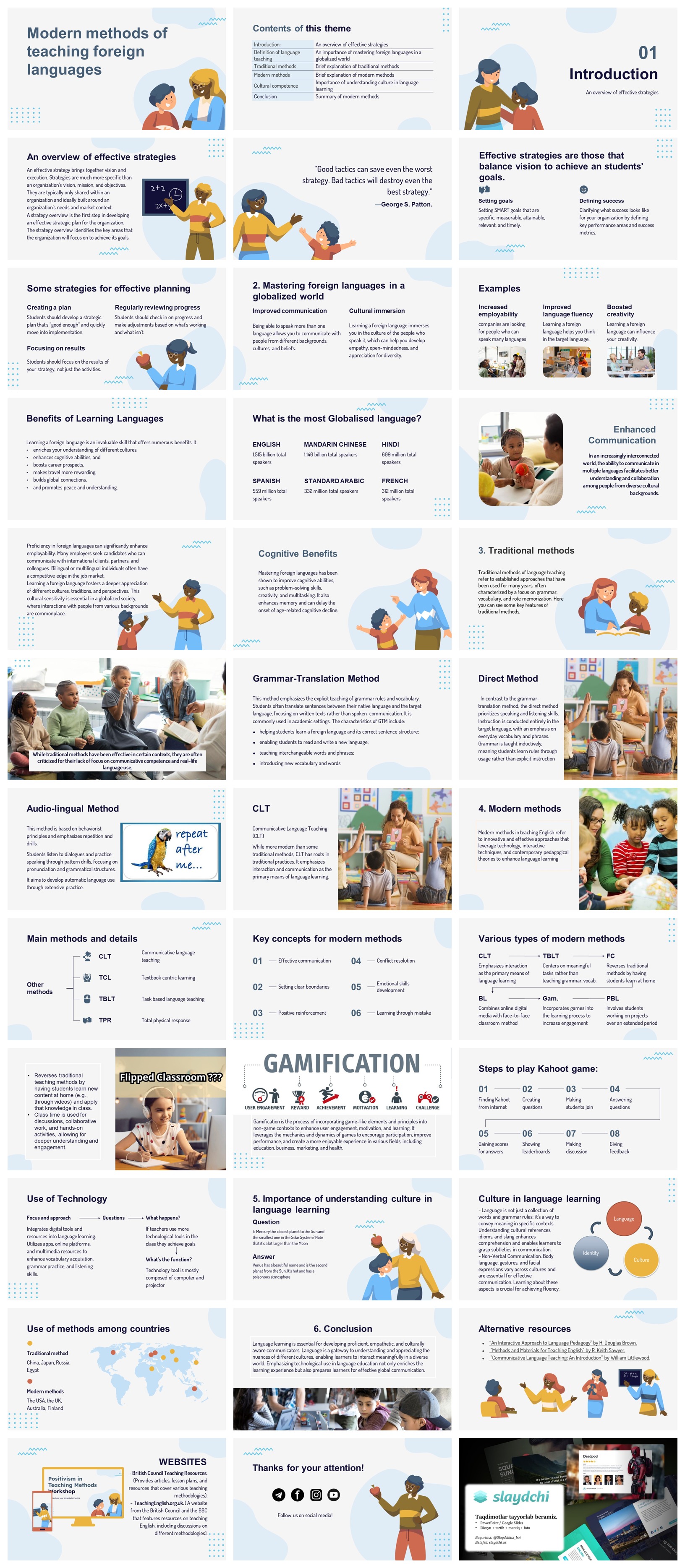
Modern methods of teaching foreign languages
Slayd 2
Contents of this theme
Introduction:
An overview of effective strategies
Definition of language teaching
An importance of mastering foreign languages in a globalized world
Traditional methods
Brief explanation of traditional methods
Modern methods
Brief explanation of modern methods
Cultural competence
Importance of understanding culture in language learning
Conclusion
Summary of modern methods
Slayd 3
Introduction
An overview of effective strategies
01
Slayd 4
An overview of effective strategies
An effective strategy brings together vision and execution. Strategies are much more specific than an organization’s vision, mission, and objectives. They are typically only shared within an organization and ideally built around an organization’s needs and market context.
A strategy overview is the first step in developing an effective strategic plan for the organization. The strategy overview identifies the key areas that the organization will focus on to achieve its goals.
Slayd 5
—George S. Patton.
“Good tactics can save even the worst strategy. Bad tactics will destroy even the best strategy.”
Slayd 6
Effective strategies are those that balance vision to achieve an students’ goals.
Clarifying what success looks like for your organization by defining key performance areas and success metrics.
Setting SMART goals that are specific, measurable, attainable, relevant, and timely.
Defining success
Setting goals
Slayd 7
Some strategies for effective planning
Students should check in on progress and make adjustments based on what’s working and what isn’t.
Students should develop a strategic plan that’s «good enough» and quickly move into implementation.
Students should focus on the results of your strategy, not just the activities.
Regularly reviewing progress
Creating a plan
Focusing on results
Slayd 8
2. Mastering foreign languages in a globalized world
Being able to speak more than one language allows you to communicate with people from different backgrounds, cultures, and beliefs.
Learning a foreign language immerses you in the culture of the people who speak it, which can help you develop empathy, open-mindedness, and appreciation for diversity.
Improved communication
Cultural immersion
Slayd 9
Examples
companies are looking for people who can speak many languages
Learning a foreign language helps you think in the target language,
Learning a foreign language can influence your creativity.
Increased employability
Improved language fluency
Boosted creativity
Slayd 10
Learning a foreign language is an invaluable skill that offers numerous benefits. It
enriches your understanding of different cultures,
enhances cognitive abilities, and
boosts career prospects.
makes travel more rewarding,
builds global connections,
and promotes peace and understanding.
Benefits of Learning Languages
Slayd 11
1.140 billion total speakers
609 million total speakers
What is the most Globalised language?
1.515 billion total speakers
559 million total speakers
332 million total speakers
312 million total speakers
ENGLISH
MANDARIN CHINESE
SPANISH
STANDARD ARABIC
HINDI
FRENCH
Slayd 12
Enhanced Communication
In an increasingly interconnected world, the ability to communicate in multiple languages facilitates better understanding and collaboration among people from diverse cultural backgrounds.
Slayd 13
Proficiency in foreign languages can significantly enhance employability. Many employers seek candidates who can communicate with international clients, partners, and colleagues. Bilingual or multilingual individuals often have a competitive edge in the job market.
Learning a foreign language fosters a deeper appreciation of different cultures, traditions, and perspectives. This cultural sensitivity is essential in a globalized society, where interactions with people from various backgrounds are commonplace.
Slayd 14
Cognitive Benefits
Mastering foreign languages has been shown to improve cognitive abilities, such as problem-solving skills, creativity, and multitasking. It also enhances memory and can delay the onset of age-related cognitive decline.
Slayd 15
3. Traditional methods
Traditional methods of language teaching refer to established approaches that have been used for many years, often characterized by a focus on grammar, vocabulary, and rote memorization. Here you can see some key features of traditional methods.
Slayd 16
While traditional methods have been effective in certain contexts, they are often criticized for their lack of focus on communicative competence and real-life language use.
Slayd 17
Grammar-Translation Method
This method emphasizes the explicit teaching of grammar rules and vocabulary. Students often translate sentences between their native language and the target language, focusing on written texts rather than spoken communication. It is commonly used in academic settings. The characteristics of GTM include:
helping students learn a foreign language and its correct sentence structure;
enabling students to read and write a new language;
teaching interchangeable words and phrases;
introducing new vocabulary and words
Slayd 18
Direct Method
In contrast to the grammar-translation method, the direct method prioritizes speaking and listening skills. Instruction is conducted entirely in the target language, with an emphasis on everyday vocabulary and phrases. Grammar is taught inductively, meaning students learn rules through usage rather than explicit instruction
Slayd 19
Audio-lingual Method
This method is based on behaviorist principles and emphasizes repetition and drills.
Students listen to dialogues and practice speaking through pattern drills, focusing on pronunciation and grammatical structures.
It aims to develop automatic language use through extensive practice.
Slayd 20
CLT
Communicative Language Teaching (CLT)
While more modern than some traditional methods, CLT has roots in traditional practices. It emphasizes interaction and communication as the primary means of language learning.
Slayd 21
4. Modern methods
Modern methods in teaching English refer to innovative and effective approaches that leverage technology, interactive techniques, and contemporary pedagogical theories to enhance language learning
Slayd 22
Main methods and details
Other methods
Communicative language teaching
CLT
Textbook centric learning
TCL
Total physical response
TPR
Task based language teaching
TBLT
Slayd 23
Key concepts for modern methods
01
Effective communication
02
Setting clear boundaries
03
Positive reinforcement
04
Conflict resolution
05
Emotional skills development
06
Learning through mistake
Slayd 24
Various types of modern methods
Emphasizes interaction as the primary means of language learning
CLT
Centers on meaningful tasks rather than teaching grammar, vocab.
TBLT
Reverses traditional methods by having students learn at home
FC
Combines online digital media with face-to-face classroom method
BL
Incorporates games into the learning process to increase engagement
Gam.
Involves students working on projects over an extended period
PBL
Slayd 25
Reverses traditional teaching methods by having students learn new content at home (e.g., through videos) and apply that knowledge in class.
Class time is used for discussions, collaborative work, and hands-on activities, allowing for deeper understanding and engagement.
Slayd 26
Gamification is the process of incorporating game-like elements and principles into non-game contexts to enhance user engagement, motivation, and learning. It leverages the mechanics and dynamics of games to encourage participation, improve performance, and create a more enjoyable experience in various fields, including education, business, marketing, and health.
Slayd 27
Steps to play Kahoot game:
Finding Kahoot from internet
01
Creating questions
02
Making students join
03
Answering questions
04
Gaining scores for answers
05
Showing leaderboards
06
Making discussion
07
Giving feedback
08
Slayd 28
Use of Technology
Integrates digital tools and resources into language learning.
Utilizes apps, online platforms, and multimedia resources to enhance vocabulary acquisition, grammar practice, and listening skills.
If teachers use more technological tools in the class they achieve goals
Questions
Focus and approach
What happens?
Technology tool is mostly composed of computer and projector
What’s the function?
Slayd 29
5. Importance of understanding culture in language learning
Is Mercury the closest planet to the Sun and the smallest one in the Solar System? Note that it’s a bit larger than the Moon
Venus has a beautiful name and is the second planet from the Sun. It’s hot and has a poisonous atmosphere
Question
Answer
Slayd 30
Culture in language learning
– Language is not just a collection of words and grammar rules; it’s a way to convey meaning in specific contexts. Understanding cultural references, idioms, and slang enhances comprehension and enables learners to grasp subtleties in communication.
– Non-Verbal Communication. Body language, gestures, and facial expressions vary across cultures and are essential for effective communication. Learning about these aspects is crucial for achieving fluency.
Language
Culture
Identity
Slayd 31
Use of methods among countries
China, Japan, Russia, Egypt
Traditional method
The USA, the UK, Australia, Finland
Modern methods
Slayd 32
6. Conclusion
Language learning is essential for developing proficient, empathetic, and culturally aware communicators. Language is a gateway to understanding and appreciating the nuances of different cultures, enabling learners to interact meaningfully in a diverse world. Emphasizing technological use in language education not only enriches the learning experience but also prepares learners for effective global communication.
Slayd 33
“An Interactive Approach to Language Pedagogy» by H. Douglas Brown.
«Methods and Materials for Teaching English» by R. Keith Sawyer.
«Communicative Language Teaching: An Introduction» by William Littlewood.
Alternative resources
Slayd 34
WEBSITES
– British Council Teaching Resources. (Provides articles, lesson plans, and resources that cover various teaching methodologies).
– TeachingEnglish.org.uk. ( A website from the British Council and the BBC that features resources on teaching English, including discussions on different methodologies).
Slayd 35
Thanks for your attention!
Follow us on social media!
Slayd 36
Foydali havolalar
🛒 Barcha taqdimotlar | 📰 Yangiliklar | ℹ️ Biz haqimizda


















Sharhlar
Hali sharhlar mavjud emas.