
- Savatga boshqa "DISCUSSION ESSAYS" qo'sha olmaysiz. Ko'rish




Slayd 1
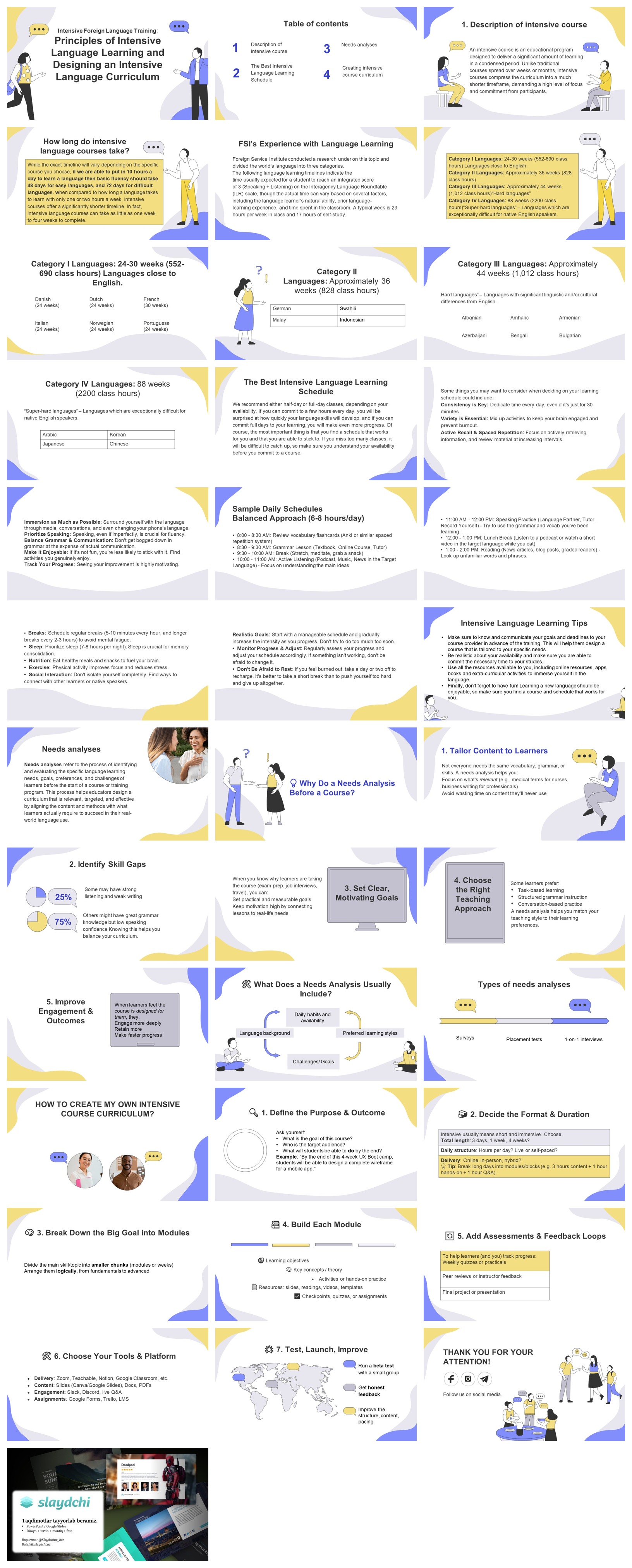
Intensive Foreign Language Training:
Principles of Intensive Language Learning and Designing an Intensive Language Curriculum
Slayd 2
Needs analyses
The Best Intensive Language Learning Schedule
Table of contents
1
2
3
Description of intensive course
Creating intensive
course curriculum
Slayd 3
1. Description of intensive course
An intensive course is an educational program designed to deliver a significant amount of learning in a condensed period. Unlike traditional
courses spread over weeks or months, intensive courses compress the curriculum into a much shorter timeframe, demanding a high level of focus and commitment from participants.
Slayd 4
How long do intensive language courses take?
While the exact timeline will vary depending on the specific course you choose, if we are able to put in 10 hours a day to learn a language then basic fluency should take 48 days for easy languages, and 72 days for difficult languages. when compared to how long a language takes to learn with only one or two hours a week, intensive courses offer a significantly shorter timeline. In fact, intensive language courses can take as little as one week to four weeks to complete.
Slayd 5
FSI’s Experience with Language Learning
Foreign Service Institute conducted a research under on this topic and divided the world’s language into three categories.
The following language learning timelines indicate the time usually expected for a student to reach an integrated score of 3 (Speaking + Listening) on the Interagency Language Roundtable (ILR) scale, though the actual time can vary based on several factors, including the language learner’s natural ability, prior language-learning experience, and time spent in the classroom. A typical week is 23 hours per week in class and 17 hours of self-study.
Slayd 6
Category I Languages: 24-30 weeks (552-690 class hours) Languages close to English.
Category II Languages: Approximately 36 weeks (828 class hours)
Category III Languages: Approximately 44 weeks (1,012 class hours)“Hard languages”
Category IV Languages: 88 weeks (2200 class hours)“Super-hard languages” – Languages which are exceptionally difficult for native English speakers.
Slayd 7
Category I Languages: 24-30 weeks (552-690 class hours) Languages close to English.
Danish (24 weeks)
Dutch (24 weeks)
French (30 weeks)
Italian (24 weeks)
Norwegian (24 weeks)
Portuguese (24 weeks)
Slayd 8
Category II Languages: Approximately 36 weeks (828 class hours)
?
!
German
Swahili
Malay
Indonesian
Slayd 9
Category III Languages: Approximately 44 weeks (1,012 class hours)
Hard languages” – Languages with significant linguistic and/or cultural differences from English.
Albanian
Amharic
Armenian
Azerbaijani
Bengali
Bulgarian
Slayd 10
Category IV Languages: 88 weeks (2200 class hours)
“Super-hard languages” – Languages which are exceptionally difficult for native English speakers.
Arabic
Korean
Japanese
Chinese
Slayd 11
The Best Intensive Language Learning Schedule
We recommend either half-day or full-day classes, depending on your availability. If you can commit to a few hours every day, you will be surprised at how quickly your language skills will develop, and if you can commit full days to your learning, you will make even more progress. Of course, the most important thing is that you find a schedule that works for you and that you are able to stick to. If you miss too many classes, it will be difficult to catch up, so make sure you understand your availability before you commit to a course.
Slayd 12
Some things you may want to consider when deciding on your learning schedule could include:
Consistency is Key: Dedicate time every day, even if it’s just for 30 minutes.
Variety is Essential: Mix up activities to keep your brain engaged and prevent burnout.
Active Recall & Spaced Repetition: Focus on actively retrieving information, and review material at increasing intervals.
Slayd 13
Immersion as Much as Possible: Surround yourself with the language through media, conversations, and even changing your phone’s language.Prioritize Speaking: Speaking, even if imperfectly, is crucial for fluency.Balance Grammar & Communication: Don’t get bogged down in grammar at the expense of actual communication.Make it Enjoyable: If it’s not fun, you’re less likely to stick with it. Find activities you genuinely enjoy.Track Your Progress: Seeing your improvement is highly motivating.
Slayd 14
Sample Daily SchedulesBalanced Approach (6-8 hours/day)• 8:00 – 8:30 AM: Review vocabulary flashcards (Anki or similar spaced repetition system)• 8:30 – 9:30 AM: Grammar Lesson (Textbook, Online Course, Tutor)• 9:30 – 10:00 AM: Break (Stretch, meditate, grab a snack)• 10:00 – 11:00 AM: Active Listening (Podcast, Music, News in the Target Language) – Focus on understanding the main ideas
Slayd 15
• 11:00 AM – 12:00 PM: Speaking Practice (Language Partner, Tutor, Record Yourself) – Try to use the grammar and vocab you’ve been learning.• 12:00 – 1:00 PM: Lunch Break (Listen to a podcast or watch a short video in the target language while you eat)• 1:00 – 2:00 PM: Reading (News articles, blog posts, graded readers) – Look up unfamiliar words and phrases.
Slayd 16
• Breaks: Schedule regular breaks (5-10 minutes every hour, and longer breaks every 2-3 hours) to avoid mental fatigue.
• Sleep: Prioritize sleep (7-8 hours per night). Sleep is crucial for memory consolidation.
• Nutrition: Eat healthy meals and snacks to fuel your brain.
• Exercise: Physical activity improves focus and reduces stress.
• Social Interaction: Don’t isolate yourself completely. Find ways to connect with other learners or native speakers.
Slayd 17
Realistic Goals: Start with a manageable schedule and gradually increase the intensity as you progress. Don’t try to do too much too soon.
• Monitor Progress & Adjust: Regularly assess your progress and adjust your schedule accordingly. If something isn’t working, don’t be afraid to change it.
• Don’t Be Afraid to Rest: If you feel burned out, take a day or two off to recharge. It’s better to take a short break than to push yourself too hard and give up altogether.
Slayd 18
Intensive Language Learning Tips
Make sure to know and communicate your goals and deadlines to your course provider in advance of the training. This will help them design a course that is tailored to your specific needs.
Be realistic about your availability and make sure you are able to commit the necessary time to your studies.
Use all the resources available to you, including online resources, apps, books and extra-curricular activities to immerse yourself in the language.
Finally, don’t forget to have fun! Learning a new language should be enjoyable, so make sure you find a course and schedule that works for you.
Slayd 19
Needs analyses
Needs analyses refer to the process of identifying and evaluating the specific language learning needs, goals, preferences, and challenges of learners before the start of a course or training program. This process helps educators design a curriculum that is relevant, targeted, and effective by aligning the content and methods with what learners actually require to succeed in their real-world language use.
Slayd 20
💡 Why Do a Needs Analysis Before a Course?
?
!
Slayd 21
Not everyone needs the same vocabulary, grammar, or skills. A needs analysis helps you:
Focus on what’s relevant (e.g., medical terms for nurses, business writing for professionals)
Avoid wasting time on content they’ll never use
1. Tailor Content to Learners
Slayd 22
Some may have strong listening and weak writing
Others might have great grammar knowledge but low speaking confidence Knowing this helps you balance your curriculum.
2. Identify Skill Gaps
75%
25%
Slayd 23
3. Set Clear, Motivating Goals
When you know why learners are taking the course (exam prep, job interviews, travel), you can:
Set practical and measurable goals
Keep motivation high by connecting lessons to real-life needs.
Slayd 24
4. Choose the Right Teaching Approach
Some learners prefer:
Task-based learning
Structured grammar instruction
Conversation-based practice
A needs analysis helps you match your teaching style to their learning preferences.
Slayd 25
5. Improve Engagement & Outcomes
When learners feel the course is designed for them, they:
Engage more deeply
Retain more
Make faster progress
Slayd 26
🛠️ What Does a Needs Analysis Usually Include?
Daily habits and availability
Challenges/ Goals
Language background
Preferred learning styles
Slayd 27
Types of needs analyses
Surveys
Placement tests
1-on-1 interviews
Slayd 28
HOW TO CREATE MY OWN INTENSIVE COURSE CURRICULUM?
Slayd 29
🔍 1. Define the Purpose & Outcome
Ask yourself:
What is the goal of this course?
Who is the target audience?
What will students be able to do by the end?
Example: “By the end of this 4-week UX Boot camp, students will be able to design a complete wireframe for a mobile app.”
Slayd 30
🧱 2. Decide the Format & Duration
Intensive usually means short and immersive. Choose: Total length: 3 days, 1 week, 4 weeks?
Daily structure: Hours per day? Live or self-paced?
Delivery: Online, in-person, hybrid? 💡 Tip: Break long days into modules/blocks (e.g. 3 hours content + 1 hour hands-on + 1 hour Q&A).
Slayd 31
🧠 3. Break Down the Big Goal into Modules
Divide the main skill/topic into smaller chunks (modules or weeks)
Arrange them logically, from fundamentals to advanced
Slayd 32
📚 4. Build Each Module
🎯 Learning objectives
✅ Checkpoints, quizzes, or assignments
Activities or hands-on practice
🧠 Key concepts / theory
📄 Resources: slides, readings, videos, templates
Slayd 33
🔄 5. Add Assessments & Feedback Loops
To help learners (and you) track progress: Weekly quizzes or practicals
Peer reviews or instructor feedback
Final project or presentation
Slayd 34
Delivery: Zoom, Teachable, Notion, Google Classroom, etc.
Content: Slides (Canva/Google Slides), Docs, PDFs
Engagement: Slack, Discord, live Q&A
Assignments: Google Forms, Trello, LMS
🛠️ 6. Choose Your Tools & Platform
Slayd 35
🌟 7. Test, Launch, Improve
Get honest feedback
Run a beta test with a small group
Improve the structure, content, pacing
Slayd 36
Follow us on social media..
THANK YOU FOR YOUR ATTENTION!
Slayd 37
Foydali havolalar
🛒 Barcha taqdimotlar | 📰 Yangiliklar | ℹ️ Biz haqimizda
Tegishli mahsulotlar

TEACHING VOCABULARY TO A 2 AND B 1 LEVEL LEARNERS mavzusidagi tayyor PPTX taqdimot. Ingliz tili darsi uchun mavzu, misollar va asosiy tushunchalar jamlangan.
- Slaydlar soni: 39 ta
- Fayl formati: PPTX
- Tili: o‘zbek tili
- Kategoriya: Ingliz tili

METHODOLOGICAL ASPECTS OF TRANSLATION mavzusidagi tayyor PPTX taqdimot. Ingliz tili darsi uchun mavzu, misollar va asosiy tushunchalar jamlangan.
- Slaydlar soni: 31 ta
- Fayl formati: PPTX
- Tili: o‘zbek tili
- Kategoriya: Ingliz tili


CLASSROOM MANAGEMENT IN WORKING WITH DEFFERENT AGES mavzusidagi tayyor PPTX taqdimot. Ingliz tili darsi uchun mavzu, misollar va asosiy tushunchalar jamlangan.
- Slaydlar soni: 18 ta
- Fayl formati: PPTX
- Tili: o‘zbek tili
- Kategoriya: Ingliz tili


HOW TO IMPROVE STUDENTS’ PRONUNCIATION LET US LOOK THROUGH mavzusidagi tayyor PPTX taqdimot. Ingliz tili darsi uchun mavzu, misollar va asosiy tushunchalar jamlangan.
- Slaydlar soni: 48 ta
- Fayl formati: PPTX
- Tili: o‘zbek tili
- Kategoriya: Ingliz tili


CANADA mavzusidagi tayyor PPTX taqdimot. Ingliz tili darsi uchun mavzu, misollar va asosiy tushunchalar jamlangan.
- Slaydlar soni: 54 ta
- Fayl formati: PPTX
- Tili: o‘zbek tili
- Kategoriya: Ingliz tili

THE STRUCTURE OF WORDS IN ENGLISH mavzusidagi tayyor PPTX taqdimot. Ingliz tili darsi uchun mavzu, misollar va asosiy tushunchalar jamlangan.
- Slaydlar soni: 20 ta
- Fayl formati: PPTX
- Tili: o‘zbek tili
- Kategoriya: Ingliz tili


RECYCLING THE RUBBISH mavzusidagi tayyor PPTX taqdimot. Ingliz tili darsi uchun mavzu, misollar va asosiy tushunchalar jamlangan.
- Slaydlar soni: 16 ta
- Fayl formati: PPTX
- Tili: o‘zbek tili
- Kategoriya: Ingliz tili

MAYTERIALS DEVELOMENT mavzusidagi tayyor PPTX taqdimot. Ingliz tili darsi uchun mavzu, misollar va asosiy tushunchalar jamlangan.
- Slaydlar soni: 40 ta
- Fayl formati: PPTX
- Tili: o‘zbek tili
- Kategoriya: Ingliz tili


LEXICAL EXPRESSIVE MEANS AND STYLISTIC DEVICES mavzusidagi tayyor PPTX taqdimot. Ingliz tili darsi uchun mavzu, misollar va asosiy tushunchalar jamlangan.
- Slaydlar soni: 25 ta
- Fayl formati: PPTX
- Tili: o‘zbek tili
- Kategoriya: Ingliz tili


DIFFERENCES BETWEEN BRITISH AND AMERICAN ENGLISH mavzusidagi tayyor PPTX taqdimot. Ingliz tili darsi uchun mavzu, misollar va asosiy tushunchalar jamlangan.
- Slaydlar soni: 40 ta
- Fayl formati: PPTX
- Tili: o‘zbek tili
- Kategoriya: Ingliz tili

CASE STUDY METHOD IN TEACHING mavzusidagi tayyor PPTX taqdimot. Ingliz tili darsi uchun mavzu, misollar va asosiy tushunchalar jamlangan.
- Slaydlar soni: 36 ta
- Fayl formati: PPTX
- Tili: o‘zbek tili
- Kategoriya: Ingliz tili


AMERICANISMS IN MODERN ENGLISH mavzusidagi tayyor PPTX taqdimot. Ingliz tili darsi uchun mavzu, misollar va asosiy tushunchalar jamlangan.
- Slaydlar soni: 31 ta
- Fayl formati: PPTX
- Tili: o‘zbek tili
- Kategoriya: Ingliz tili
Sharhlar
Hali sharhlar mavjud emas.