



Slayd 1
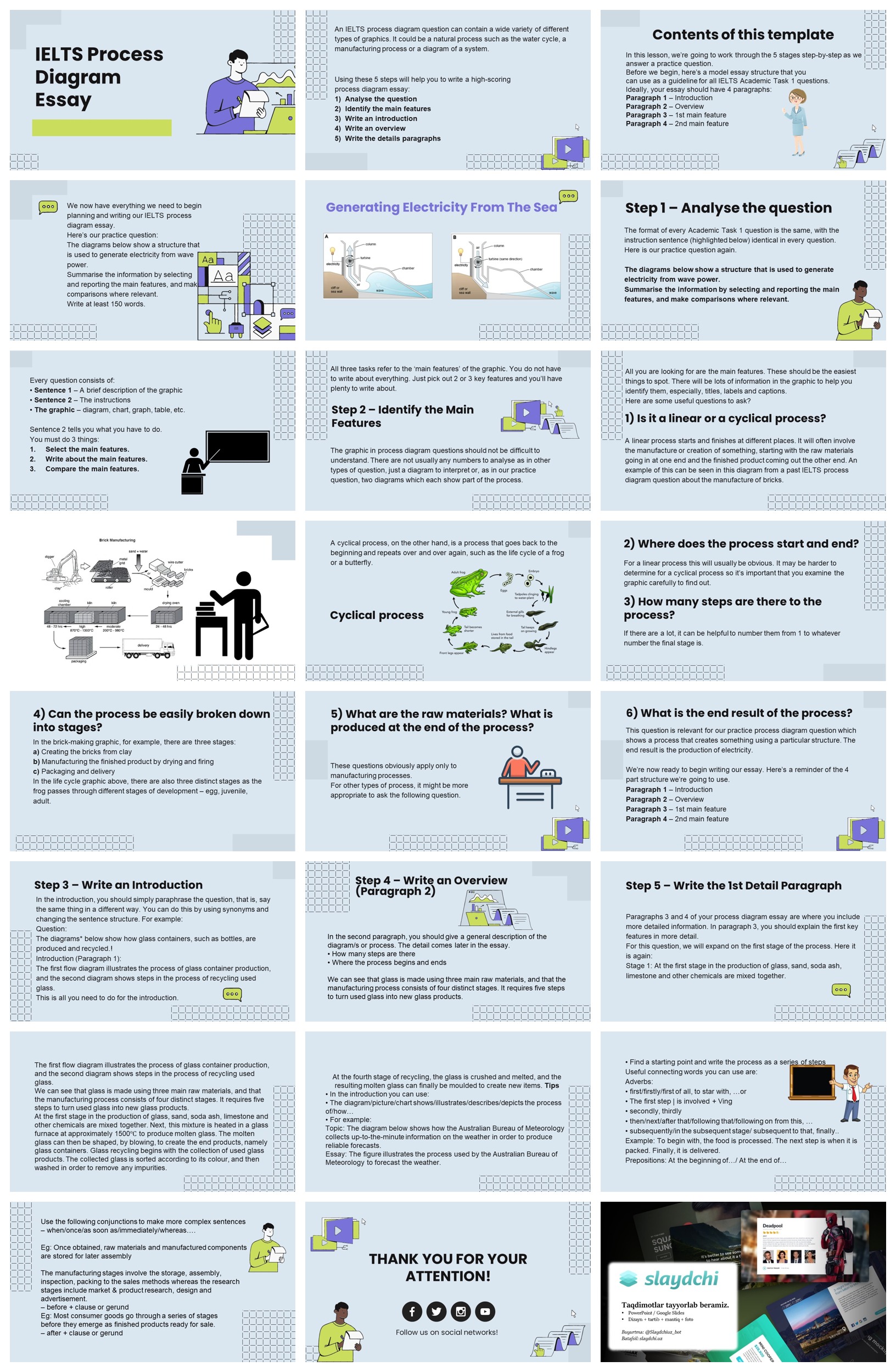
IELTS Process Diagram Essay
Slayd 2
An IELTS process diagram question can contain a wide variety of different types of graphics. It could be a natural process such as the water cycle, a manufacturing process or a diagram of a system.
Using these 5 steps will help you to write a high-scoring process diagram essay:
1) Analyse the question
2) Identify the main features
3) Write an introduction
4) Write an overview
5) Write the details paragraphs
Slayd 3
Contents of this template
In this lesson, we’re going to work through the 5 stages step-by-step as we answer a practice question.
Before we begin, here’s a model essay structure that you
can use as a guideline for all IELTS Academic Task 1 questions.
Ideally, your essay should have 4 paragraphs:
Paragraph 1 – Introduction
Paragraph 2 – Overview
Paragraph 3 – 1st main feature
Paragraph 4 – 2nd main feature
Slayd 4
We now have everything we need to begin planning and writing our IELTS process diagram essay.
Here’s our practice question:
The diagrams below show a structure that is used to generate electricity from wave power.
Summarise the information by selecting and reporting the main features, and make comparisons where relevant.
Write at least 150 words.
Slayd 5
Generating Electricity From The Sea
Slayd 6
Step 1 – Analyse the question
The format of every Academic Task 1 question is the same, with the instruction sentence (highlighted below) identical in every question. Here is our practice question again.
The diagrams below show a structure that is used to generate electricity from wave power.
Summarise the information by selecting and reporting the main features, and make comparisons where relevant.
Slayd 7
Every question consists of:
• Sentence 1 – A brief description of the graphic
• Sentence 2 – The instructions
• The graphic – diagram, chart, graph, table, etc.
Sentence 2 tells you what you have to do.
You must do 3 things:
1. Select the main features.
2. Write about the main features.
3. Compare the main features.
Slayd 8
Step 2 – Identify the Main Features
All three tasks refer to the ‘main features’ of the graphic. You do not have to write about everything. Just pick out 2 or 3 key features and you’ll have plenty to write about.
The graphic in process diagram questions should not be difficult to understand. There are not usually any numbers to analyse as in other types of question, just a diagram to interpret or, as in our practice question, two diagrams which each show part of the process.
Slayd 9
1) Is it a linear or a cyclical process?
All you are looking for are the main features. These should be the easiest things to spot. There will be lots of information in the graphic to help you identify them, especially, titles, labels and captions.
Here are some useful questions to ask?
A linear process starts and finishes at different places. It will often involve the manufacture or creation of something, starting with the raw materials going in at one end and the finished product coming out the other end. An example of this can be seen in this diagram from a past IELTS process diagram question about the manufacture of bricks.
Slayd 10
Slayd 11
Cyclical process
A cyclical process, on the other hand, is a process that goes back to the beginning and repeats over and over again, such as the life cycle of a frog or a butterfly.
Slayd 12
2) Where does the process start and end?
If there are a lot, it can be helpful to number them from 1 to whatever number the final stage is.
For a linear process this will usually be obvious. It may be harder to determine for a cyclical process so it’s important that you examine the graphic carefully to find out.
3) How many steps are there to the process?
Slayd 13
4) Can the process be easily broken down into stages?
In the brick-making graphic, for example, there are three stages:
a) Creating the bricks from clay
b) Manufacturing the finished product by drying and firing
c) Packaging and delivery
In the life cycle graphic above, there are also three distinct stages as the frog passes through different stages of development – egg, juvenile, adult.
Slayd 14
5) What are the raw materials? What is produced at the end of the process?
These questions obviously apply only to manufacturing processes.
For other types of process, it might be more appropriate to ask the following question.
Slayd 15
6) What is the end result of the process?
This question is relevant for our practice process diagram question which shows a process that creates something using a particular structure. The end result is the production of electricity.
We’re now ready to begin writing our essay. Here’s a reminder of the 4 part structure we’re going to use.
Paragraph 1 – Introduction
Paragraph 2 – Overview
Paragraph 3 – 1st main feature
Paragraph 4 – 2nd main feature
Slayd 16
Step 3 – Write an Introduction
In the introduction, you should simply paraphrase the question, that is, say the same thing in a different way. You can do this by using synonyms and changing the sentence structure. For example:
Question:
The diagrams* below show how glass containers, such as bottles, are produced and recycled.!
Introduction (Paragraph 1):
The first flow diagram illustrates the process of glass container production, and the second diagram shows steps in the process of recycling used glass.
This is all you need to do for the introduction.
Slayd 17
Step 4 – Write an Overview (Paragraph 2)
In the second paragraph, you should give a general description of the diagram/s or process. The detail comes later in the essay.
• How many steps are there
• Where the process begins and ends
We can see that glass is made using three main raw materials, and that the manufacturing process consists of four distinct stages. It requires five steps to turn used glass into new glass products.
Slayd 18
Paragraphs 3 and 4 of your process diagram essay are where you include more detailed information. In paragraph 3, you should explain the first key features in more detail.
For this question, we will expand on the first stage of the process. Here it is again:
Stage 1: At the first stage in the production of glass, sand, soda ash, limestone and other chemicals are mixed together.
Step 5 – Write the 1st Detail Paragraph
Slayd 19
The first flow diagram illustrates the process of glass container production, and the second diagram shows steps in the process of recycling used glass.
We can see that glass is made using three main raw materials, and that the manufacturing process consists of four distinct stages. It requires five steps to turn used glass into new glass products.
At the first stage in the production of glass, sand, soda ash, limestone and other chemicals are mixed together. Next, this mixture is heated in a glass furnace at approximately 1500℃ to produce molten glass. The molten glass can then be shaped, by blowing, to create the end products, namely glass containers. Glass recycling begins with the collection of used glass products. The collected glass is sorted according to its colour, and then washed in order to remove any impurities.
Slayd 20
At the fourth stage of recycling, the glass is crushed and melted, and the resulting molten glass can finally be moulded to create new items. Tips
• In the introduction you can use:
• The diagram/picture/chart shows/illustrates/describes/depicts the process of/how…
• For example:
Topic: The diagram below shows how the Australian Bureau of Meteorology collects up-to-the-minute information on the weather in order to produce reliable forecasts.
Essay: The figure illustrates the process used by the Australian Bureau of Meteorology to forecast the weather.
Slayd 21
• Find a starting point and write the process as a series of steps
Useful connecting words you can use are:
Adverbs:
• first/firstly/first of all, to star with, …or
• The first step | is involved + Ving
• secondly, thirdly
• then/next/after that/following that/following on from this, …
• subsequently/in the subsequent stage/ subsequent to that, finally..
Example: To begin with, the food is processed. The next step is when it is packed. Finally, it is delivered.
Prepositions: At the beginning of…/ At the end of…
Slayd 22
Use the following conjunctions to make more complex sentences
– when/once/as soon as/immediately/whereas….
Eg: Once obtained, raw materials and manufactured components are stored for later assembly
The manufacturing stages involve the storage, assembly, inspection, packing to the sales methods whereas the research stages include market & product research, design and advertisement.
– before + clause or gerund
Eg: Most consumer goods go through a series of stages
before they emerge as finished products ready for sale.
– after + clause or gerund
Slayd 23
THANK YOU FOR YOUR ATTENTION!
Follow us on social networks!
Slayd 24
Foydali havolalar
🛒 Barcha taqdimotlar | 📰 Yangiliklar | ℹ️ Biz haqimizda












Sharhlar
Hali sharhlar mavjud emas.