



Slayd 1
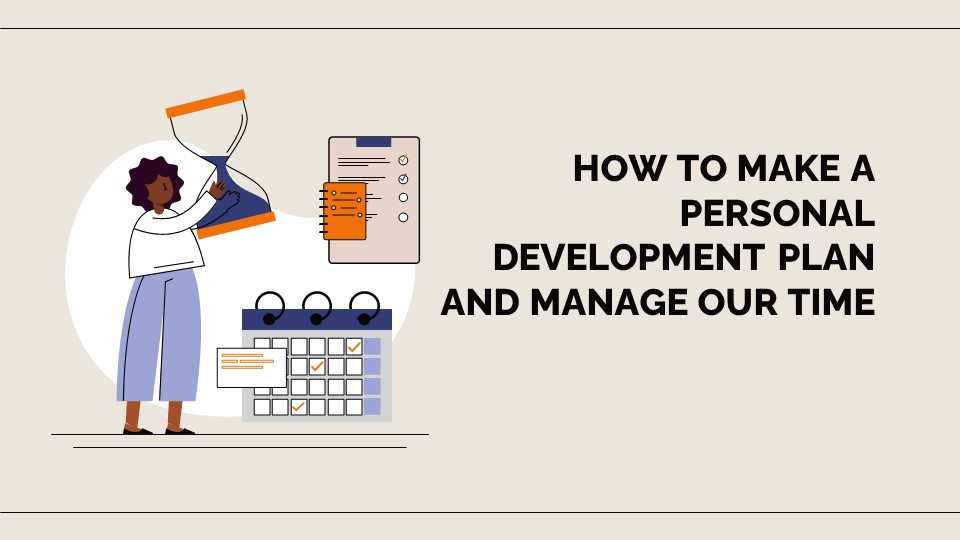
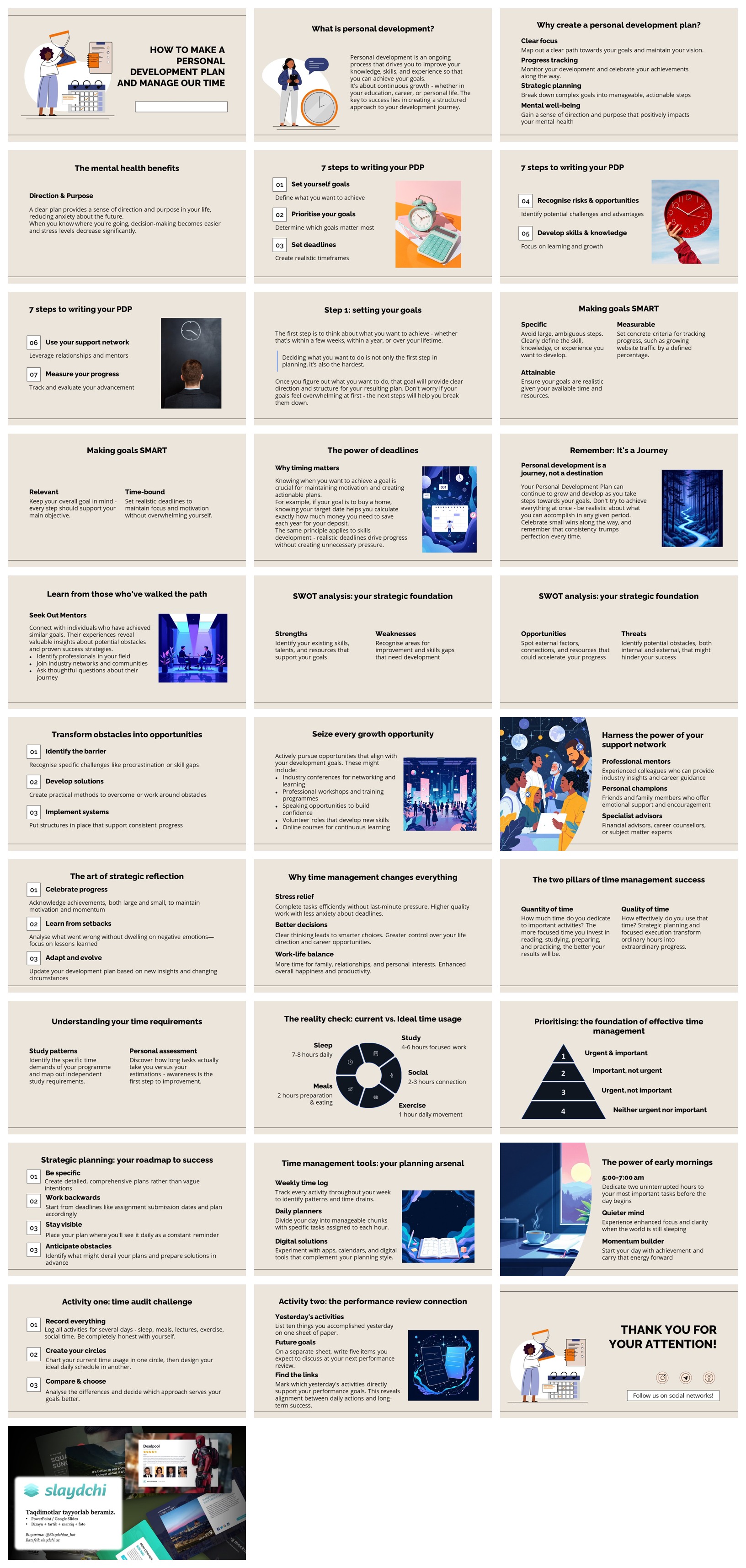
HOW TO MAKE A PERSONAL DEVELOPMENT PLAN AND MANAGE OUR TIME
Slayd 2
What is personal development?
Personal development is an ongoing process that drives you to improve your knowledge, skills, and experience so that you can achieve your goals.
It’s about continuous growth – whether in your education, career, or personal life. The key to success lies in creating a structured approach to your development journey.
Slayd 3
Why create a personal development plan?
Clear focus
Map out a clear path towards your goals and maintain your vision.
Progress tracking
Monitor your development and celebrate your achievements along the way.
Strategic planning
Break down complex goals into manageable, actionable steps
Mental well-being
Gain a sense of direction and purpose that positively impacts your mental health
Slayd 4
The mental health benefits
A clear plan provides a sense of direction and purpose in your life, reducing anxiety about the future.
When you know where you’re going, decision-making becomes easier and stress levels decrease significantly.
Direction & Purpose
Slayd 5
7 steps to writing your PDP
01
Define what you want to achieve
Set yourself goals
02
Determine which goals matter most
Prioritise your goals
03
Create realistic timeframes
Set deadlines
Slayd 6
7 steps to writing your PDP
04
Identify potential challenges and advantages
Recognise risks & opportunities
05
Focus on learning and growth
Develop skills & knowledge
Slayd 7
7 steps to writing your PDP
06
Leverage relationships and mentors
Use your support network
07
Track and evaluate your advancement
Measure your progress
Slayd 8
Step 1: setting your goals
The first step is to think about what you want to achieve – whether that’s within a few weeks, within a year, or over your lifetime.
Deciding what you want to do is not only the first step in planning, it’s also the hardest.
Once you figure out what you want to do, that goal will provide clear direction and structure for your resulting plan. Don’t worry if your goals feel overwhelming at first – the next steps will help you break them down.
Slayd 9
Making goals SMART
Specific
Avoid large, ambiguous steps. Clearly define the skill, knowledge, or experience you want to develop.
Measurable
Set concrete criteria for tracking progress, such as growing website traffic by a defined percentage.
Attainable
Ensure your goals are realistic given your available time and resources.
Slayd 10
Making goals SMART
Relevant
Keep your overall goal in mind – every step should support your main objective.
Time-bound
Set realistic deadlines to maintain focus and motivation without overwhelming yourself.
Slayd 11
The power of deadlines
Why timing matters
Knowing when you want to achieve a goal is crucial for maintaining motivation and creating actionable plans.
For example, if your goal is to buy a home, knowing your target date helps you calculate exactly how much money you need to save each year for your deposit.
The same principle applies to skills development – realistic deadlines drive progress without creating unnecessary pressure.
Slayd 12
Remember: It’s a Journey
Personal development is a journey, not a destination
Your Personal Development Plan can continue to grow and develop as you take steps towards your goals. Don’t try to achieve everything at once – be realistic about what you can accomplish in any given period.
Celebrate small wins along the way, and remember that consistency trumps perfection every time.
Slayd 13
Learn from those who’ve walked the path
Seek Out Mentors
Connect with individuals who have achieved similar goals. Their experiences reveal valuable insights about potential obstacles and proven success strategies.
Identify professionals in your field
Join industry networks and communities
Ask thoughtful questions about their journey
Slayd 14
SWOT analysis: your strategic foundation
Strengths
Identify your existing skills, talents, and resources that support your goals
Weaknesses
Recognise areas for improvement and skills gaps that need development
Slayd 15
SWOT analysis: your strategic foundation
Opportunities
Spot external factors, connections, and resources that could accelerate your progress
Threats
Identify potential obstacles, both internal and external, that might hinder your success
Slayd 16
Transform obstacles into opportunities
01
Recognise specific challenges like procrastination or skill gaps
Identify the barrier
02
Create practical methods to overcome or work around obstacles
Develop solutions
03
Put structures in place that support consistent progress
Implement systems
Slayd 17
Seize every growth opportunity
Actively pursue opportunities that align with your development goals. These might include:
Industry conferences for networking and learning
Professional workshops and training programmes
Speaking opportunities to build confidence
Volunteer roles that develop new skills
Online courses for continuous learning
Slayd 18
Harness the power of your support network
Professional mentors
Experienced colleagues who can provide industry insights and career guidance
Personal champions
Friends and family members who offer emotional support and encouragement
Specialist advisors
Financial advisors, career counsellors, or subject matter experts
Slayd 19
The art of strategic reflection
01
Acknowledge achievements, both large and small, to maintain motivation and momentum
Celebrate progress
02
Analyse what went wrong without dwelling on negative emotions—focus on lessons learned
Learn from setbacks
03
Update your development plan based on new insights and changing circumstances
Adapt and evolve
Slayd 20
Why time management changes everything
Complete tasks efficiently without last-minute pressure. Higher quality work with less anxiety about deadlines.
Stress relief
Clear thinking leads to smarter choices. Greater control over your life direction and career opportunities.
Better decisions
More time for family, relationships, and personal interests. Enhanced overall happiness and productivity.
Work-life balance
Slayd 21
The two pillars of time management success
Quantity of time
How much time do you dedicate to important activities? The more focused time you invest in reading, studying, preparing, and practicing, the better your results will be.
Quality of time
How effectively do you use that time? Strategic planning and focused execution transform ordinary hours into extraordinary progress.
Slayd 22
Understanding your time requirements
Study patterns
Identify the specific time demands of your programme and map out independent study requirements.
Personal assessment
Discover how long tasks actually take you versus your estimations – awareness is the first step to improvement.
Slayd 23
The reality check: current vs. Ideal time usage
Sleep
7-8 hours daily
Meals
2 hours preparation & eating
Study
4-6 hours focused work
Social
2-3 hours connection
Exercise
1 hour daily movement
Slayd 24
Prioritising: the foundation of effective time management
Urgent & important
1
2
3
4
Important, not urgent
Urgent, not important
Neither urgent nor important
Slayd 25
Strategic planning: your roadmap to success
01
Create detailed, comprehensive plans rather than vague intentions
Be specific
02
Start from deadlines like assignment submission dates and plan accordingly
Work backwards
03
Place your plan where you’ll see it daily as a constant reminder
Stay visible
Identify what might derail your plans and prepare solutions in advance
Anticipate obstacles
Slayd 26
Time management tools: your planning arsenal
Weekly time log
Track every activity throughout your week to identify patterns and time drains.
Daily planners
Divide your day into manageable chunks with specific tasks assigned to each hour.
Digital solutions
Experiment with apps, calendars, and digital tools that complement your planning style.
Slayd 27
The power of early mornings
5:00-7:00 am
Dedicate two uninterrupted hours to your most important tasks before the day begins
Quieter mind
Experience enhanced focus and clarity when the world is still sleeping
Momentum builder
Start your day with achievement and carry that energy forward
Slayd 28
Activity one: time audit challenge
01
Log all activities for several days – sleep, meals, lectures, exercise, social time. Be completely honest with yourself.
Record everything
02
Chart your current time usage in one circle, then design your ideal daily schedule in another.
Create your circles
03
Analyse the differences and decide which approach serves your goals better.
Compare & choose
Slayd 29
Activity two: the performance review connection
Yesterday’s activities
List ten things you accomplished yesterday on one sheet of paper.
Future goals
On a separate sheet, write five items you expect to discuss at your next performance review.
Find the links
Mark which yesterday’s activities directly support your performance goals. This reveals alignment between daily actions and long-term success.
Slayd 30
THANK YOU FOR YOUR ATTENTION!
Follow us on social networks!
Slayd 31
Foydali havolalar
🛒 Barcha taqdimotlar | 📰 Yangiliklar | ℹ️ Biz haqimizda


















Sharhlar
Hali sharhlar mavjud emas.