


Slayd 1
Hobbies/Interests Sentence completion (listening)Model Two Minute Talk (speaking)
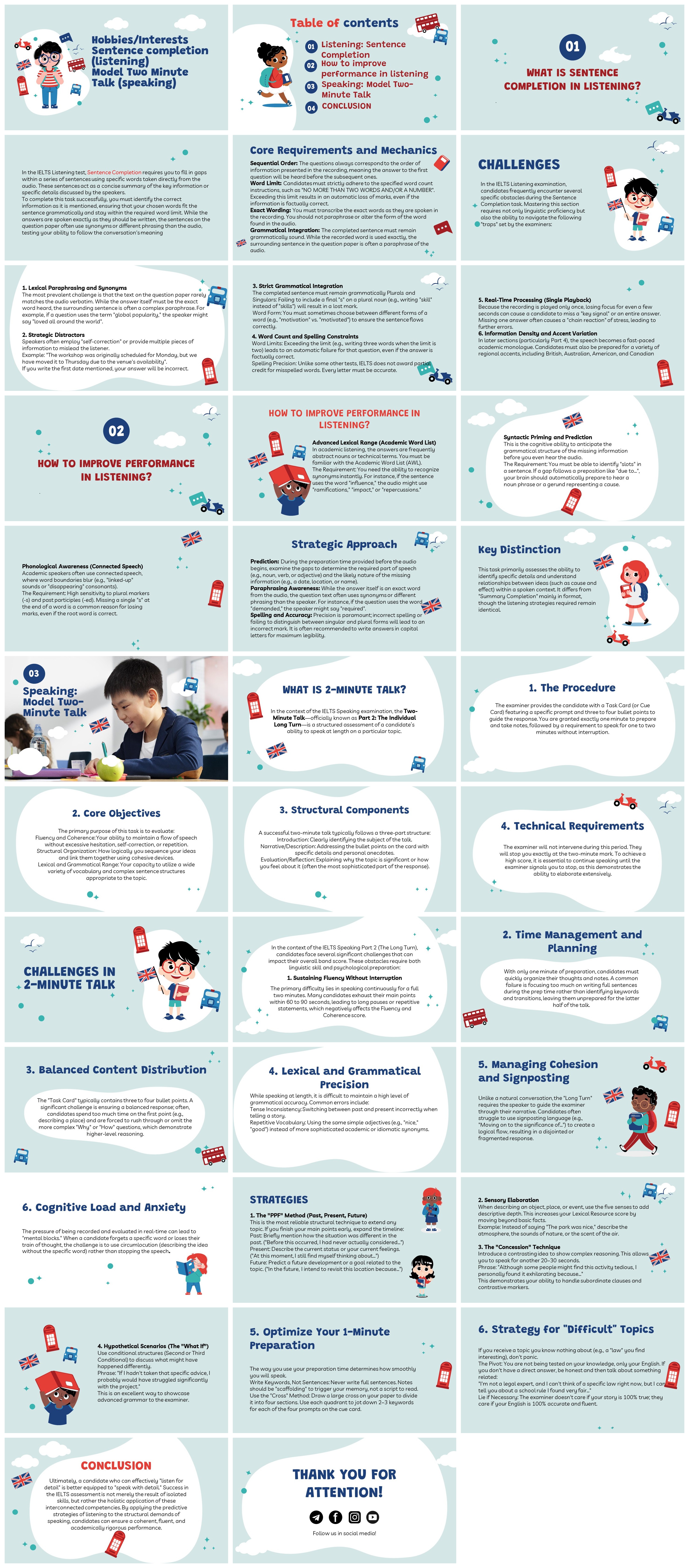
Slayd 2
01
Listening: Sentence Completion
How to improve performance in listening
02
Speaking: Model Two-Minute Talk
03
CONCLUSION
04
Table of contents
Slayd 3
WHAT IS SENTENCE COMPLETION IN LISTENING?
01
.
Slayd 4
In the IELTS Listening test, Sentence Completion requires you to fill in gaps within a series of sentences using specific words taken directly from the audio. These sentences act as a concise summary of the key information or specific details discussed by the speakers.To complete this task successfully, you must identify the correct information as it is mentioned, ensuring that your chosen words fit the sentence grammatically and stay within the required word limit. While the answers are spoken exactly as they should be written, the sentences on the question paper often use synonyms or different phrasing than the audio, testing your ability to follow the conversation’s meaning
Slayd 5
Core Requirements and Mechanics
Sequential Order: The questions always correspond to the order of information presented in the recording, meaning the answer to the first question will be heard before the subsequent ones.
Word Limit: Candidates must strictly adhere to the specified word count instructions, such as «NO MORE THAN TWO WORDS AND/OR A NUMBER». Exceeding this limit results in an automatic loss of marks, even if the information is factually correct.
Exact Wording: You must transcribe the exact words as they are spoken in the recording. You should not paraphrase or alter the form of the word found in the audio.
Grammatical Integration: The completed sentence must remain grammatically sound. While the recorded word is used exactly, the surrounding sentence in the question paper is often a paraphrase of the audio.
Slayd 6
CHALLENGES
In the IELTS Listening examination, candidates frequently encounter several specific obstacles during the Sentence Completion task. Mastering this section requires not only linguistic proficiency but also the ability to navigate the following «traps» set by the examiners:
Slayd 7
1. Lexical Paraphrasing and Synonyms
The most prevalent challenge is that the text on the question paper rarely matches the audio verbatim. While the answer itself must be the exact word heard, the surrounding sentence is often a complex paraphrase. For example, if a question uses the term «global popularity,» the speaker might say «loved all around the world».
2. Strategic Distractors
Speakers often employ «self-correction» or provide multiple pieces of information to mislead the listener.
Example: «The workshop was originally scheduled for Monday, but we have moved it to Thursday due to the venue’s availability».
If you write the first date mentioned, your answer will be incorrect.
Slayd 8
3. Strict Grammatical Integration
The completed sentence must remain grammatically Plurals and Singulars: Failing to include a final «s» on a plural noun (e.g., writing «skill» instead of «skills») will result in a lost mark.
Word Form: You must sometimes choose between different forms of a word (e.g., «motivation» vs. «motivated») to ensure the sentence flows correctly.
4. Word Count and Spelling ConstraintsWord Limits: Exceeding the limit (e.g., writing three words when the limit is two) leads to an automatic failure for that question, even if the answer is factually correct.Spelling Precision: Unlike some other tests, IELTS does not award partial credit for misspelled words. Every letter must be accurate.
Slayd 9
5. Real-Time Processing (Single Playback)Because the recording is played only once, losing focus for even a few seconds can cause a candidate to miss a «key signal» or an entire answer. Missing one answer often causes a «chain reaction» of stress, leading to further errors. 6. Information Density and Accent VariationIn later sections (particularly Part 4), the speech becomes a fast-paced academic monologue. Candidates must also be prepared for a variety of regional accents, including British, Australian, American, and Canadian
Slayd 10
HOW TO IMPROVE PERFORMANCE IN LISTENING?
02
.
Slayd 11
Advanced Lexical Range (Academic Word List)In academic listening, the answers are frequently abstract nouns or technical terms. You must be familiar with the Academic Word List (AWL).The Requirement: You need the ability to recognize synonyms instantly. For instance, if the sentence uses the word «influence,» the audio might use «ramifications,» «impact,» or «repercussions.»
HOW TO IMPROVE PERFORMANCE IN LISTENING?
Slayd 12
Syntactic Priming and Prediction
This is the cognitive ability to anticipate the grammatical structure of the missing information before you even hear the audio.
The Requirement: You must be able to identify «slots» in a sentence. If a gap follows a preposition like «due to…», your brain should automatically prepare to hear a noun phrase or a gerund representing a cause.
Slayd 13
.
Phonological Awareness (Connected Speech)
Academic speakers often use connected speech, where word boundaries blur (e.g., «linked-up» sounds or «disappearing» consonants).
The Requirement: High sensitivity to plural markers (-s) and past participles (-ed). Missing a single «s» at the end of a word is a common reason for losing marks, even if the root word is correct.
Slayd 14
Strategic Approach
Prediction: During the preparation time provided before the audio begins, examine the gaps to determine the required part of speech (e.g., noun, verb, or adjective) and the likely nature of the missing information (e.g., a date, location, or name).
Paraphrasing Awareness: While the answer itself is an exact word from the audio, the question text often uses synonyms or different phrasing than the speaker. For instance, if the question uses the word «demanded,» the speaker might say «required».
Spelling and Accuracy: Precision is paramount; incorrect spelling or failing to distinguish between singular and plural forms will lead to an incorrect mark. It is often recommended to write answers in capital letters for maximum legibility.
Slayd 15
Key Distinction
This task primarily assesses the ability to identify specific details and understand relationships between ideas (such as cause and effect) within a spoken context. It differs from «Summary Completion» mainly in format, though the listening strategies required remain identical.
Slayd 16
Speaking: Model Two-Minute Talk
03
Slayd 17
WHAT IS 2-MINUTE TALK?
In the context of the IELTS Speaking examination, the Two-Minute Talk—officially known as Part 2: The Individual Long Turn—is a structured assessment of a candidate’s ability to speak at length on a particular topic.
Slayd 18
1. The Procedure
The examiner provides the candidate with a Task Card (or Cue Card) featuring a specific prompt and three to four bullet points to guide the response. You are granted exactly one minute to prepare and take notes, followed by a requirement to speak for one to two minutes without interruption.
30%
90%
Slayd 19
The primary purpose of this task is to evaluate:
Fluency and Coherence: Your ability to maintain a flow of speech without excessive hesitation, self-correction, or repetition.
Structural Organization: How logically you sequence your ideas and link them together using cohesive devices.
Lexical and Grammatical Range: Your capacity to utilize a wide variety of vocabulary and complex sentence structures appropriate to the topic.
2. Core Objectives
Slayd 20
A successful two-minute talk typically follows a three-part structure:
Introduction: Clearly identifying the subject of the talk.
Narrative/Description: Addressing the bullet points on the card with specific details and personal anecdotes.
Evaluation/Reflection: Explaining why the topic is significant or how you feel about it (often the most sophisticated part of the response).
3. Structural Components
Slayd 21
4. Technical Requirements
The examiner will not intervene during this period. They will stop you exactly at the two-minute mark. To achieve a high score, it is essential to continue speaking until the examiner signals you to stop, as this demonstrates the ability to elaborate extensively.
Slayd 22
CHALLENGES IN 2-MINUTE TALK
Slayd 23
In the context of the IELTS Speaking Part 2 (The Long Turn), candidates face several significant challenges that can impact their overall band score. These obstacles require both linguistic skill and psychological preparation:
1. Sustaining Fluency Without Interruption
The primary difficulty lies in speaking continuously for a full two minutes. Many candidates exhaust their main points within 60 to 90 seconds, leading to long pauses or repetitive statements, which negatively affects the Fluency and Coherence score.
Slayd 24
2. Time Management and Planning
With only one minute of preparation, candidates must quickly organize their thoughts and notes. A common failure is focusing too much on writing full sentences during the prep time rather than identifying keywords and transitions, leaving them unprepared for the latter half of the talk.
Slayd 25
3. Balanced Content Distribution
The «Task Card» typically contains three to four bullet points. A significant challenge is ensuring a balanced response; often, candidates spend too much time on the first point (e.g., describing a place) and are forced to rush through or omit the more complex «Why» or «How» questions, which demonstrate higher-level reasoning.
Slayd 26
While speaking at length, it is difficult to maintain a high level of grammatical accuracy. Common errors include:
Tense Inconsistency: Switching between past and present incorrectly when telling a story.
Repetitive Vocabulary: Using the same simple adjectives (e.g., «nice,» «good») instead of more sophisticated academic or idiomatic synonyms.
4. Lexical and Grammatical Precision
Slayd 27
5. Managing Cohesion and Signposting
Unlike a natural conversation, the «Long Turn» requires the speaker to guide the examiner through their narrative. Candidates often struggle to use signposting language (e.g., «Moving on to the significance of…») to create a logical flow, resulting in a disjointed or fragmented response.
Slayd 28
6. Cognitive Load and AnxietyThe pressure of being recorded and evaluated in real-time can lead to «mental blocks.» When a candidate forgets a specific word or loses their train of thought, the challenge is to use circumlocution (describing the idea without the specific word) rather than stopping the speech.
Slayd 29
STRATEGIES
1. The «PPF» Method (Past, Present, Future)
This is the most reliable structural technique to extend any topic. If you finish your main points early, expand the timeline:
Past: Briefly mention how the situation was different in the past. («Before this occurred, I had never actually considered…»)
Present: Describe the current status or your current feelings. («At this moment, I still find myself thinking about…»)
Future: Predict a future development or a goal related to the topic. («In the future, I intend to revisit this location because…»)
Slayd 30
2. Sensory Elaboration
When describing an object, place, or event, use the five senses to add descriptive depth. This increases your Lexical Resource score by moving beyond basic facts.
Example: Instead of saying «The park was nice,» describe the atmosphere, the sounds of nature, or the scent of the air.
3. The «Concession» Technique
Introduce a contrasting idea to show complex reasoning. This allows you to speak for another 20–30 seconds.
Phrase: «Although some people might find this activity tedious, I personally found it exhilarating because…»
This demonstrates your ability to handle subordinate clauses and contrastive markers.
Slayd 31
4. Hypothetical Scenarios (The «What If»)Use conditional structures (Second or Third Conditional) to discuss what might have happened differently.Phrase: «If I hadn’t taken that specific advice, I probably would have struggled significantly with the project.»This is an excellent way to showcase advanced grammar to the examiner.
Slayd 32
5. Optimize Your 1-Minute Preparation
The way you use your preparation time determines how smoothly you will speak.
Write Keywords, Not Sentences: Never write full sentences. Notes should be «scaffolding» to trigger your memory, not a script to read.
Use the «Cross» Method: Draw a large cross on your paper to divide it into four sections. Use each quadrant to jot down 2–3 keywords for each of the four prompts on the cue card.
Slayd 33
6. Strategy for «Difficult» Topics
If you receive a topic you know nothing about (e.g., a «law» you find interesting), don’t panic.
The Pivot: You are not being tested on your knowledge, only your English. If you don’t have a direct answer, be honest and then talk about something related:
«I’m not a legal expert, and I can’t think of a specific law right now, but I can tell you about a school rule I found very fair…»
Lie if Necessary: The examiner doesn’t care if your story is 100% true; they care if your English is 100% accurate and fluent.
.
.
Slayd 34
CONCLUSION
Ultimately, a candidate who can effectively «listen for detail» is better equipped to «speak with detail.» Success in the IELTS assessment is not merely the result of isolated skills, but rather the holistic application of these interconnected competencies. By applying the predictive strategies of listening to the structural demands of speaking, candidates can ensure a coherent, fluent, and academically rigorous performance.
Slayd 35
THANK YOU FOR ATTENTION!
Follow us in social media!
Slayd 36
Foydali havolalar
🛒 Barcha taqdimotlar | 📰 Yangiliklar | ℹ️ Biz haqimizda











Sharhlar
Hali sharhlar mavjud emas.