




Slayd 1
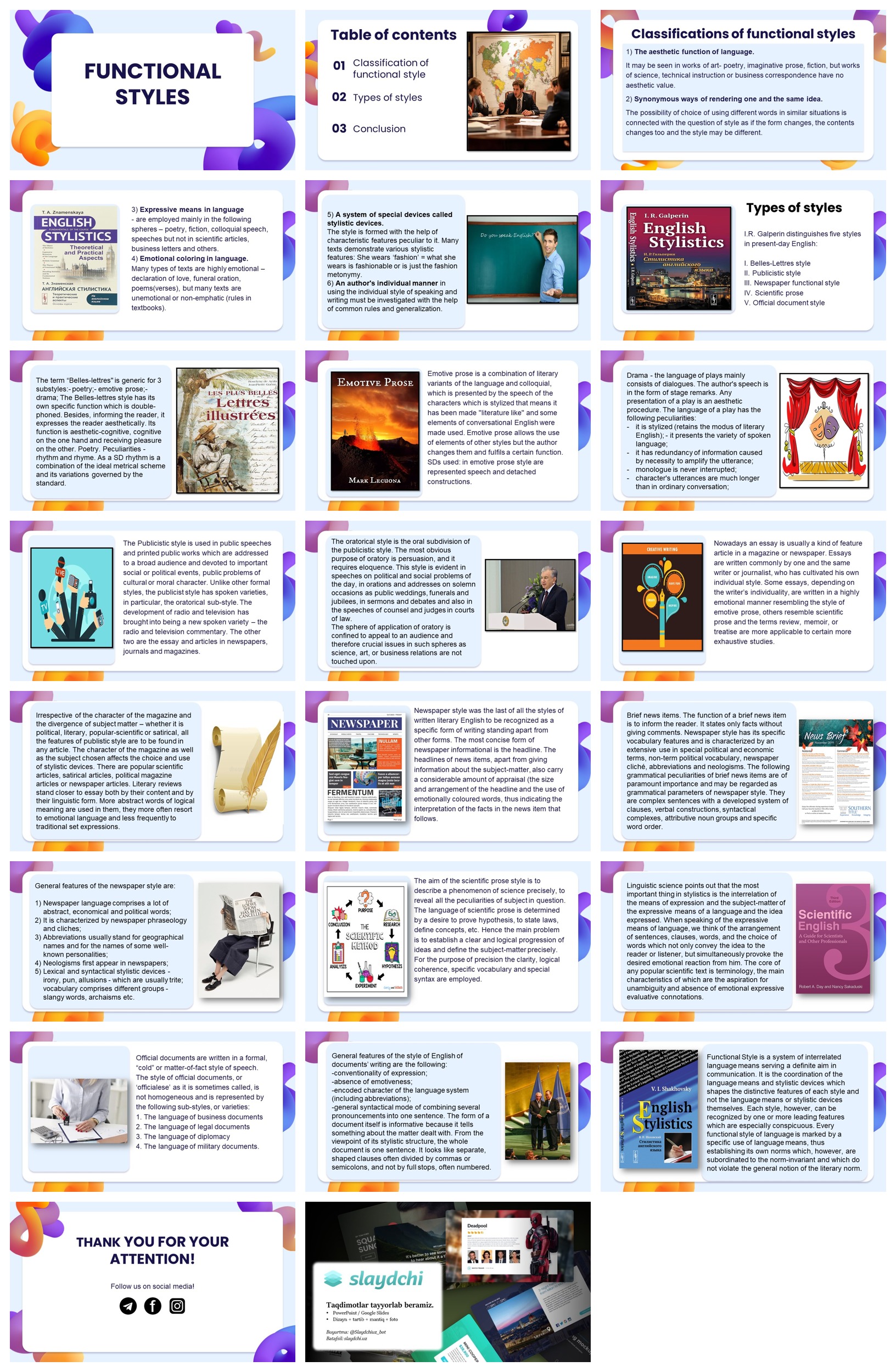
FUNCTIONAL STYLES
Slayd 2
Classification of functional style
Table of contents
01
02
Types of styles
03
Conclusion
Slayd 3
Classifications of functional styles
1) The aesthetic function of language.
It may be seen in works of art- poetry, imaginative prose, fiction, but works of science, technical instruction or business correspondence have no aesthetic value.
2) Synonymous ways of rendering one and the same idea.
The possibility of choice of using different words in similar situations is connected with the question of style as if the form changes, the contents changes too and the style may be different.
Slayd 4
3) Expressive means in language
– are employed mainly in the following spheres – poetry, fiction, colloquial speech, speeches but not in scientific articles, business letters and others.
4) Emotional coloring in language.
Many types of texts are highly emotional – declaration of love, funeral oration, poems(verses), but many texts are unemotional or non-emphatic (rules in textbooks).
Slayd 5
5) A system of special devices called stylistic devices.
The style is formed with the help of characteristic features peculiar to it. Many texts demonstrate various stylistic features: She wears ‘fashion’ = what she wears is fashionable or is just the fashion metonymy.
6) An author’s individual manner in using the individual style of speaking and writing must be investigated with the help of common rules and generalization.
Slayd 6
I.R. Galperin distinguishes five styles in present-day English:
I. Belles-Lettres style
II. Publicistic style
III. Newspaper functional style
IV. Scientific prose V. Official document style
Types of styles
Slayd 7
The term “Belles-lettres» is generic for 3 substyles:- poetry;- emotive prose;- drama; The Belles-lettres style has its own specific function which is double-phoned. Besides, informing the reader, it expresses the reader aesthetically. Its function is aesthetic-cognitive, cognitive on the one hand and receiving pleasure on the other. Poetry. Peculiarities – rhythm and rhyme. As a SD rhythm is a combination of the ideal metrical scheme and its variations governed by the standard.
Slayd 8
Emotive prose is a combination of literary variants of the language and colloquial, which is presented by the speech of the characters which is stylized that means it has been made «literature like» and some elements of conversational English were made used. Emotive prose allows the use of elements of other styles but the author changes them and fulfils a certain function. SDs used: in emotive prose style are represented speech and detached constructions.
Slayd 9
Drama – the language of plays mainly consists of dialogues. The author’s speech is in the form of stage remarks. Any presentation of a play is an aesthetic procedure. The language of a play has the following peculiarities:
it is stylized (retains the modus of literary English); – it presents the variety of spoken language;
it has redundancy of information caused by necessity to amplify the utterance;
monologue is never interrupted;
character’s utterances are much longer than in ordinary conversation;
Slayd 10
The Publicistic style is used in public speeches and printed public works which are addressed to a broad audience and devoted to important social or political events, public problems of cultural or moral character. Unlike other formal styles, the publicist style has spoken varieties, in particular, the oratorical sub-style. The development of radio and television has brought into being a new spoken variety – the radio and television commentary. The other two are the essay and articles in newspapers, journals and magazines.
Slayd 11
The oratorical style is the oral subdivision of the publicistic style. The most obvious purpose of oratory is persuasion, and it requires eloquence. This style is evident in speeches on political and social problems of the day, in orations and addresses on solemn occasions as public weddings, funerals and jubilees, in sermons and debates and also in the speeches of counsel and judges in courts of law.
The sphere of application of oratory is confined to appeal to an audience and therefore crucial issues in such spheres as science, art, or business relations are not touched upon.
Slayd 12
Nowadays an essay is usually a kind of feature article in a magazine or newspaper. Essays are written commonly by one and the same writer or journalist, who has cultivated his own individual style. Some essays, depending on the writer’s individuality, are written in a highly emotional manner resembling the style of emotive prose, others resemble scientific prose and the terms review, memoir, or treatise are more applicable to certain more exhaustive studies.
Slayd 13
Irrespective of the character of the magazine and the divergence of subject matter – whether it is political, literary, popular-scientific or satirical, all the features of publistic style are to be found in any article. The character of the magazine as well as the subject chosen affects the choice and use of stylistic devices. There are popular scientific articles, satirical articles, political magazine articles or newspaper articles. Literary reviews stand closer to essay both by their content and by their linguistic form. More abstract words of logical meaning are used in them, they more often resort to emotional language and less frequently to traditional set expressions.
Slayd 14
Newspaper style was the last of all the styles of written literary English to be recognized as a specific form of writing standing apart from other forms. The most concise form of newspaper informational is the headline. The headlines of news items, apart from giving information about the subject-matter, also carry a considerable amount of appraisal (the size and arrangement of the headline and the use of emotionally coloured words, thus indicating the interpretation of the facts in the news item that follows.
Slayd 15
Brief news items. The function of a brief news item is to inform the reader. It states only facts without giving comments. Newspaper style has its specific vocabulary features and is characterized by an extensive use in special political and economic terms, non-term political vocabulary, newspaper cliché, abbreviations and neologisms. The following grammatical peculiarities of brief news items are of paramount importance and may be regarded as grammatical parameters of newspaper style. They are complex sentences with a developed system of clauses, verbal constructions, syntactical complexes, attributive noun groups and specific word order.
Slayd 16
General features of the newspaper style are:
1) Newspaper language comprises a lot of abstract, economical and political words;
2) It is characterized by newspaper phraseology and cliches;
3) Abbreviations usually stand for geographical names and for the names of some well-known personalities;
4) Neologisms first appear in newspapers;
5) Lexical and syntactical stylistic devices – irony, pun, allusions – which are usually trite; vocabulary comprises different groups – slangy words, archaisms etc.
Slayd 17
The aim of the scientific prose style is to describe a phenomenon of science precisely, to reveal all the peculiarities of subject in question. The language of scientific prose is determined by a desire to prove hypothesis, to state laws, define concepts, etc. Hence the main problem is to establish a clear and logical progression of ideas and define the subject-matter precisely. For the purpose of precision the clarity, logical coherence, specific vocabulary and special syntax are employed.
Slayd 18
Linguistic science points out that the most important thing in stylistics is the interrelation of the means of expression and the subject-matter of the expressive means of a language and the idea expressed. When speaking of the expressive means of language, we think of the arrangement of sentences, clauses, words, and the choice of words which not only convey the idea to the reader or listener, but simultaneously provoke the desired emotional reaction from him. The core of any popular scientific text is terminology, the main characteristics of which are the aspiration for unambiguity and absence of emotional expressive evaluative connotations.
Slayd 19
Official documents are written in a formal, “cold” or matter-of-fact style of speech. The style of official documents, or ‘officialese’ as it is sometimes called, is not homogeneous and is represented by the following sub-styles, or varieties:
1. The language of business documents
2. The language of legal documents
3. The language of diplomacy
4. The language of military documents.
Slayd 20
General features of the style of English of documents’ writing are the following:
-conventionality of expression;
-absence of emotiveness;
-encoded character of the language system (including abbreviations);
-general syntactical mode of combining several pronouncements into one sentence. The form of a document itself is informative because it tells something about the matter dealt with. From the viewpoint of its stylistic structure, the whole document is one sentence. It looks like separate, shaped clauses often divided by commas or semicolons, and not by full stops, often numbered.
Slayd 21
Functional Style is a system of interrelated language means serving a definite aim in communication. It is the coordination of the language means and stylistic devices which shapes the distinctive features of each style and not the language means or stylistic devices themselves. Each style, however, can be recognized by one or more leading features which are especially conspicuous. Every functional style of language is marked by a specific use of language means, thus establishing its own norms which, however, are subordinated to the norm-invariant and which do not violate the general notion of the literary norm.
Slayd 22
THANK YOU FOR YOUR ATTENTION!
Follow us on social media!
Slayd 23
Foydali havolalar
🛒 Barcha taqdimotlar | 📰 Yangiliklar | ℹ️ Biz haqimizda
Tegishli mahsulotlar

HOW TO IMPROVE STUDENTS’ PRONUNCIATION LET US LOOK THROUGH mavzusidagi tayyor PPTX taqdimot. Ingliz tili darsi uchun mavzu, misollar va asosiy tushunchalar jamlangan.
- Slaydlar soni: 48 ta
- Fayl formati: PPTX
- Tili: o‘zbek tili
- Kategoriya: Ingliz tili
LEXICAL EXPRESSIVE MEANS AND STYLISTIC DEVICES mavzusidagi tayyor PPTX taqdimot. Ingliz tili darsi uchun mavzu, misollar va asosiy tushunchalar jamlangan.
- Slaydlar soni: 25 ta
- Fayl formati: PPTX
- Tili: o‘zbek tili
- Kategoriya: Ingliz tili

TEACHING VOCABULARY TO A 2 AND B 1 LEVEL LEARNERS mavzusidagi tayyor PPTX taqdimot. Ingliz tili darsi uchun mavzu, misollar va asosiy tushunchalar jamlangan.
- Slaydlar soni: 39 ta
- Fayl formati: PPTX
- Tili: o‘zbek tili
- Kategoriya: Ingliz tili
METHODOLOGICAL ASPECTS OF TRANSLATION mavzusidagi tayyor PPTX taqdimot. Ingliz tili darsi uchun mavzu, misollar va asosiy tushunchalar jamlangan.
- Slaydlar soni: 31 ta
- Fayl formati: PPTX
- Tili: o‘zbek tili
- Kategoriya: Ingliz tili

CONTINUOUS TENSES IN ENGLISH GRAMMAR mavzusidagi tayyor PPTX taqdimot. Ingliz tili darsi uchun mavzu, misollar va asosiy tushunchalar jamlangan.
- Slaydlar soni: 48 ta
- Fayl formati: PPTX
- Tili: o‘zbek tili
- Kategoriya: Ingliz tili

CANADA mavzusidagi tayyor PPTX taqdimot. Ingliz tili darsi uchun mavzu, misollar va asosiy tushunchalar jamlangan.
- Slaydlar soni: 54 ta
- Fayl formati: PPTX
- Tili: o‘zbek tili
- Kategoriya: Ingliz tili


CASE STUDY METHOD IN TEACHING mavzusidagi tayyor PPTX taqdimot. Ingliz tili darsi uchun mavzu, misollar va asosiy tushunchalar jamlangan.
- Slaydlar soni: 36 ta
- Fayl formati: PPTX
- Tili: o‘zbek tili
- Kategoriya: Ingliz tili
BRITISH AND AMERICAN EDUCATION SYSTEMS mavzusidagi tayyor PPTX taqdimot. Ingliz tili darsi uchun mavzu, misollar va asosiy tushunchalar jamlangan.
- Slaydlar soni: 25 ta
- Fayl formati: PPTX
- Tili: o‘zbek tili
- Kategoriya: Ingliz tili

CULTURE. TALKING ABOUT FESTIVALS AND HISTORICAL SITES mavzusidagi tayyor PPTX taqdimot. Ingliz tili darsi uchun mavzu, misollar va asosiy tushunchalar jamlangan.
- Slaydlar soni: 29 ta
- Fayl formati: PPTX
- Tili: o‘zbek tili
- Kategoriya: Ingliz tili
THE STRUCTURE OF WORDS IN ENGLISH mavzusidagi tayyor PPTX taqdimot. Ingliz tili darsi uchun mavzu, misollar va asosiy tushunchalar jamlangan.
- Slaydlar soni: 20 ta
- Fayl formati: PPTX
- Tili: o‘zbek tili
- Kategoriya: Ingliz tili

ACCURACY AND CORRECTING MISTAKES mavzusidagi tayyor PPTX taqdimot. Ingliz tili darsi uchun mavzu, misollar va asosiy tushunchalar jamlangan.
- Slaydlar soni: 24 ta
- Fayl formati: PPTX
- Tili: o‘zbek tili
- Kategoriya: Ingliz tili

DESCRIBING PEOPLE mavzusidagi tayyor PPTX taqdimot. Ingliz tili darsi uchun mavzu, misollar va asosiy tushunchalar jamlangan.
- Slaydlar soni: 33 ta
- Fayl formati: PPTX
- Tili: o‘zbek tili
- Kategoriya: Ingliz tili
Sharhlar
Hali sharhlar mavjud emas.