



Slayd 1
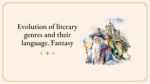
Evolution of literary genres and their language. Fantasy
Slayd 2
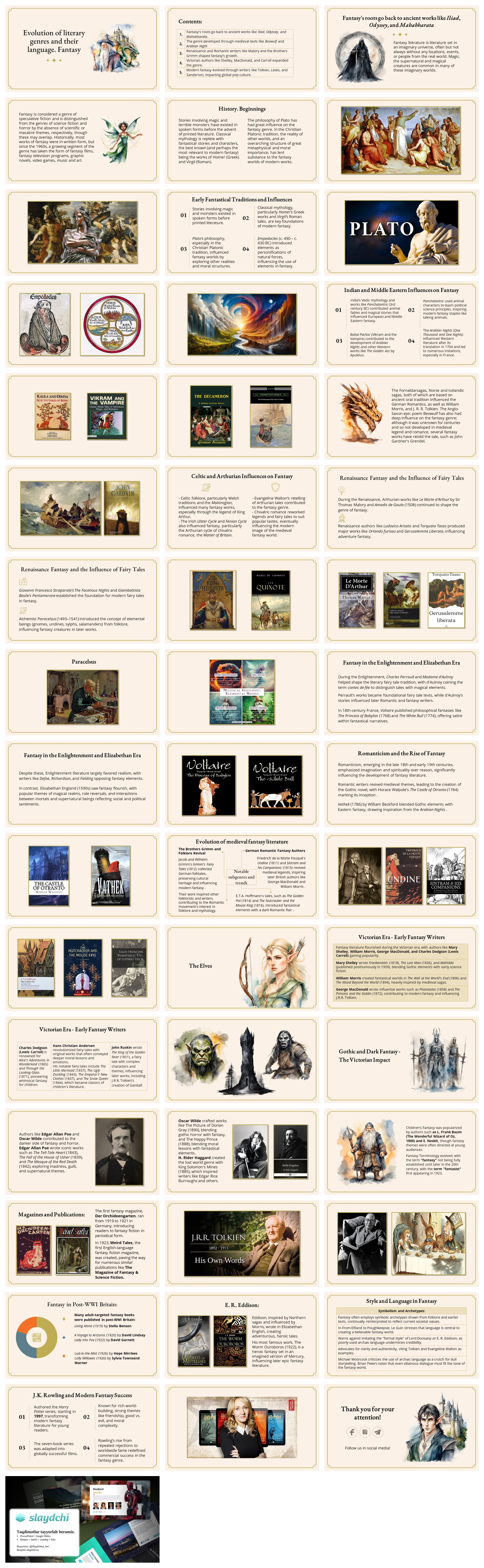
Contents:
1.
Fantasy’s roots go back to ancient works like Iliad, Odyssey, and Mahabharata.
2.
The genre developed through medieval texts like Beowulf and Arabian Night
3.
Renaissance and Romantic writers like Malory and the Brothers Grimm shaped fantasy’s growth.
4.
Victorian authors like Shelley, MacDonald, and Carroll expanded the genre.
5.
Modern fantasy evolved through writers like Tolkien, Lewis, and Sanderson, impacting global pop culture.
Slayd 3
Fantasy’s roots go back to ancient works like Iliad, Odyssey, and Mahabharata
Fantasy literature is literature set in an imaginary universe, often but not always without any locations, events, or people from the real world. Magic, the supernatural and magical creatures are common in many of these imaginary worlds.
Slayd 4
Fantasy is considered a genre of speculative fiction and is distinguished from the genres of science fiction and horror by the absence of scientific or macabre themes, respectively, though these may overlap. Historically, most works of fantasy were in written form, but since the 1960s, a growing segment of the genre has taken the form of fantasy films, fantasy television programs, graphic novels, video games, music and art.
Slayd 5
History. Beginnings
The philosophy of Plato has had great influence on the fantasy genre. In the Christian Platonic tradition, the reality of other worlds, and an overarching structure of great metaphysical and moral importance, has lent substance to the fantasy worlds of modern works.
Stories involving magic and terrible monsters have existed in spoken forms before the advent of printed literature. Classical mythology is replete with fantastical stories and characters, the best known (and perhaps the most relevant to modern fantasy) being the works of Homer (Greek) and Virgil (Roman).
Slayd 6
Slayd 7
Slayd 8
Early Fantastical Traditions and Influences
01
Stories involving magic and monsters existed in spoken forms before printed literature.
02
Classical mythology, particularly Homer’s Greek works and Virgil’s Roman tales, are key foundations of modern fantasy.
03
Plato’s philosophy, especially in the Christian Platonic tradition, influenced fantasy worlds by exploring other realities and moral structures.
04
Empedocles (c. 490 – c. 430 BC) introduced elements as personifications of natural forces, influencing the use of elements in fantasy.
Slayd 9
Slayd 10
Slayd 11
Slayd 12
Indian and Middle Eastern Influences on Fantasy
01
India’s Vedic mythology and works like Panchatantra (3rd century BC) contributed animal fables and magical stories that influenced European and Middle Eastern fantasy.
02
Panchatantra used animal characters to teach political science principles, inspiring modern fantasy staples like talking animals.
03
Baital Pachisi (Vikram and the Vampire) contributed to the development of Arabian Nights and other Western works like The Golden Ass by Apuleius.
04
The Arabian Nights (One Thousand and One Nights) influenced Western literature after its translation in 1704 and led to numerous imitations, especially in France.
Slayd 13
Slayd 14
Slayd 15
The Fornaldarsagas, Norse and Icelandic sagas, both of which are based on ancient oral tradition influenced the German Romantics, as well as William Morris, and J. R. R. Tolkien. The Anglo-Saxon epic poem Beowulf has also had deep influence on the fantasy genre; although it was unknown for centuries and so not developed in medieval legend and romance, several fantasy works have retold the tale, such as John Gardner’s Grendel.
Slayd 16
Slayd 17
Celtic and Arthurian Influences on Fantasy
– Evangeline Walton’s retelling of Arthurian tales contributed to the fantasy genre.
– Chivalric romance reworked legends and fairy tales to suit popular tastes, eventually influencing the modern image of the medieval fantasy world.
– Celtic folklore, particularly Welsh traditions and the Mabinogion, influenced many fantasy works, especially through the legend of King Arthur.
– The Irish Ulster Cycle and Fenian Cycle also influenced fantasy, particularly the Arthurian cycle of chivalric romance, the Matter of Britain.
Slayd 18
Renaissance Fantasy and the Influence of Fairy Tales
During the Renaissance, Arthurian works like Le Morte d’Arthur by Sir Thomas Malory and Amadis de Gaula (1508) continued to shape the genre of fantasy.
Renaissance authors like Ludovico Ariosto and Torquato Tasso produced major works like Orlando furioso and Gerusalemme Liberata, influencing adventure fantasy.
Slayd 19
Renaissance Fantasy and the Influence of Fairy Tales
Giovanni Francesco Straparola’s The Facetious Nights and Giambattista Basile’s Pentamerone established the foundation for modern fairy tales in fantasy.
Alchemist Paracelsus (1493–1541) introduced the concept of elemental beings (gnomes, undines, sylphs, salamanders) from folklore, influencing fantasy creatures in later works.
Slayd 20
Slayd 21
Slayd 22
Paracelsus
Slayd 23
Slayd 24
Perrault’s works became foundational fairy tale texts, while d’Aulnoy’s stories influenced later Romantic and fantasy writers.
In 18th-century France, Voltaire published philosophical fantasies like The Princess of Babylon (1768) and The White Bull (1774), offering satire within fantastical narratives.
Fantasy in the Enlightenment and Elizabethan Era
During the Enlightenment, Charles Perrault and Madame d’Aulnoy helped shape the literary fairy tale tradition, with d’Aulnoy coining the term contes de fée to distinguish tales with magical elements.
Slayd 25
Fantasy in the Enlightenment and Elizabethan Era
Despite these, Enlightenment literature largely favored realism, with writers like Defoe, Richardson, and Fielding opposing fantasy elements.
In contrast, Elizabethan England (1590s) saw fantasy flourish, with popular themes of magical realms, role reversals, and interactions between mortals and supernatural beings reflecting social and political sentiments.
Slayd 26
Slayd 27
Romanticism and the Rise of Fantasy
Romanticism, emerging in the late 18th and early 19th centuries, emphasized imagination and spirituality over reason, significantly influencing the development of fantasy literature.
Romantic writers revived medieval themes, leading to the creation of the Gothic novel, with Horace Walpole’s The Castle of Otranto (1764) marking its inception .
Vathek (1786) by William Beckford blended Gothic elements with Eastern fantasy, drawing inspiration from the Arabian Nights .
Slayd 28
Slayd 29
Evolution of medieval fantasy literature
Notable subgenres and trends
The Brothers Grimm and Folklore Revival
Jacob and Wilhelm Grimm’s Grimm’s Fairy Tales (1812) collected German folktales, preserving cultural heritage and influencing modern fantasy .
Their work inspired other folklorists and writers, contributing to the Romantic movement’s interest in folklore and mythology.
German Romantic Fantasy Authors
Friedrich de la Motte Fouqué’s Undine (1811) and Sintram and his Companions (1815) revived medieval legends, inspiring later British authors like George MacDonald and William Morris .
E.T.A. Hoffmann’s tales, such as The Golden Pot (1814) and The Nutcracker and the Mouse King (1816), introduced fantastical elements with a dark Romantic flair .
Slayd 30
Slayd 31
Slayd 32
The Elves
Slayd 33
Victorian Era – Early Fantasy Writers
Fantasy literature flourished during the Victorian era, with authors like Mary Shelley, William Morris, George MacDonald, and Charles Dodgson (Lewis Carroll) gaining popularity.
Mary Shelley wrote Frankenstein (1818), The Last Man (1826), and Mathilda (published posthumously in 1959), blending Gothic elements with early science fiction.
William Morris created fantastical worlds in The Well at the World’s End (1896) and The Wood Beyond the World (1894), heavily inspired by medieval sagas.
George MacDonald wrote influential works such as Phantastes (1858) and The Princess and the Goblin (1872), contributing to modern fantasy and influencing J.R.R. Tolkien.
Slayd 34
Victorian Era – Early Fantasy Writers
Charles Dodgson (Lewis Carroll) is renowned for Alice’s Adventures in Wonderland (1865) and Through the Looking-Glass (1871), pioneering whimsical fantasy for children.
Hans Christian Andersen revolutionized fairy tales with original works that often conveyed deeper moral lessons and emotions. His notable fairy tales include The Little Mermaid (1837), The Ugly Duckling (1843), The Emperor’s New Clothes (1837), and The Snow Queen (1844), which became classics of children’s literature.
John Ruskin wrote The King of the Golden River (1851), a fairy tale with complex characters and themes, influencing later works, including J.R.R. Tolkien’s creation of Gandalf.
Slayd 35
Slayd 36
Gothic and Dark Fantasy – The Victorian Impact
Slayd 37
Authors like Edgar Allan Poe and Oscar Wilde contributed to the darker side of fantasy and horror.Edgar Allan Poe wrote iconic works such as The Tell-Tale Heart (1843), The Fall of the House of Usher (1839), and The Masque of the Red Death (1842), exploring madness, guilt, and supernatural themes.
Slayd 38
Oscar Wilde crafted works like The Picture of Dorian Gray (1890), blending gothic horror with fantasy, and The Happy Prince (1888), blending moral lessons with fantastical elements.H. Rider Haggard created the lost world genre with King Solomon’s Mines (1885), which inspired writers like Edgar Rice Burroughs and others.
Slayd 39
Children’s Fantasy was popularized by authors such as L. Frank Baum (The Wonderful Wizard of Oz, 1900) and E. Nesbit, though fantasy themes were often directed at young audiences.
Fantasy Terminology evolved, with the term «fantasy» not being fully established until later in the 20th century, with the term «fantasist» first appearing in 1923.
Slayd 40
Magazines and Publications:
The first fantasy magazine, Der Orchideengarten, ran from 1919 to 1921 in Germany, introducing readers to fantasy fiction in periodical form.
In 1923, Weird Tales, the first English-language fantasy fiction magazine, was created, paving the way for numerous similar publications like The Magazine of Fantasy & Science Fiction.
Slayd 41
Slayd 42
Slayd 43
Fantasy in Post-WWI Britain:
Many adult-targeted fantasy books were published in post-WWI Britain:
Living Alone (1919) by Stella Benson
A Voyage to Arcturus (1920) by David Lindsay
Lady into Fox (1922) by David Garnett
Lud-in-the-Mist (1926) by Hope Mirrlees
Lolly Willowes (1926) by Sylvia Townsend Warner
Slayd 44
Eddison, inspired by Northern sagas and influenced by Morris, wrote in Elizabethan English, creating adventurous, heroic tales.
His most famous work, The Worm Ouroboros (1922), is a heroic fantasy set in an imagined version of Mercury, influencing later epic fantasy literature.
E. R. Eddison:
Slayd 45
Style and Language in Fantasy
Symbolism and Archetypes:
Fantasy often employs symbolic archetypes drawn from folklore and earlier texts, continually reinterpreted to reflect current societal values.
In From Elfland to Poughkeepsie, Le Guin stresses that language is central to creating a believable fantasy world.
Warns against imitating the «formal style» of Lord Dunsany or E. R. Eddison, as poorly used archaic language undermines credibility.
Advocates for clarity and authenticity, citing Tolkien and Evangeline Walton as examples.
Michael Moorcock criticizes the use of archaic language as a crutch for dull storytelling. Brian Peters notes that even villainous dialogue must fit the tone of the fantasy world.
Slayd 46
J.K. Rowling and Modern Fantasy Success
01
Authored the Harry Potter series, starting in 1997, transforming modern fantasy literature for young readers.
02
Known for rich world-building, strong themes like friendship, good vs. evil, and moral complexity.
03
The seven-book series was adapted into globally successful films.
04
Rowling’s rise from repeated rejections to worldwide fame redefined commercial success in the fantasy genre.
Slayd 47
Slayd 48
Thank you for your attention!
Follow us in social media!
Slayd 49
Foydali havolalar
🛒 Barcha taqdimotlar | 📰 Yangiliklar | ℹ️ Biz haqimizda













Sharhlar
Hali sharhlar mavjud emas.