

Slayd 1
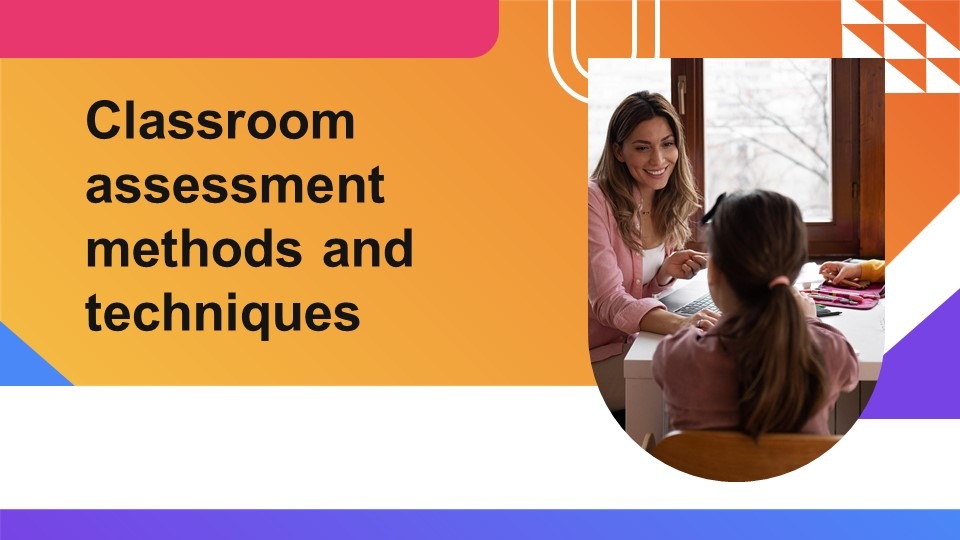
Classroom assessment methods and techniques
Slayd 2
Introduction
Classroom assessment can take many forms, such as tests, quizzes, projects, observations, discussions, and self-reflection activities. The goal of classroom assessment is to provide feedback to both students and instructors, identify areas of improvement, and guide instructional strategies to enhance student learning.
Classroom assessment refers to the process of gathering information about students’ knowledge, skills, and understanding of a subject or topic in order to evaluate their learning progress and make informed instructional decisions. It involves using various methods and techniques to assess students’ understanding, engagement, and performance in the classroom.
Slayd 3
The role of classroom assessment is multifaceted and plays a crucial role in the teaching and learning process. Here are some key roles of classroom assessment:
Slayd 4
Key roles:
Classroom assessments provide feedback to both students and teachers. Students receive feedback on their performance, helping them understand their strengths and weaknesses and guiding their future learning efforts.
Classroom assessments help teachers evaluate students’ understanding and mastery of the subject matter. They provide information about what students have learned and what areas they may need further support or instruction in.
Providing feedback:
Evaluating student learning:
Slayd 5
Key roles
Classroom assessments help track students’ progress over time. By regularly assessing student learning, teachers can identify if students are making progress toward learning goals and adjust instruction accordingly.
Classroom assessments inform instructional decisions by helping teachers identify areas where students may be struggling or excelling. This information allows teachers to tailor their instruction to meet individual student needs, providing additional support or enrichment as needed.
Monitoring progress:
Guiding instruction:
Slayd 6
Key roles
Classroom assessments can foster self-regulated learning by encouraging students to monitor their own progress and take responsibility for their learning. Through self-reflection activities and goal-setting, students become active participants in the assessment process.
Classroom assessments can be designed to actively engage students in the learning process. They encourage students to reflect on their own learning, participate in discussions, and apply their knowledge to real-world situations.
Promoting self-regulated learning:
Promoting student engagement:
Slayd 7
Key roles
Informing decision-making: Classroom assessments provide valuable data that can inform decision-making at various levels, such as curriculum planning, instructional strategies, and resource allocation. By analyzing assessment results, educators can make informed decisions to improve teaching and learning outcomes
Informing decision-making
Slayd 8
Classroom techniques:1. 3-2-1 Format
The 3-2-1 format is a quick reflective activity similar to think-pair-share. It encourages students to reflect on a course experience and organize their thoughts and identify areas of confusion or concern.
Similar to minute papers, muddiest point, and think-pair-share, the 3-2-1 Format can be a helpful tool for getting students to organize their thoughts, and promote reflection and metacognition. This activity provides an easy way to check for understanding and gauge student interest. It is also an effective way to promote discuss or review material.
Why would you use it?
Slayd 9
How does it work?
In reaction to presented content, students are asked to take a few moments and jot down:
3 ideas or issues from what was presented
2 example or uses for how the ideas could be implemented
1 unresolved area / muddiest point
Students are then asked to share their ideas in pairs or small groups. Use the responses to help guide teaching decisions. Consider areas of curriculum that need to be reviewed again or specific concepts or activities that are most interesting for students.
Slayd 10
Alternative versions
Use 3-2-1 Format to transition into class discussion.
Student can complete 3-2-1 as individuals, pairs, or small groups
Have students focus 3-2-1 on main ideas (most important ideas, supporting details, etc.)
Slayd 11
2. One Minute Paper
One minute paper is a popular introductory active learning strategy that requires minimal preparation on the part of the instructor. During a one minute paper exercise students are given one minute to write a response to a prompt or question posed by the instructor. Minute papers can segue into a discussion or simply be collected for review by the instructor.
Minute papers provide immediate feedback and allow quick response
to students. This exercise can be easily facilitated for any class size.
Allows students who are less vocal to participate.
Why would you use it?
Slayd 12
This technique is probably best used in lecture or discussion however it can easily be adapted to other settings such as labs, clinicals, or homework assignments. While this technique is flexible it is not universally applicable. Not all learning experiences can be assessed by a technique that asks students to note significant points or open questions. Be cognizant of your goal when choosing a classroom assessment technique.
Slayd 13
How does it work?
Slayd 14
Decide what you want to focus on, where you want students to reflect on a topic.Write Minute Paper prompts that fit your class and meet your goal. The prompts are the heart of one minute papers.Set aside 5-10 minutes to facilitate, as well as time later to discuss the results.Let students know how much time they will have, what kinds of responses you are looking for (words, bullets, short sentences), and when they can expect feedback.Respond to the students’ feedback during the next class meeting. Share with students how responses will be used as a guide to plan the next instruction.
Slayd 15
3. Jigsaw
Slayd 16
A picture is worth a thousand words
Slayd 17
Jigsaw
Jigsaw involves students doing individual research on a subset of a given subject area, and then piecing their research together with other students “to build the whole picture”. Jigsaw exercises challenge students to engage in reciprocal teaching and can be a popular activity for courses that rely on heavy transference of information.
Jigsaw requires a moderate to high amount of faculty preparation and takes a fair amount of class time. Do not overuse this technique, as repeating too often can feel contrived (it is not very flexible). It should be used no more than twice per semester.
Slayd 18
How does it work?
Identify a concept area (the whole puzzle) which contains roughly 4-6 subtopics (pieces of the puzzle).
Divide the class into teams of 4-6 students
Assign each student on the teams a different subtopic. Allow sufficient time for students to “develop expertise”, doing their own reading and research. Jigsaw falls apart if students are not prepared. Assigning questions, reading logs, study guides or reaction papers helps to ensure preparation. Consider asking for a summary of their readings by a certain date.
They are asked to discuss the topic as a group and how best to present it to their respective teams, possibly through creating review sheets / summary guide / examples/ list of resources etc.
Slayd 19
4. Memory Matrix
Memory Matrix is a simple, two-dimensional table divided into rows and columns. The table is used to organize information and identify relationships in the content. Some cells in the table are intentionally left blank where students are asked to fill in the blank cells, demonstrating their understanding of the content. There is moderate investment of time required on behalf of faculty to create the matrix and then analyze the results.
Slayd 20
When can you use it?
Memory matrix is simple to implement and easy to use during instruction however there is some up-front preparation that must be completed. Consider content carefully. Content needs to appropriately align with column and row organization. This exercise is effective after lectures, videos, reading assignments, etc.
Slayd 21
How does it work?
Carefully choose your content topic. Make sure the content can be organized in a table with rows and columns.
Create a simple matrix. Make one completed matrix to use as a key and create a blank matrix for students to fill in.
Explain the purpose of the exercise.
Handout blank or partially filled matrix. Have students work on in class, individually or in groups. Provide practice matrices or examples if this is the first time you are presenting a memory matrix.
Scan the completed matrices and compare to your key matrix. correct responses vs incorrect responses – focus on patterns in the responses.
Provide feedback and clear misconceptions at next class meeting
Slayd 22
THANK YOU FOR YOUR ATTENTION!
Follow us on social media!
Slayd 23
Foydali havolalar
🛒 Barcha taqdimotlar | 📰 Yangiliklar | ℹ️ Biz haqimizda











Sharhlar
Hali sharhlar mavjud emas.