





Slayd 1
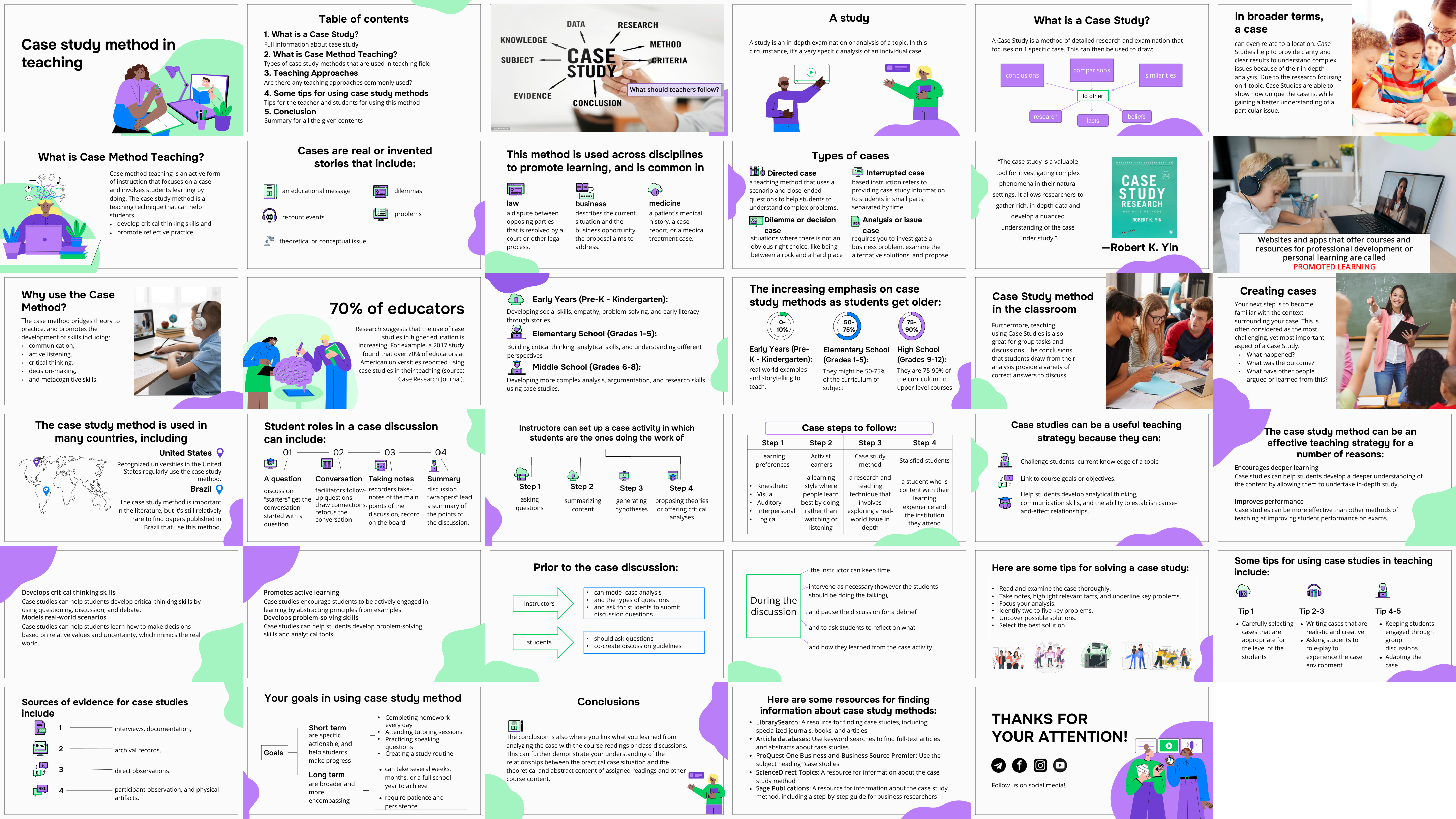
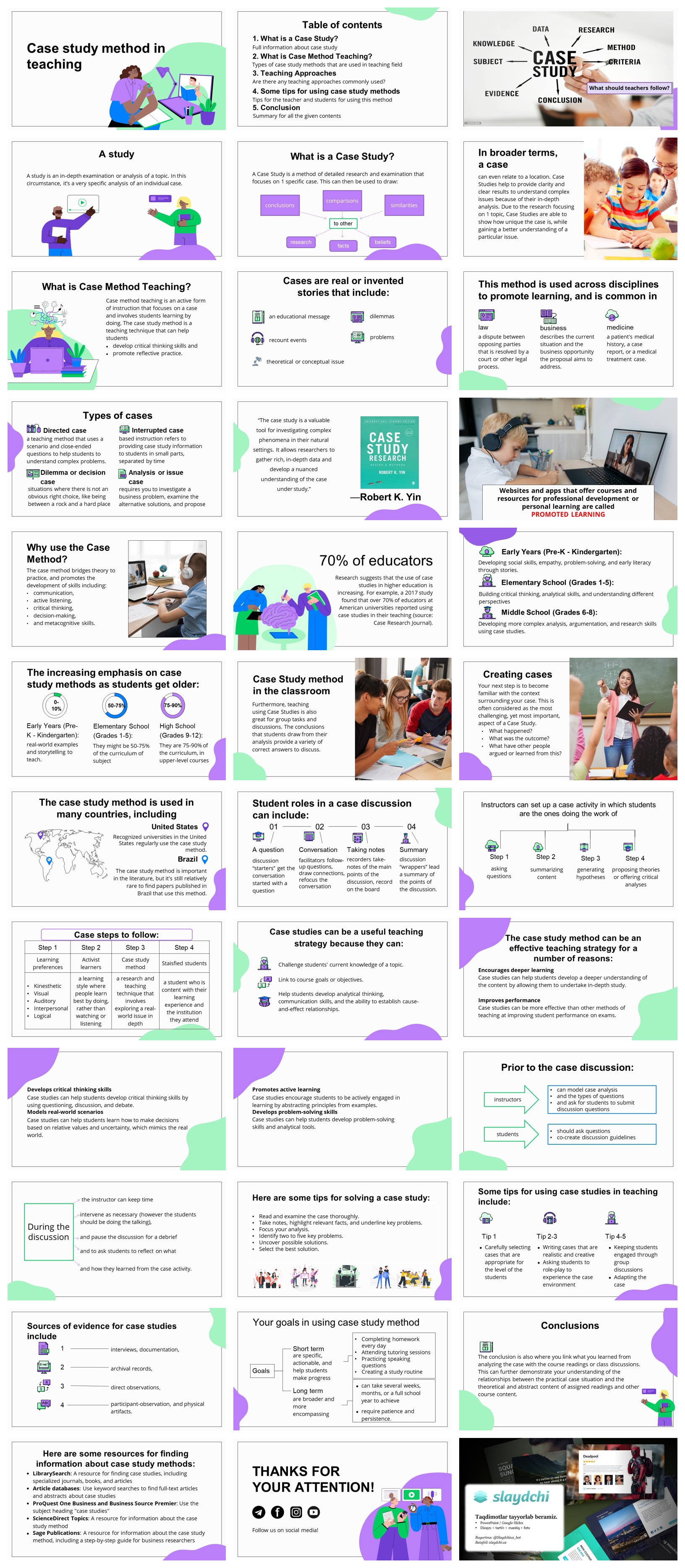
Case study method in teaching
Slayd 2
Table of contents
Full information about case study
Types of case study methods that are used in teaching field
Are there any teaching approaches commonly used?
1. What is a Case Study?
2. What is Case Method Teaching?
3. Teaching Approaches
4. Some tips for using case study methods
Tips for the teacher and students for using this method
5. Conclusion
Summary for all the given contents
Slayd 3
What should teachers follow?
Slayd 4
A study
A study is an in-depth examination or analysis of a topic. In this circumstance, it’s a very specific analysis of an individual case.
Slayd 5
What is a Case Study?
A Case Study is a method of detailed research and examination that focuses on 1 specific case. This can then be used to draw:
conclusions
comparisons
similarities
to other
facts
research
beliefs
Slayd 6
In broader terms, a case
can even relate to a location. Case Studies help to provide clarity and clear results to understand complex issues because of their in-depth analysis. Due to the research focusing on 1 topic, Case Studies are able to show how unique the case is, while gaining a better understanding of a particular issue.
Slayd 7
What is Case Method Teaching?
Case method teaching is an active form of instruction that focuses on a case and involves students learning by doing. The case study method is a teaching technique that can help students
develop critical thinking skills and
promote reflective practice.
Slayd 8
Cases are real or invented stories that include:
an educational message
recount events
problems
dilemmas
theoretical or conceptual issue
Slayd 9
This method is used across disciplines to promote learning, and is common in
a dispute between opposing parties that is resolved by a court or other legal process.
describes the current situation and the business opportunity the proposal aims to address.
a patient’s medical history, a case report, or a medical treatment case.
law
business
medicine
Slayd 10
Types of cases
a teaching method that uses a scenario and close-ended questions to help students to understand complex problems.
based instruction refers to providing case study information to students in small parts, separated by time
Directed case
Interrupted case
Dilemma or decision case
Analysis or issue case
situations where there is not an obvious right choice, like being between a rock and a hard place
requires you to investigate a business problem, examine the alternative solutions, and propose
Slayd 11
“The case study is a valuable tool for investigating complex phenomena in their natural settings. It allows researchers to gather rich, in-depth data and develop a nuanced understanding of the case under study.”
—Robert K. Yin
Slayd 12
Websites and apps that offer courses and resources for professional development or personal learning are called PROMOTED LEARNING
Slayd 13
Why use the Case Method?
The case method bridges theory to practice, and promotes the development of skills including:
communication,
active listening,
critical thinking,
decision-making,
and metacognitive skills.
Slayd 14
70% of educators
Research suggests that the use of case studies in higher education is increasing. For example, a 2017 study found that over 70% of educators at American universities reported using case studies in their teaching (source: Case Research Journal).
Slayd 15
Elementary School (Grades 1-5):
Building critical thinking, analytical skills, and understanding different perspectives
Middle School (Grades 6-8):
Developing more complex analysis, argumentation, and research skills using case studies.
Developing social skills, empathy, problem-solving, and early literacy through stories.
Early Years (Pre-K – Kindergarten):
Slayd 16
The increasing emphasis on case study methods as students get older:
real-world examples and storytelling to teach.
Early Years (Pre- K – Kindergarten):
They might be 50-75% of the curriculum of subject
Elementary School (Grades 1-5):
They are 75-90% of the curriculum, in upper-level courses
High School (Grades 9-12):
50-75%
75-90%
0-10%
Slayd 17
Case Study method in the classroom
Furthermore, teaching using Case Studies is also great for group tasks and discussions. The conclusions that students draw from their analysis provide a variety of correct answers to discuss.
Slayd 18
Creating cases
Your next step is to become familiar with the context surrounding your case. This is often considered as the most challenging, yet most important, aspect of a Case Study.
What happened?
What was the outcome?
What have other people argued or learned from this?
Slayd 19
United States
Brazil
The case study method is used in many countries, including
Recognized universities in the United States regularly use the case study method.
The case study method is important in the literature, but it’s still relatively rare to find papers published in Brazil that use this method.
Slayd 20
Student roles in a case discussion can include:
A question
discussion “starters” get the conversation started with a question
Conversation
facilitators follow-up questions, draw connections, refocus the conversation
Taking notes
recorders take-notes of the main points of the discussion, record on the board
Summary
discussion “wrappers” lead a summary of the points of the discussion.
01
02
03
04
Slayd 21
Step 2
Instructors can set up a case activity in which students are the ones doing the work of
Step 1
Step 3
Step 4
summarizing content
asking questions
generating hypotheses
proposing theories or offering critical analyses
Slayd 22
Step 1
Step 2
Step 3
Step 4
Learning preferences
Activist learners
Case study method
Staisfied students
Kinesthetic Visual Auditory Interpersonal Logical
a learning style where people learn best by doing, rather than watching or listening
a research and teaching technique that involves exploring a real-world issue in depth
a student who is content with their learning experience and the institution they attend
Case steps to follow:
Slayd 23
Case studies can be a useful teaching strategy because they can:
Challenge students’ current knowledge of a topic.
Link to course goals or objectives.
Help students develop analytical thinking, communication skills, and the ability to establish cause-and-effect relationships.
Slayd 24
The case study method can be an effective teaching strategy for a number of reasons:
Encourages deeper learning
Case studies can help students develop a deeper understanding of the content by allowing them to undertake in-depth study.
Improves performance
Case studies can be more effective than other methods of teaching at improving student performance on exams.
Slayd 25
Develops critical thinking skills
Case studies can help students develop critical thinking skills by using questioning, discussion, and debate.
Models real-world scenarios
Case studies can help students learn how to make decisions based on relative values and uncertainty, which mimics the real world.
Slayd 26
Promotes active learning
Case studies encourage students to be actively engaged in learning by abstracting principles from examples.
Develops problem-solving skills
Case studies can help students develop problem-solving skills and analytical tools.
Slayd 27
Prior to the case discussion:
instructors
can model case analysis
and the types of questions
and ask for students to submit discussion questions
students
should ask questions
co-create discussion guidelines
Slayd 28
intervene as necessary (however the students should be doing the talking),
and how they learned from the case activity.
and pause the discussion for a debrief
and to ask students to reflect on what
the instructor can keep time
During the discussion
Slayd 29
Here are some tips for solving a case study:
Read and examine the case thoroughly.
Take notes, highlight relevant facts, and underline key problems.
Focus your analysis.
Identify two to five key problems.
Uncover possible solutions.
Select the best solution.
Slayd 30
Some tips for using case studies in teaching include:
Carefully selecting cases that are appropriate for the level of the students
Writing cases that are realistic and creative
Asking students to role-play to experience the case environment
Keeping students engaged through group discussions
Adapting the case
Tip 1
Tip 2-3
Tip 4-5
Slayd 31
Sources of evidence for case studies include
1
interviews, documentation,
2
archival records,
3
direct observations,
4
participant-observation, and physical artifacts.
Slayd 32
Your goals in using case study method
Goals
are specific, actionable, and help students make progress
Short term
are broader and more encompassing
Long term
Completing homework every day
Attending tutoring sessions
Practicing speaking questions
Creating a study routine
can take several weeks, months, or a full school year to achieve
require patience and persistence.
Slayd 33
Conclusions
The conclusion is also where you link what you learned from analyzing the case with the course readings or class discussions. This can further demonstrate your understanding of the relationships between the practical case situation and the theoretical and abstract content of assigned readings and other course content.
Slayd 34
Here are some resources for finding information about case study methods:
LibrarySearch: A resource for finding case studies, including specialized journals, books, and articles
Article databases: Use keyword searches to find full-text articles and abstracts about case studies
ProQuest One Business and Business Source Premier: Use the subject heading «case studies»
ScienceDirect Topics: A resource for information about the case study method
Sage Publications: A resource for information about the case study method, including a step-by-step guide for business researchers
Slayd 35
Follow us on social media!
THANKS FOR YOUR ATTENTION!
Slayd 36
Foydali havolalar
🛒 Barcha taqdimotlar | 📰 Yangiliklar | ℹ️ Biz haqimizda
Tegishli mahsulotlar


CLASSROOM MANAGEMENT WORKING WITH DIFFERENT AGES mavzusidagi tayyor PPTX taqdimot. Ingliz tili darsi uchun mavzu, misollar va asosiy tushunchalar jamlangan.
- Slaydlar soni: 19 ta
- Fayl formati: PPTX
- Tili: o‘zbek tili
- Kategoriya: Ingliz tili

ACCURACY AND CORRECTING MISTAKES mavzusidagi tayyor PPTX taqdimot. Ingliz tili darsi uchun mavzu, misollar va asosiy tushunchalar jamlangan.
- Slaydlar soni: 24 ta
- Fayl formati: PPTX
- Tili: o‘zbek tili
- Kategoriya: Ingliz tili

ESSAYS. DIFFERENT TYPES OF ESSAYS IN IELTS WRITING mavzusidagi tayyor PPTX taqdimot. Ingliz tili darsi uchun mavzu, misollar va asosiy tushunchalar jamlangan.
- Slaydlar soni: 31 ta
- Fayl formati: PPTX
- Tili: o‘zbek tili
- Kategoriya: Ingliz tili

TECHNOLOGY INTEGRATED LANGUAGE TEACHING mavzusidagi tayyor PPTX taqdimot. Ingliz tili darsi uchun mavzu, misollar va asosiy tushunchalar jamlangan.
- Slaydlar soni: 21 ta
- Fayl formati: PPTX
- Tili: o‘zbek tili
- Kategoriya: Ingliz tili


CONTINUOUS TENSES IN ENGLISH GRAMMAR mavzusidagi tayyor PPTX taqdimot. Ingliz tili darsi uchun mavzu, misollar va asosiy tushunchalar jamlangan.
- Slaydlar soni: 48 ta
- Fayl formati: PPTX
- Tili: o‘zbek tili
- Kategoriya: Ingliz tili


CULTURAL ASPECTS IN LANGUAGE LEARNING mavzusidagi tayyor PPTX taqdimot. Ingliz tili darsi uchun mavzu, misollar va asosiy tushunchalar jamlangan.
- Slaydlar soni: 24 ta
- Fayl formati: PPTX
- Tili: o‘zbek tili
- Kategoriya: Ingliz tili

ASSESSMENT CHECK EVALUATE mavzusidagi tayyor PPTX taqdimot. Ingliz tili darsi uchun mavzu, misollar va asosiy tushunchalar jamlangan.
- Slaydlar soni: 22 ta
- Fayl formati: PPTX
- Tili: o‘zbek tili
- Kategoriya: Ingliz tili

WHAT IS LEXICOGRAPHY mavzusidagi tayyor PPTX taqdimot. Ingliz tili darsi uchun mavzu, misollar va asosiy tushunchalar jamlangan.
- Slaydlar soni: 28 ta
- Fayl formati: PPTX
- Tili: o‘zbek tili
- Kategoriya: Ingliz tili


DIFFERENCES BETWEEN BRITISH AND AMERICAN ENGLISH mavzusidagi tayyor PPTX taqdimot. Ingliz tili darsi uchun mavzu, misollar va asosiy tushunchalar jamlangan.
- Slaydlar soni: 40 ta
- Fayl formati: PPTX
- Tili: o‘zbek tili
- Kategoriya: Ingliz tili

BINOMIAL PAIRS mavzusidagi tayyor PPTX taqdimot. Ingliz tili darsi uchun mavzu, misollar va asosiy tushunchalar jamlangan.
- Slaydlar soni: 24 ta
- Fayl formati: PPTX
- Tili: o‘zbek tili
- Kategoriya: Ingliz tili

GUIDELINES FOR WRITING mavzusidagi tayyor PPTX taqdimot. Ingliz tili darsi uchun mavzu, misollar va asosiy tushunchalar jamlangan.
- Slaydlar soni: 30 ta
- Fayl formati: PPTX
- Tili: o‘zbek tili
- Kategoriya: Ingliz tili


ASSESSMENT AND TESTING IN THE CLASSROOM mavzusidagi tayyor PPTX taqdimot. Ingliz tili darsi uchun mavzu, misollar va asosiy tushunchalar jamlangan.
- Slaydlar soni: 37 ta
- Fayl formati: PPTX
- Tili: o‘zbek tili
- Kategoriya: Ingliz tili
Sharhlar
Hali sharhlar mavjud emas.