
Slayd 1
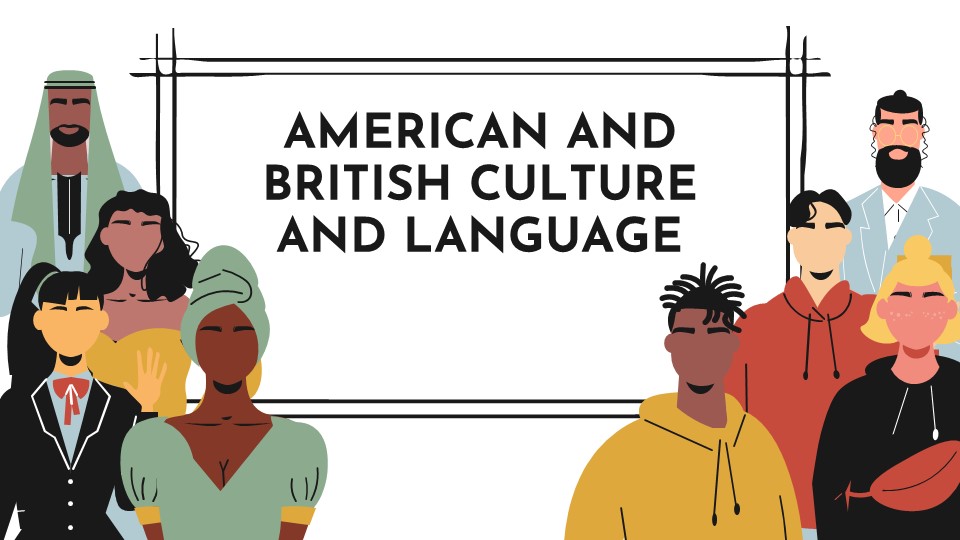
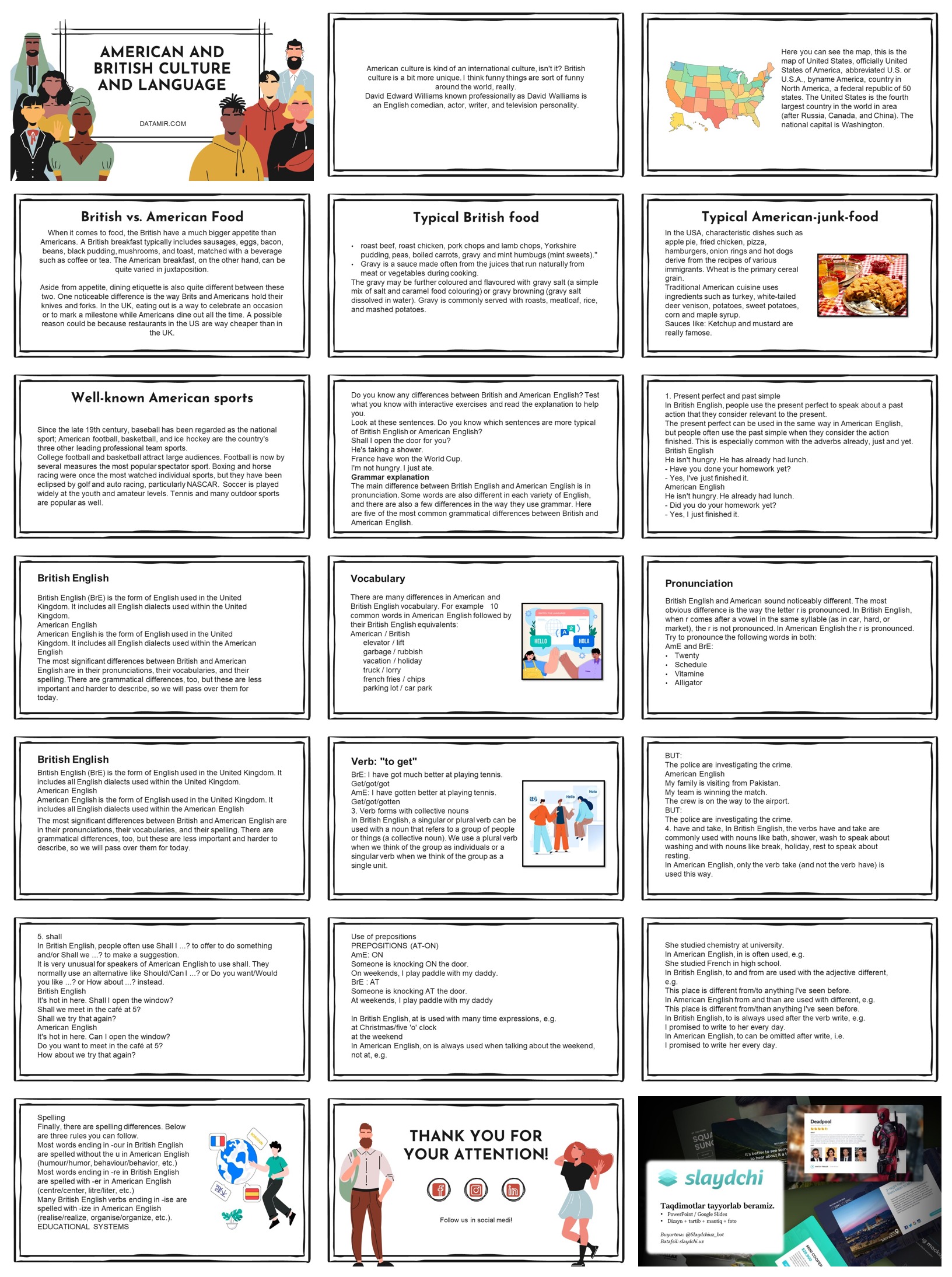
AMERICAN AND BRITISH CULTURE AND LANGUAGE
DATAMIR.COM
Slayd 2
American culture is kind of an international culture, isn’t it? British culture is a bit more unique. I think funny things are sort of funny around the world, really.
David Edward Williams known professionally as David Walliams is an English comedian, actor, writer, and television personality.
Slayd 3
Here you can see the map, this is the map of United States, officially United States of America, abbreviated U.S. or U.S.A., byname America, country in North America, a federal republic of 50 states. The United States is the fourth largest country in the world in area (after Russia, Canada, and China). The national capital is Washington.
Slayd 4
British vs. American Food
When it comes to food, the British have a much bigger appetite than Americans. A British breakfast typically includes sausages, eggs, bacon, beans, black pudding, mushrooms, and toast, matched with a beverage such as coffee or tea. The American breakfast, on the other hand, can be quite varied in juxtaposition.
Aside from appetite, dining etiquette is also quite different between these two. One noticeable difference is the way Brits and Americans hold their knives and forks. In the UK, eating out is a way to celebrate an occasion or to mark a milestone while Americans dine out all the time. A possible reason could be because restaurants in the US are way cheaper than in the UK.
Slayd 5
Typical British food
roast beef, roast chicken, pork chops and lamb chops, Yorkshire pudding, peas, boiled carrots, gravy and mint humbugs (mint sweets).»
Gravy is a sauce made often from the juices that run naturally from meat or vegetables during cooking.
The gravy may be further coloured and flavoured with gravy salt (a simple mix of salt and caramel food colouring) or gravy browning (gravy salt dissolved in water). Gravy is commonly served with roasts, meatloaf, rice, and mashed potatoes.
Slayd 6
Typical American-junk-food
In the USA, characteristic dishes such as apple pie, fried chicken, pizza, hamburgers, onion rings and hot dogs derive from the recipes of various immigrants. Wheat is the primary cereal grain.
Traditional American cuisine uses ingredients such as turkey, white-tailed deer venison, potatoes, sweet potatoes, corn and maple syrup.
Sauces like: Ketchup and mustard are really famose.
Slayd 7
Well-known American sports
Since the late 19th century, baseball has been regarded as the national sport; American football, basketball, and ice hockey are the country’s three other leading professional team sports.
College football and basketball attract large audiences. Football is now by several measures the most popular spectator sport. Boxing and horse racing were once the most watched individual sports, but they have been eclipsed by golf and auto racing, particularly NASCAR. Soccer is played widely at the youth and amateur levels. Tennis and many outdoor sports are popular as well.
Slayd 8
Do you know any differences between British and American English? Test what you know with interactive exercises and read the explanation to help you.
Look at these sentences. Do you know which sentences are more typical of British English or American English?
Shall I open the door for you?
He’s taking a shower.
France have won the World Cup.
I’m not hungry. I just ate.
Grammar explanation
The main difference between British English and American English is in pronunciation. Some words are also different in each variety of English, and there are also a few differences in the way they use grammar. Here are five of the most common grammatical differences between British and American English.
Slayd 9
1. Present perfect and past simple
In British English, people use the present perfect to speak about a past action that they consider relevant to the present.
The present perfect can be used in the same way in American English, but people often use the past simple when they consider the action finished. This is especially common with the adverbs already, just and yet.
British English
He isn’t hungry. He has already had lunch.
– Have you done your homework yet?
– Yes, I’ve just finished it.
American English
He isn’t hungry. He already had lunch.
– Did you do your homework yet?
– Yes, I just finished it.
Slayd 10
British English
British English (BrE) is the form of English used in the United Kingdom. It includes all English dialects used within the United Kingdom.
American English
American English is the form of English used in the United Kingdom. It includes all English dialects used within the American English
The most significant differences between British and American English are in their pronunciations, their vocabularies, and their spelling. There are grammatical differences, too, but these are less important and harder to describe, so we will pass over them for today.
Slayd 11
Vocabulary
There are many differences in American and British English vocabulary. For example 10 common words in American English followed by their British English equivalents:
American / British
elevator / lift
garbage / rubbish
vacation / holiday
truck / lorry
french fries / chips
parking lot / car park
Slayd 12
Pronunciation
British English and American sound noticeably different. The most obvious difference is the way the letter r is pronounced. In British English, when r comes after a vowel in the same syllable (as in car, hard, or market), the r is not pronounced. In American English the r is pronounced.
Try to pronounce the following words in both:
AmE and BrE:
Twenty
Schedule
Vitamine
Alligator
Slayd 13
British English
British English (BrE) is the form of English used in the United Kingdom. It includes all English dialects used within the United Kingdom.
American English
American English is the form of English used in the United Kingdom. It includes all English dialects used within the American English
The most significant differences between British and American English are in their pronunciations, their vocabularies, and their spelling. There are grammatical differences, too, but these are less important and harder to describe, so we will pass over them for today.
Slayd 14
Verb: «to get»
BrE: I have got much better at playing tennis.
Get/got/got
AmE: I have gotten better at playing tennis.
Get/got/gotten
3. Verb forms with collective nouns
In British English, a singular or plural verb can be used with a noun that refers to a group of people or things (a collective noun). We use a plural verb when we think of the group as individuals or a singular verb when we think of the group as a single unit.
Slayd 15
BUT:
The police are investigating the crime.
American English
My family is visiting from Pakistan.
My team is winning the match.
The crew is on the way to the airport.
4. have and take, In British English, the verbs have and take are commonly used with nouns like bath, shower, wash to speak about washing and with nouns like break, holiday, rest to speak about resting.
In American English, only the verb take (and not the verb have) is used this way.
Slayd 16
5. shall
In British English, people often use Shall I …? to offer to do something and/or Shall we …? to make a suggestion.
It is very unusual for speakers of American English to use shall. They normally use an alternative like Should/Can I …? or Do you want/Would you like …? or How about …? instead.
British English
It’s hot in here. Shall I open the window?
Shall we meet in the café at 5?
Shall we try that again?
American English
It’s hot in here. Can I open the window?
Do you want to meet in the café at 5?
How about we try that again?
Slayd 17
Use of prepositions
PREPOSITIONS (AT-ON)
AmE: ON
Someone is knocking ON the door.
On weekends, I play paddle with my daddy.
BrE : AT
Someone is knocking AT the door.
At weekends, I play paddle with my daddy
In British English, at is used with many time expressions, e.g.
at Christmas/five ‘o’ clock
at the weekend
In American English, on is always used when talking about the weekend, not at, e.g.
Slayd 18
She studied chemistry at university.
In American English, in is often used, e.g.
She studied French in high school.
In British English, to and from are used with the adjective different, e.g.
This place is different from/to anything I’ve seen before.
In American English from and than are used with different, e.g.
This place is different from/than anything I’ve seen before.
In British English, to is always used after the verb write, e.g.
I promised to write to her every day.
In American English, to can be omitted after write, i.e.
I promised to write her every day.
Slayd 19
Spelling
Finally, there are spelling differences. Below are three rules you can follow.
Most words ending in -our in British English are spelled without the u in American English (humour/humor, behaviour/behavior, etc.)
Most words ending in -re in British English are spelled with -er in American English (centre/center, litre/liter, etc.)
Many British English verbs ending in -ise are spelled with -ize in American English (realise/realize, organise/organize, etc.).
EDUCATIONAL SYSTEMS
Slayd 20
THANK YOU FOR YOUR ATTENTION!
Follow us in social medi!
Slayd 21
Foydali havolalar
🛒 Barcha taqdimotlar | 📰 Yangiliklar | ℹ️ Biz haqimizda
Tegishli mahsulotlar


CLASSROOM MANAGEMENT WORKING WITH DIFFERENT AGES mavzusidagi tayyor PPTX taqdimot. Ingliz tili darsi uchun mavzu, misollar va asosiy tushunchalar jamlangan.
- Slaydlar soni: 19 ta
- Fayl formati: PPTX
- Tili: o‘zbek tili
- Kategoriya: Ingliz tili
INDEFINITE PRONOUNS GUMON OLMOSHLARI SOME, ANY OLMOSHLARI mavzusidagi tayyor PPTX taqdimot. Ingliz tili darsi uchun mavzu, misollar va asosiy tushunchalar jamlangan.
- Slaydlar soni: 14 ta
- Fayl formati: PPTX
- Tili: o‘zbek tili
- Kategoriya: Ingliz tili
BINOMIAL PAIRS mavzusidagi tayyor PPTX taqdimot. Ingliz tili darsi uchun mavzu, misollar va asosiy tushunchalar jamlangan.
- Slaydlar soni: 24 ta
- Fayl formati: PPTX
- Tili: o‘zbek tili
- Kategoriya: Ingliz tili
WHAT IS LEXICOGRAPHY mavzusidagi tayyor PPTX taqdimot. Ingliz tili darsi uchun mavzu, misollar va asosiy tushunchalar jamlangan.
- Slaydlar soni: 28 ta
- Fayl formati: PPTX
- Tili: o‘zbek tili
- Kategoriya: Ingliz tili
STRATEGIES FOR READING COMPREHENSION mavzusidagi tayyor PPTX taqdimot. Ingliz tili darsi uchun mavzu, misollar va asosiy tushunchalar jamlangan.
- Slaydlar soni: 33 ta
- Fayl formati: PPTX
- Tili: o‘zbek tili
- Kategoriya: Ingliz tili


CULTURAL ASPECTS IN LANGUAGE LEARNING mavzusidagi tayyor PPTX taqdimot. Ingliz tili darsi uchun mavzu, misollar va asosiy tushunchalar jamlangan.
- Slaydlar soni: 24 ta
- Fayl formati: PPTX
- Tili: o‘zbek tili
- Kategoriya: Ingliz tili

CULTURE. TALKING ABOUT FESTIVALS AND HISTORICAL SITES mavzusidagi tayyor PPTX taqdimot. Ingliz tili darsi uchun mavzu, misollar va asosiy tushunchalar jamlangan.
- Slaydlar soni: 29 ta
- Fayl formati: PPTX
- Tili: o‘zbek tili
- Kategoriya: Ingliz tili
CONTINUOUS TENSES IN ENGLISH GRAMMAR mavzusidagi tayyor PPTX taqdimot. Ingliz tili darsi uchun mavzu, misollar va asosiy tushunchalar jamlangan.
- Slaydlar soni: 48 ta
- Fayl formati: PPTX
- Tili: o‘zbek tili
- Kategoriya: Ingliz tili

MAYTERIALS DEVELOMENT mavzusidagi tayyor PPTX taqdimot. Ingliz tili darsi uchun mavzu, misollar va asosiy tushunchalar jamlangan.
- Slaydlar soni: 40 ta
- Fayl formati: PPTX
- Tili: o‘zbek tili
- Kategoriya: Ingliz tili
METHODOLOGICAL ASPECTS OF TRANSLATION mavzusidagi tayyor PPTX taqdimot. Ingliz tili darsi uchun mavzu, misollar va asosiy tushunchalar jamlangan.
- Slaydlar soni: 31 ta
- Fayl formati: PPTX
- Tili: o‘zbek tili
- Kategoriya: Ingliz tili
ESSAYS. DIFFERENT TYPES OF ESSAYS IN IELTS WRITING mavzusidagi tayyor PPTX taqdimot. Ingliz tili darsi uchun mavzu, misollar va asosiy tushunchalar jamlangan.
- Slaydlar soni: 31 ta
- Fayl formati: PPTX
- Tili: o‘zbek tili
- Kategoriya: Ingliz tili

THE STRUCTURE OF WORDS IN ENGLISH mavzusidagi tayyor PPTX taqdimot. Ingliz tili darsi uchun mavzu, misollar va asosiy tushunchalar jamlangan.
- Slaydlar soni: 20 ta
- Fayl formati: PPTX
- Tili: o‘zbek tili
- Kategoriya: Ingliz tili
Sharhlar
Hali sharhlar mavjud emas.