



Slayd 1
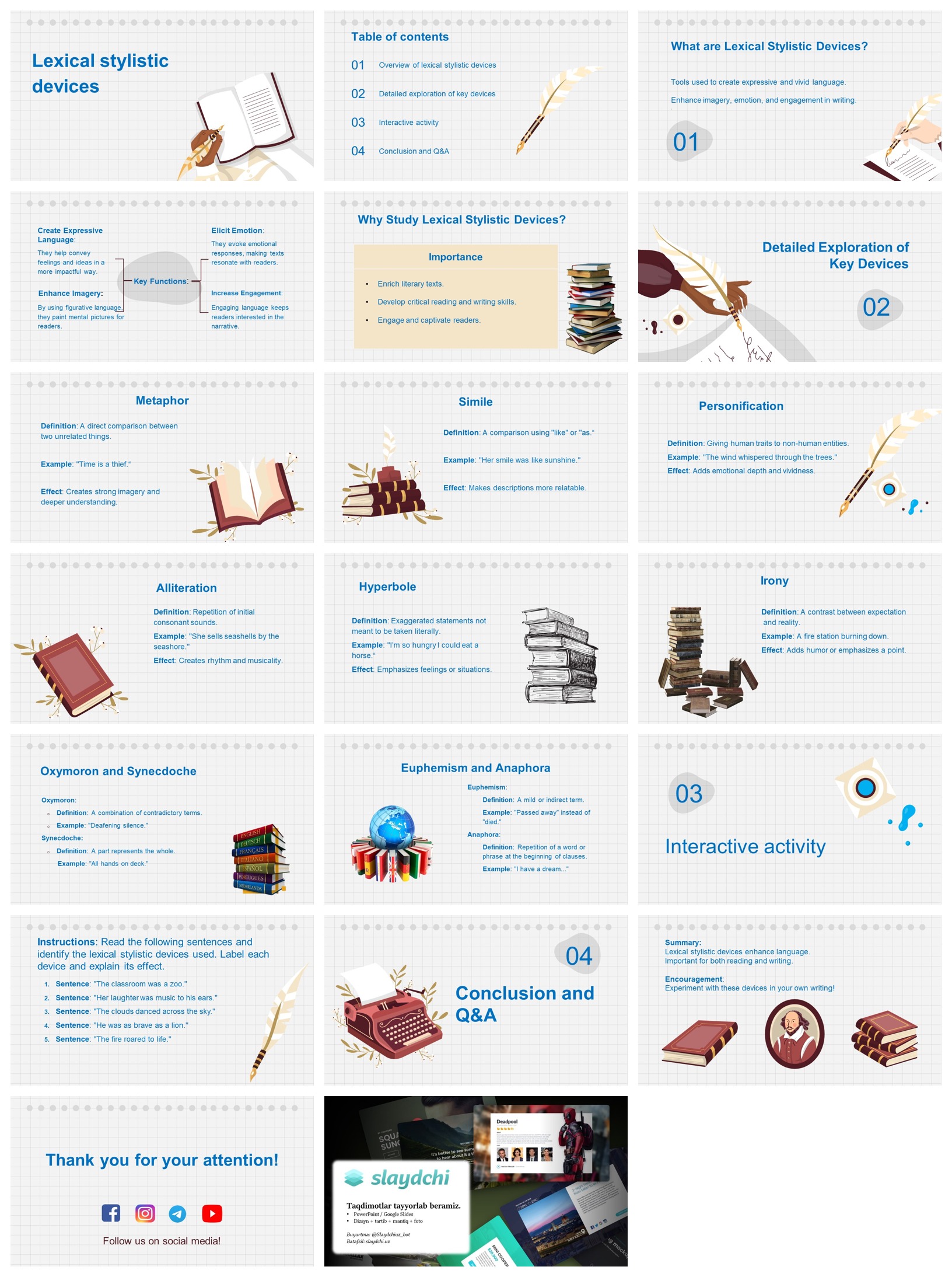
Lexical stylistic devices
Slayd 2
Table of contents
01
Overview of lexical stylistic devices
02
Detailed exploration of key devices
03
Interactive activity
04
Conclusion and Q&A
Slayd 3
01
What are Lexical Stylistic Devices?Tools used to create expressive and vivid language.Enhance imagery, emotion, and engagement in writing..
Slayd 4
Key Functions:
Create Expressive Language:
They help convey feelings and ideas in a more impactful way.
Elicit Emotion:
They evoke emotional responses, making texts resonate with readers.
Enhance Imagery:
By using figurative language, they paint mental pictures for readers.
Increase Engagement:
Engaging language keeps readers interested in the narrative.
Slayd 5
Why Study Lexical Stylistic Devices?
Importance
Enrich literary texts. Develop critical reading and writing skills. Engage and captivate readers.
Slayd 6
02
Detailed Exploration of Key Devices
Slayd 7
Metaphor
Definition: A direct comparison between two unrelated things.
Example: «Time is a thief.“
Effect: Creates strong imagery and deeper understanding.
Slayd 8
Simile
Definition: A comparison using «like» or «as.“
Example: «Her smile was like sunshine.»
Effect: Makes descriptions more relatable.
Slayd 9
Personification
Definition: Giving human traits to non-human entities.
Example: «The wind whispered through the trees.»
Effect: Adds emotional depth and vividness.
Slayd 10
Alliteration
Definition: Repetition of initial consonant sounds.
Example: «She sells seashells by the seashore.»
Effect: Creates rhythm and musicality.
Slayd 11
Hyperbole
Definition: Exaggerated statements not meant to be taken literally.
Example: «I’m so hungry I could eat a horse.“
Effect: Emphasizes feelings or situations.
Slayd 12
Irony
Definition: A contrast between expectation and reality.
Example: A fire station burning down.
Effect: Adds humor or emphasizes a point.
Slayd 13
Oxymoron and Synecdoche
Oxymoron:
Definition: A combination of contradictory terms.
Example: «Deafening silence.»
Synecdoche:
Definition: A part represents the whole.
Example: «All hands on deck.»
Slayd 14
Euphemism and Anaphora
Euphemism:
Definition: A mild or indirect term.
Example: «Passed away» instead of «died.»
Anaphora:
Definition: Repetition of a word or phrase at the beginning of clauses.
Example: «I have a dream…»
Slayd 15
03
Interactive activity
Slayd 16
Instructions: Read the following sentences and identify the lexical stylistic devices used. Label each device and explain its effect.
Sentence: «The classroom was a zoo.»
Sentence: «Her laughter was music to his ears.»
Sentence: «The clouds danced across the sky.»
Sentence: «He was as brave as a lion.»
Sentence: «The fire roared to life.»
Slayd 17
04
Conclusion and Q&A
Slayd 18
Summary:Lexical stylistic devices enhance language.Important for both reading and writing.Encouragement: Experiment with these devices in your own writing!
Slayd 19
Thank you for your attention!
Follow us on social media!
Slayd 20
Foydali havolalar
🛒 Barcha taqdimotlar | 📰 Yangiliklar | ℹ️ Biz haqimizda
Tegishli mahsulotlar

ASSESSMENT CHECK EVALUATE mavzusidagi tayyor PPTX taqdimot. Ingliz tili darsi uchun mavzu, misollar va asosiy tushunchalar jamlangan.
- Slaydlar soni: 22 ta
- Fayl formati: PPTX
- Tili: o‘zbek tili
- Kategoriya: Ingliz tili

STRATEGIES FOR READING COMPREHENSION mavzusidagi tayyor PPTX taqdimot. Ingliz tili darsi uchun mavzu, misollar va asosiy tushunchalar jamlangan.
- Slaydlar soni: 33 ta
- Fayl formati: PPTX
- Tili: o‘zbek tili
- Kategoriya: Ingliz tili
METHODOLOGICAL ASPECTS OF TRANSLATION mavzusidagi tayyor PPTX taqdimot. Ingliz tili darsi uchun mavzu, misollar va asosiy tushunchalar jamlangan.
- Slaydlar soni: 31 ta
- Fayl formati: PPTX
- Tili: o‘zbek tili
- Kategoriya: Ingliz tili

DESCRIBING PEOPLE mavzusidagi tayyor PPTX taqdimot. Ingliz tili darsi uchun mavzu, misollar va asosiy tushunchalar jamlangan.
- Slaydlar soni: 33 ta
- Fayl formati: PPTX
- Tili: o‘zbek tili
- Kategoriya: Ingliz tili
GUIDELINES FOR WRITING mavzusidagi tayyor PPTX taqdimot. Ingliz tili darsi uchun mavzu, misollar va asosiy tushunchalar jamlangan.
- Slaydlar soni: 30 ta
- Fayl formati: PPTX
- Tili: o‘zbek tili
- Kategoriya: Ingliz tili

CONTINUOUS TENSES IN ENGLISH GRAMMAR mavzusidagi tayyor PPTX taqdimot. Ingliz tili darsi uchun mavzu, misollar va asosiy tushunchalar jamlangan.
- Slaydlar soni: 48 ta
- Fayl formati: PPTX
- Tili: o‘zbek tili
- Kategoriya: Ingliz tili

HOW TO IMPROVE STUDENTS’ PRONUNCIATION LET US LOOK THROUGH mavzusidagi tayyor PPTX taqdimot. Ingliz tili darsi uchun mavzu, misollar va asosiy tushunchalar jamlangan.
- Slaydlar soni: 48 ta
- Fayl formati: PPTX
- Tili: o‘zbek tili
- Kategoriya: Ingliz tili

AMERICANISMS IN MODERN ENGLISH mavzusidagi tayyor PPTX taqdimot. Ingliz tili darsi uchun mavzu, misollar va asosiy tushunchalar jamlangan.
- Slaydlar soni: 31 ta
- Fayl formati: PPTX
- Tili: o‘zbek tili
- Kategoriya: Ingliz tili


CLASSROOM MANAGEMENT IN WORKING WITH DEFFERENT AGES mavzusidagi tayyor PPTX taqdimot. Ingliz tili darsi uchun mavzu, misollar va asosiy tushunchalar jamlangan.
- Slaydlar soni: 18 ta
- Fayl formati: PPTX
- Tili: o‘zbek tili
- Kategoriya: Ingliz tili
WHAT IS LEXICOGRAPHY mavzusidagi tayyor PPTX taqdimot. Ingliz tili darsi uchun mavzu, misollar va asosiy tushunchalar jamlangan.
- Slaydlar soni: 28 ta
- Fayl formati: PPTX
- Tili: o‘zbek tili
- Kategoriya: Ingliz tili


CULTURAL ASPECTS IN LANGUAGE LEARNING mavzusidagi tayyor PPTX taqdimot. Ingliz tili darsi uchun mavzu, misollar va asosiy tushunchalar jamlangan.
- Slaydlar soni: 24 ta
- Fayl formati: PPTX
- Tili: o‘zbek tili
- Kategoriya: Ingliz tili

ACCURACY AND CORRECTING MISTAKES mavzusidagi tayyor PPTX taqdimot. Ingliz tili darsi uchun mavzu, misollar va asosiy tushunchalar jamlangan.
- Slaydlar soni: 24 ta
- Fayl formati: PPTX
- Tili: o‘zbek tili
- Kategoriya: Ingliz tili
Sharhlar
Hali sharhlar mavjud emas.