



Slayd 1
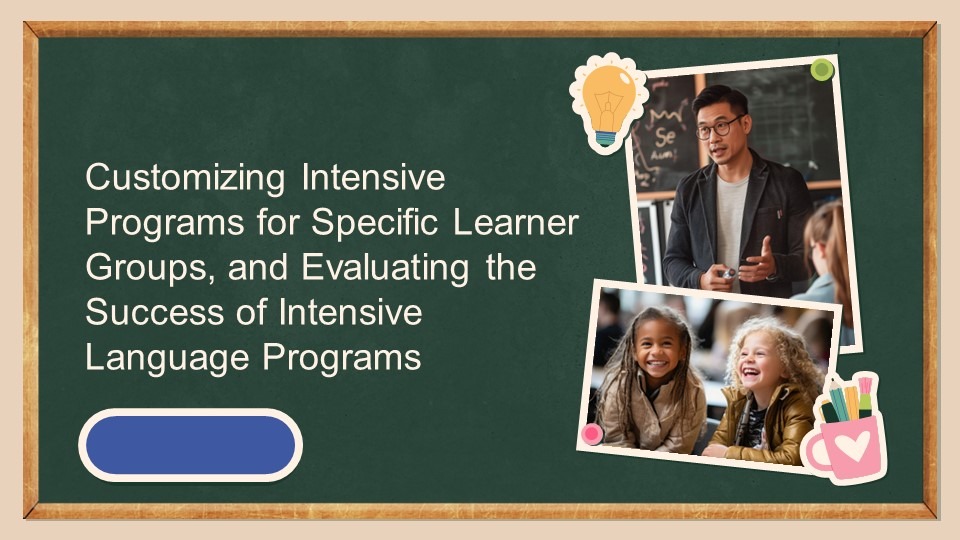
Customizing Intensive Programs for Specific Learner Groups, and Evaluating the Success of Intensive Language Programs
Slayd 2
Why Customize Language Programs for Specific Groups?
Language proficiency
Learning styles/ Cultural experiences
01
03
02
04
Background knowledge
Learning goals
Slayd 3
Needs Analysis
Methods: questionnaires, interviews, placement tests, observation.
Learner-Centered Approach
Learners actively participate in setting goals and selecting materials.
Contextual Relevance
Course content must reflect real-life language use specific to the learner group’s environment and needs.
Flexible Curriculum Design
rograms must be adjustable during the course.
Balanced Skill Developmen
Prioritize skills depending on the learner group’s daily communication needs.
Slayd 4
Learner Group
Business Professionals
Business terminology, formal emails, presentations
Simulations, negotiations, role-plays
Migrants
Daily communication, social services, legal terms
Dialogues, survival language scenarios
Medical Staff
Medical vocabulary, patient interaction
Role-plays, case discussions, simulations
Slayd 5
Tour Guides
Descriptive language, cultural facts, tourist Q&A
Tour simulations, storytelling
Children
Basic vocabulary, simple grammar, fun activities
Songs, stories, games, drawings
Slayd 6
Methods for Customizing Language Programs
Communicative Language Teaching (CLT)
Task-Based Language Teaching (TBLT)
Content-Based Instruction (CBI)
Project-Based Learning (PBL)
Blended Learning
Slayd 7
Communicative Language Teaching (CLT)
Communicative Language Teaching (CLT) is a modern language teaching approach that focuses on enabling learners to communicate effectively and fluently in real-life situations. It emphasizes meaningful interaction as both the means and goal of learning a language, rather than just memorizing grammar rules or vocabulary lists.
Slayd 8
Task-Based Language Teaching (TBLT)
Task-Based Language Teaching (TBLT) focuses on using language as a tool to complete meaningful, real-life tasks. The task is the core unit of planning and instruction.
Language is learned through doing tasks, not through isolated grammar lessons.
Tasks are authentic, purposeful, and meaningful.
Emphasizes communication and problem-solving
Slayd 9
TBLT in Intensive Programs
Migrants: plan a shopping list on a budget.
Medical staff: role-play emergency situations.
Business professionals: plan a meeting agenda.
Slayd 10
Content-Based Instruction (CBI)
Content-Based Instruction (CBI) is a method where language is taught through subject matter content. Students learn both the language and specific information about a topic.
Ideal for professionals who need job-specific language:
Business English through company case studies.
Tourism English via local history and culture lessons.
Slayd 11
Project-Based Learning (PBL)
Project-Based Learning (PBL) involves learners working together on extended projects that require them to use the target language to research, plan, and create a final product.
Useful for groups with specific work or life goals:
Migrants: create a “life in our city” guide.
Medical staff: produce a patient health information leaflet.
Slayd 12
Blended Learning
Blended Learning combines traditional face-to-face teaching with online learning resources and activities.
Business English: online email writing tasks.
Migrants: language apps for survival vocabulary.
Face-to-face discussions + online vocabulary games.
Grammar lessons in class + video homework.
Slayd 13
Challenges in Customizing Programs
Diverse learner abilities within the same group.
Limited time for program preparation and implementation.
Access to context-specific materials.
Cultural and educational background differences.
Keeping learners motivated in intensive schedules.
Slayd 14
Solutions and Recommendations
Regular needs analysis and program evaluation.
Incorporating learner feedback throughout the course.
Creating a flexible and dynamic syllabus.
Using a variety of teaching techniques.
Integrating technology and mobile learning.
Including cultural elements to make learning authentic and meaningful.
Slayd 15
Evaluation is a crucial stage in any educational program, especially in intensive language courses where a lot is expected to happen in a short time. It helps:
Measure whether learning objectives were achieved.
Identify strengths and weaknesses in the program.
Understand learners’ progress and satisfaction.
Provide feedback for teachers and administrators.
Make decisions about future program improvements.
Why Evaluate?
Slayd 16
Learners’ Language Progress
Pre- and post-course proficiency tests.
Progress tests (weekly quizzes, mid-course assessments).
Speaking, listening, reading, writing assessments.
Program Logistics
Evaluate scheduling, facilities, online tools, and available resources.
What to Evaluate in Intensive Language Programs
Slayd 17
Achievement of Program Goals
Check whether the planned objectives were met.
Example: Did migrants learn essential daily vocabulary?Did business professionals improve presentation skills?
Learner Satisfaction
Collect feedback on teaching methods, materials, pace, classroom environment.
Methods: questionnaires, interviews, focus groups.
Slayd 18
Teaching Effectiveness
Observe lessons, collect peer and learner feedback.
Reflect on teaching techniques and classroom management.
Curriculum and Material Effectiveness
Evaluate whether content was relevant, engaging, and appropriate.
Check how well activities and materials matched learners’ needs.
Slayd 19
Teaching Effectiveness
Observe lessons, collect peer and learner feedback.
Reflect on teaching techniques and classroom management.
Curriculum and Material Effectiveness
Evaluate whether content was relevant, engaging, and appropriate.
Check how well activities and materials matched learners’ needs.
Slayd 20
Tests and Quizzes (diagnostic, formative, summative)
Portfolios (collection of learner work: essays, recordings, projects)
Teacher Observations
Learner Self-Assessment (reflection journals, progress checklists)
Questionnaires and Surveys
Interviews and Focus Groups
Attendance and Participation Records
Feedback from Stakeholders (learners, teachers, administrators)
Methods of Evaluation
Slayd 21
Purpose: To measure learners’ knowledge and skills at different stages of the program.
Types:
Diagnostic tests: Conducted before the course starts to assess learners’ existing proficiency and identify areas for focus.Formative tests/quizzes: Regular, low-stakes assessments during the course that provide ongoing feedback to learners and instructors.Summative tests: Comprehensive assessments at the end of the program that evaluate overall achievement.
Tests and Quizzes
Slayd 22
Purpose: To showcase learner progress over time through a collection of work.
What it Includes: Essays, recorded speeches, project reports, worksheets, and reflections.
Benefits: Encourages learner self-reflection, demonstrates gradual improvement, and provides diverse evidence of language skills.
Use: Can be reviewed periodically and at the course end to assess development.
Portfolios
Slayd 23
Purpose: To assess teaching effectiveness and learner engagement in real time.
How: Teachers or supervisors observe classes, focusing on:
Learner participation
Use of target language
Interaction patterns
Classroom atmosphere
Benefits: Provides qualitative insights beyond test scores.
Use: Can identify areas where learners struggle or where teaching methods could improve.
Teacher Observations
Slayd 24
Purpose: To promote learner autonomy and awareness of their progress.
Methods:
Reflection journals where learners write about what they learned and challenges faced.
Progress checklists or rating scales for skills like speaking confidence or vocabulary knowledge.
Benefits: Empowers learners to take ownership of their learning.
Use: Can be combined with teacher assessments for a balanced evaluation.
Learner Self-Assessment
Slayd 25
Purpose: To collect learners’ opinions on various aspects of the program.
What They Measure: Satisfaction with teaching methods, materials, pace, difficulty, and overall experience.
Advantages: Easy to administer to large groups and useful for gathering broad feedback.
Use: Can inform program adjustments and improvements.
Questionnaires and Surveys
Slayd 26
Interviews and Focus Groups
Purpose: To gather in-depth qualitative feedback.
How: Conduct individual or group interviews to discuss learners’ experiences, challenges, and suggestions.
Advantages: Provides detailed insights and uncovers issues that surveys might miss.
Use: Best for understanding specific learner needs or testing new program elements.
Slayd 27
Attendance and Participation Records
Purpose: To monitor learners’ commitment and engagement.
How: Track attendance rates and active participation in class activities.
Importance: Consistent attendance often correlates with better learning outcomes.
Use: Helps identify learners at risk and assess the program’s scheduling effectiveness.
Slayd 28
Attendance and Participation Records
Purpose: To monitor learners’ commitment and engagement.
How: Track attendance rates and active participation in class activities.
Importance: Consistent attendance often correlates with better learning outcomes.
Use: Helps identify learners at risk and assess the program’s scheduling effectiveness.
Slayd 29
Feedback from Stakeholders
Who: Learners, teachers, program
administrators, and possibly employers or sponsors.
Purpose: To get a 360-degree view of program effectiveness.
Methods: Meetings, written reports, informal discussions.
Benefits: Provides diverse perspectives for comprehensive evaluation.
Slayd 30
Indicators of a Successful Intensive Language Program
Clear improvement in learners’ language proficiency.
High levels of learner satisfaction.
Achievement of course objectives.
Active participation and engagement.
Positive feedback from teachers and administrators.
Effective use of resources and materials.
Practical application of language skills in real-world contexts.
Slayd 31
Follow us on social media!
THANK YOU TO YOUR ATTENTION!
Slayd 32
Foydali havolalar
🛒 Barcha taqdimotlar | 📰 Yangiliklar | ℹ️ Biz haqimizda




















Sharhlar
Hali sharhlar mavjud emas.